The Upper Mustang Trek - 15 Days

161 reviews
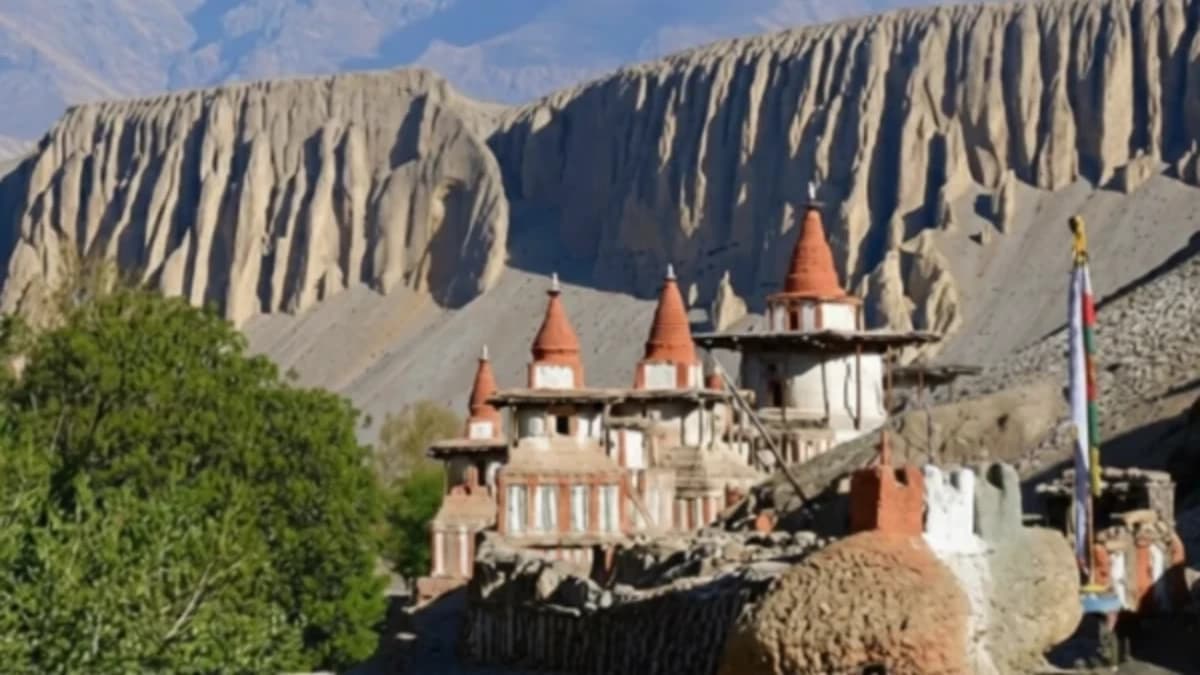
Ancient Buddhist stupas in front of large desert cliffs in Upper Mustang, Nepal.
Quick Overview
Duration15 Days
Trip GradeModerate
Maximum Altitude3,840m / 12,598ft
Group Size2-20
StartsKathmandu
EndsKathmandu
ActivitiesTrekking
Best TimeSep to Nov and Mar to May

The Upper Mustang Trek takes you on an amazing journey through the old Kingdom of Lo, which is one of Nepal's most remote and culturally rich areas. This desert terrain is very different from the lush foliage that is common in Nepal. It is located in the rain shadow  of the Himalayas. Upper Mustang has been a restricted area for hundreds of years, which has helped keep  its distinctive Tibetan Buddhist culture, old monasteries, and stunning caverns on the cliffs. Today, it is a top teahouse excursion for people who want to explore culture and history up close and personal, away from the masses.

What Makes This Trek Unforgettable

  • For adventure activities like Rafting, Bungee Jumping, Slacklining, and Paragliding.
  • major pilgrimage sites like Muktinath, Kagbeni, Talbarahi temple, and many more.
  • A varied terrain from tropical forest to alpine terrain to mountain.
  • Going to the old walled city of Lo Manthang.
  • Seeing the one-of-a-kind high desert terrain.
  • Finding old cave homes.
  • Seeing the Tiji Festival (if you get the timing right).
  • Crossing steep mountain crossings like Chogo La.
  • Visiting the holy Muktinath Temple.
  • Walking across the Kali Gandaki, the deepest gorge in the world.
  • Seeing wide vistas of the Annapurna and Dhaulagiri mountains.
  • Experiencing Tibetan Buddhist culture that has been maintained.
  • Having a real experience in the Himalayas is far away.

15-Day Upper Mustang Trek Overview

Explore Upper Mustang, a region of Nepal that remained isolated from the rest of the world until 1992. This secluded area is sometimes nicknamed the "Last Forbidden Kingdom." It keeps Tibetan Buddhist culture alive in its purest form through old monasteries, medieval palaces, and traditional villages that have remained unchanged over time. The terrain is very different from what you would expect to see in the Himalayas. It's a beautiful high-altitude desert with eroded cliffs, deep valleys, and huge, dry plateaus. This walk is more than just an adventure; it's a deep cultural experience that lets you see how the Loba people live, speak, and practice their religion, which are all part of a rich Tibetan legacy.

The hike brings you into the Himalayas' rain shadow, where the rocks change into a beautiful mix of red, brown, and ochre. After the Kali Gandaki valley, which is the deepest valley in the world, you'll walk over pathways that are blown by the wind and have amazing views of big mountains like Dhaulagiri, Annapurna, and Nilgiri. This area has a unique trans-Himalayan ecology, showcasing uncommon plants, historic cave homes, and rocks adorned with prayer flags. The architecture of Mustang,  with its whitewashed buildings, beautifully carved entrances, and mountain fortifications, is a mix of Nepalese and Tibetan styles. Such diversity makes it a wonderful place for photographers and culture lovers to visit. 

Our journey starts with a beautiful drive from Pokhara to Kagbeni. The entrance to Upper Mustang and Chele is where the desert environment truly comes to life. The best part of the trip is Lo Manthang, the walled capital of the old kingdom. You will see historic monuments like the Royal Palace, Thubchen Gompa,  and  the  Chhoser  Cave  Complex,  which  is  a  maze  of  tunnels  constructed  by  people thousands of years ago. The way back through Ghami and Muktinath adds a spiritual element, as Muktinath is a holy place for both Hindus and Buddhists.

The Upper Mustang Trek offers a once-in-a-lifetime experience that combines stunning scenery with living history.  It's great for experienced  trekkers  and  people  who  want  to  learn  about  different cultures. Every moment in Mustang feels like stepping into a lost period, from the lively Tiji Festival (if you schedule it properly) to the kind welcome of the Loba people. It's not only about getting to a place on this walk; it's about finding the essence of the Himalayas.

Before You Arrive

For a smooth and easy start, we highly recommend arriving in Kathmandu by 4 PM the day before we leave. This gives you enough time for a final gear check, a trip briefing with your guide, and to make sure you have everything you need before heading to the trek. 

Online Briefing

This is like our first coffee before the trip, but online!  This online meeting is our chance to show you everything that will happen on the trip. We will discuss everything from what gear to bring to what each day on the route will be like and how it will feel. Additionally, we will answer any questions you have.  After you book, we'll send you an email with a couple of times when we can talk. We'll set up the meeting after the booking process is completed. Also, our trek itinerary does not include your hotel stay in Kathmandu. During the online meeting, please share your preferences, budget, and the standard of the hotel you would like to stay at in Kathmandu. We will arrange it for you accordingly. 

Your Trek, Your Way

Experience the Himalayas on your terms. We create personal, intimate treks for groups of two or more. Whether you select our Budget, Standard, or Luxury package, your adventure will be tailored exclusively for you and your companions, for a comfortable and personalized journey from start to finish.

Note on Pokhara Meals

In Pokhara, only breakfast at your hotel is included (all tiers). Lunch and dinner in Pokhara are at your own expense — we want you to have the freedom to explore Pokhara’s incredible restaurant scene on your own terms. Meals during the drive between Kathmandu and Pokhara are also not included, as there are many great stops along the way.

Kathmandu Accommodation

Your hotel in Kathmandu is not included in the trek package. During the online briefing before your trek, we will ask about your preferences and budget — whether you want a simple guesthouse or a five-star hotel — and help you arrange it. Your trek package begins when you leave Kathmandu for the mountains.

Compare Our Three Packages

  Budget Standard Luxury
Price from USD 1,292 USD 1,930 USD 3,500
Meals Choose your own (approx. USD 15-25/day) 3 meals + tea + fruits + 2L water daily All meals + all drinks anytime (except alcohol)
Room Shared teahouse Private twin w/ bathroom Private deluxe w/ bed heater
Porter Not included 1 per 2 trekkers 1 per trekker (carry nothing)
Guide 1 guide, assistant at 8+ 1 guide per 6, assistant at 6+ 1 guide per 2 trekkers
Transport Local vehicle Private tourist vehicle Luxury private vehicle
SIM data SIM only Limited data Unlimited data
Best for Backpackers and independent travellers Comfort trekkers, couples, families Premium experience seekers

Himalayas for Every Budget — same expert guides, same safety, three comfort levels.

Your Trek, Our Family

Shreejan Simkhada doesn’t just run a trekking company — he comes from three generations of Himalayan expertise. His grandfather arranged expeditions in the 1960s. His father served at the Nepal Tourism Board. Shreejan personally designs every itinerary and hand-picks the guide for your group.

Your guide will be one of our Nepal government well-trained professionals — qualified mountaineering experts, all with years of Himalayan experience. Shreejan briefs every guide personally before your trek begins.

Need anything? WhatsApp Shreejan directly: +977 9810351300.

Our Credentials

  • 197+ TripAdvisor Reviews — 4.9 out of 5 stars, TripAdvisor Travellers Choice 2024
  • 108+ Google Reviews — 4.9 out of 5 stars
  • TAAN Certified — Member #1586, Government Reg: 147653/072/073
  • Secure 10% Deposit — pay just $70 to reserve, via Himalayan Bank
  • Himalayas for Every Budget — breakfast, lunch, and dinner throughout the trek
  • Three Generations — family guiding in the Himalayas since the 1960s

Solo Trekkers Welcome

Most of our trekkers join solo — you will be part of a small group of like-minded adventurers from around the world. Our groups are kept small (2-20 people) so you get a personal experience, not a conveyor belt. Many of our solo trekkers tell us the group becomes like a second family by day three.

You also have the option to book the trek privately for yourself. If you choose to make it a public group, we will list your dates as fixed departures on our website so other solo travellers can join you.

Difficulty: Challenging (4/5)

Trek through the restricted Nar and Phu valleys — hidden Tibetan villages at the back of the Annapurna massif. You will walk 5-7 hours per day to a maximum of 4,300m.

Trek With a Purpose — Changing the World, One Step at a Time

A portion of every booking supports the Nagarjun Learning Center, founded by our family in 2019. Today, 70 children receive free education and hot meals daily at our flagship centre in Saldum Village, Dhading District. We have also provided free medical care to 600+ people and reached 275+ women through support programmes. The centre is verified and listed on the UN Partner Portal.

When you trek with us, you are not just climbing mountains — you are building futures. Trek With a Purpose.

What Trekkers Say About This Trek

"Worth every penny. The experience is priceless. Our guide knew the history of every monastery and cave we visited in the Mustang region."

— TripAdvisor Review, 5 stars

"Upper Mustang is unlike anywhere else in Nepal. Red desert canyons, cave monasteries, and ancient Tibetan culture. We went in July during monsoon season but Mustang is in the rain shadow so the weather was perfect."

— David Kim, South Korea (TripAdvisor, 5 stars)

"Worth every penny. The permit cost is high but the experience is priceless. Our guide knew the history of every monastery and cave we visited."

— Google Review, 5 stars

"Upper Mustang felt like stepping into another world. The ancient walled city of Lo Manthang, the desert landscape, and the Tibetan Buddhist culture were all extraordinary."

— TripAdvisor Review, 5 stars

Read all 320+ reviews →

Short Itinerary
Day 01: Morning  start  210  km/  135  miles  drive  to  Pokhara  (820m)  west  of  the  Kathmandu Valley. Drive Time: Approx. 6-7 hrs. with a total elevation change of 580 m/1902.89 ft.
Day 02: Day 2: Drive from Pokhara to Kagbeni (2,800 m/9,186 ft.). With a total elevation change of 1980 m/6496.063 ft.
Max Altitude: 2,800 m/9,186 ft
Day 03: Morning start with a 14 km/8.7 mile walk from Kagbeni (2,800 m/9,186 ft) to Chele (3,055 m/10,023 ft). Trek Time: Approx. 5-6 hrs, with a total elevation change of 255 m/836.614 ft.
Max Altitude: 3,055 m/10,023 ft
Day 04: Morning start 15 km/9.3 miles walk from Chele to Syangboche (3,930 m/12,894 ft). Trek Time: Approx. 5–6 hours with a total elevation change of 875 m/2870.73 ft.
Max Altitude: 3,930 m/2,441 ft
Day 05: Morning start with a 15 km/9.3 mile walk from Syangboche to Ghami (3,520 m/11,549 ft). Trek Time: Approx. 5–6 hours with a total elevation change of 410 m/1345.14 ft.
Max Altitude: 3,520 m/11,549 ft
Day 06: Morning start with a 10 km/6.2 mile walk from Ghami to Tsarang (3505 m/11,499 ft). Trek Time: Approx. 5-6 hrs.
Max Altitude: 3505 m/11,499 ft
Day 07: Morning start with an 11 km/6.8 mile walk from Tsarang to Lo Manthang (3810 m/12,500 ft). Trek Time: Approx. 5 hrs. with a total elevation change of 305 m/1000.66 ft.
Max Altitude: 3810 m/12,500 ft
Day 08: Rest and exploration day in Lo Manthang
Day 09: Morning start with a 15 km/9.3 mile walk from Lo Manthang to Ghami (3,520 m/11,549 ft). Trek Time: approximately 6–7 hours, with a total elevation change of 290 m/951.444 ft.
Max Altitude: 3,520 m/11,549 ft
Day 10: Morning start with a 14 km/8.7 mile walk from Ghami to Samar (3,700 m/12,299 ft). Trek Time: Approx. 6-7 hrs. with a total elevation change of 180 m/590.551 ft.
Max Altitude: 3,700 m/12,299 ft
Day 11: Morning start with a 7.7 km/4.7 mile walk from Samar to Chhusang (2,980 m/9,777 ft). Trek Time: Approx. 5–6 hours with a total elevation change of 720 m/2362.2 ft.
Max Altitude: 2,980 m/1,851 ft
Day 12: Morning start with a 16 km/9.9 mile walk from Chhusang to Muktinath (3,760 m/12,336 ft). Trek Time: Approx. 6-7 hrs. with a total elevation change of 780 m/2559.06 ft.
Max Altitude: 3,760 m/12,336 ft
Day 13: Morning start 20 km/12.4 miles walk from Muktinath to Jomsom (2,720 m/8,924 ft). Trek Time: Approx. 5 hrs. with a total elevation change of 1,040 m/3,412.073 ft.
Max Altitude: 2,720m/  1,690ft
Day 14: Drive back from Jomsom to Pokhara (820 m/2,690 ft). With a total elevation change of 1900 m/6233.596 ft.
Max Altitude: 820 m/2,690 ft
Day 15: Morning start with a 210 km/135-mile drive from Pokhara (820m) to the Kathmandu Valley. Drive Time: Approx. 7-8 hrs. with a total elevation change of 580 m/1902.89 ft.
Expand
Detailed Itinerary
Day 01:

The Upper Mustang trek begins with a long drive west from Kathmandu, and the six or seven hours on the Prithvi Highway offer a slow-motion introduction to the Nepal you're about to leave behind. Your vehicle winds along the Trisuli River gorge, past terraced rice paddies stacked up hillsides in shades of green that seem almost artificial; through market towns where bus horns compete with Hindi pop music from tea stall radios; and past roadside shrines draped in marigold garlands where truck drivers pause to ask the gods for safe passage. This is the Nepal of postcards and travel brochures: lush, subtropical, impossibly fertile, and it bears almost no resemblance to where you're heading. The arid, wind-blasted valleys of Upper Mustang feel like a different planet, and the contrast makes both places more vivid.

Your guide will sit beside you, answering questions and pointing out landmarks as the highway follows the river west. He's done this drive dozens of times, but he still watches the landscape with a quiet attentiveness that suggests genuine affection rather than professional habit. Past Mugling, the valley opens and the road improves, and the final stretch into Pokhara brings the Annapurna massif into view for the first time, its snowy ridgeline floating above the haze like something painted onto the sky. Pokhara sits at just 820 meters beside Phewa Lake, and the air here is warm, soft, and scented with bougainvillea. After the noise of Kathmandu, the lakeside feels almost Mediterranean in its relaxed pace.

Check into your hotel and take a walk along the lakeside promenade. The Annapurna range fills the northern horizon, and if you've arrived on a clear afternoon, Machapuchare's fishtail summit catches the last sunlight in a blaze of gold that silences even the most talkative tour groups. Kathmandu's medieval chaos already feels distant, replaced by rowboats drifting on still water and paragliders circling above Sarangkot like slow, colorful birds. Dinner tonight is at a lakeside restaurant where the dal bhat comes with a view. Your guide will brief you on what lies ahead: the drive to Kagbeni tomorrow, the restricted area ahead, and the ancient kingdom of Lo that was closed to all foreigners until 1992. Upper Mustang receives fewer than three thousand visitors per year, making it one of the least visited trekking regions in the Himalaya. The $500 restricted area permit exists to keep it that way.

Before bed, check your packing one final time. Upper Mustang's climate is nothing like the rest of Nepal. You'll need serious sun protection for the high-altitude desert, a windproof shell for the brutal afternoon gusts that sweep through the Kali Gandaki gorge, and warm layers for cold nights in stone-walled lodges. There are no gear shops beyond Pokhara, and the few village stores in Mustang sell little beyond biscuits and instant noodles. Confirm your restricted area permit is secure in your daypack. Tomorrow the road heads north into the deepest gorge on earth, and by evening you'll be standing at the gateway to the last forbidden kingdom. Set your alarm early. The mountains wait for nobody.

View the Full Upper Mustang Trek Route on Google Maps

Duration: 6-7 hrsDistance: 210  km/  135  milesElevation: 580 m/1902.89 ft.
Day 02:

The drive from Pokhara to Jomsom follows the Kali Gandaki River north through the deepest gorge on earth, flanked by Dhaulagiri (8,167m) on the west and Annapurna I (8,091m) on the east, and the scale of what surrounds you is almost impossible to process from a vehicle window. The road clings to the valley wall, sometimes carved into the cliff face itself, and your driver navigates switchbacks, river crossings, and sections of loose gravel with the calm competence of someone who does this run several times a week. Waterfalls spill from overhanging rock hundreds of meters above, misting the windscreen as you pass beneath them, and the river below runs grey-white with glacial sediment, roaring through boulder fields that dwarf the trucks parked beside them.

The landscape changes dramatically as you climb. The lush subtropical vegetation of the lower gorge gives way to dry pine forest, then to scrubby juniper and finally to the bare, wind-scoured terrain that defines the trans-Himalayan zone. By the time you reach Jomsom at 2,720 meters, the greenery of Pokhara feels like a memory from another season. Jomsom is a functional town, a district headquarters with an airstrip, a military post, and a handful of hotels serving trekkers and traders heading into the upper Kali Gandaki. The wind here is legendary. Every afternoon, a gale funnels up the gorge from the south with such force that it can knock an unprepared trekker off their feet. Your guide will time the onward drive to Kagbeni to avoid the worst of it.

The short drive from Jomsom to Kagbeni takes you through apple orchards and past the village of Marpha, famous across Nepal for its apple brandy and its impeccably clean cobbled streets. Marpha sits in a sheltered pocket of the valley where the microclimate allows fruit trees to thrive in an otherwise arid landscape, and the scent of fermenting apples drifts from distillery doorways as you pass. Beyond Marpha, the valley narrows and the vegetation thins further. Prayer flags begin to appear in greater numbers, strung between cairns and across bridges in long, colorful lines that snap and flutter in the constant wind. The culture is shifting beneath you. You're leaving Hindu Nepal and entering the Tibetan Buddhist world of Mustang.

Kagbeni, at 2,800 meters, is a medieval village of mud-brick houses, narrow alleys, and a crumbling red fortress that overlooks the confluence of the Jhong Khola and the Kali Gandaki. This is the official gateway to the restricted area of Upper Mustang, and the police checkpoint at the northern edge of town is where your permit will be inspected for the first time. Beyond this point, the landscape transforms entirely. The green valleys of central Nepal are behind you. Ahead lies a high desert of ochre cliffs, wind-carved rock formations, and ancient cave dwellings that were occupied three thousand years ago. Settle into your lodge, a traditional stone building with low ceilings and thick walls built to withstand the cold. Dinner is dal bhat with Tibetan bread, and the evening light turns the surrounding cliffs to deep copper. Tomorrow the trek begins in earnest. You're about to walk into a landscape that looks more like Mars than Nepal.

Max Altitude: 2,800 m/9,186 ftDuration: 4 hrsDistance: 8–10 km /5–6 milesElevation: 1980 m/6496.063 ft.
Day 03:

The trail north from Kagbeni enters the restricted zone within minutes, and the checkpoint officer stamps your permit with a seriousness that reminds you this is not ordinary trekking territory. Upper Mustang was sealed to outsiders until 1992, and the restricted area permit system exists to protect what remains of a culture that has survived largely unchanged for centuries. Beyond the checkpoint, the path follows the east bank of the Kali Gandaki through a landscape stripped to its geological bones. Red and ochre cliffs rise vertically on both sides, their surfaces eroded into pillars, arches, and cave mouths that stare down like hollow eyes. The rock here is ancient seabed, once the floor of the Tethys Ocean, and if you look closely at the trail beneath your boots, you'll find fossilized ammonites curled in the stone like tiny stone nautilus shells.

The five to six hours of walking today follow a well-defined trail through terrain that alternates between narrow gorge sections, where the cliffs close in and the wind howls overhead, and broader stretches where the valley opens to reveal distant snow peaks against a sky so blue it almost hurts. Your guide sets a steady pace that allows time to absorb the details: the way prayer flags strung between cliff faces create corridors of faded colour, the sound of wind through eroded rock formations producing a low harmonic that sounds almost musical, and the occasional flash of a blue sheep on a ridge above, perfectly camouflaged until it moves. This is Upper Mustang's signature landscape, and it bears no resemblance to the green, forested treks of the Everest or Annapurna regions.

Lunch is taken at a small settlement where the teahouse owner serves thukpa, a Tibetan noodle soup thick with vegetables and spiced with chili, eaten from a metal bowl while sitting on a bench outside the stone-walled kitchen. The warmth of the soup matters. Despite the fierce sun, the wind at this altitude carries real cold, and the moment you stop walking, your body temperature drops rapidly. Pull on your wind layer at every rest stop. The afternoon wind in the Kali Gandaki valley is notorious, building from a gentle breeze after noon to a sustained gale by three o'clock, and timing your arrival at the day's destination before the worst of it is part of your guide's strategy.

Chele, at 3,055 meters, is a small village perched on a shelf above the river, its flat-roofed mud-brick houses blending so completely with the surrounding cliffs that from a distance the settlement is almost invisible. The lodge is simple but comfortable by Mustang standards: thick walls that block the wind, a warm kitchen where the family gathers in the evening, and a menu that leans heavily on Tibetan staples. Accommodation in Upper Mustang varies from basic to surprisingly pleasant, and Chele falls somewhere in the middle. After dinner, walk to the edge of the village and look south down the gorge you've just walked through. The evening light turns the cliffs from ochre to deep red, and the shadows pool in the valley floor like dark water. You've crossed into a different world today. Respect the culture you're about to encounter, and it will reveal itself to you in ways that no guidebook can prepare you for.

Max Altitude: 3,055 m/10,023 ftDuration: 5–6 hoursDistance: 14 kilometers/8.7 milesElevation: 255 m/836.614 ft
Day 04:

Today's trek from Chele to Syangboche is the most physically demanding day of the entire journey, gaining nearly 900 meters through terrain that looks like it belongs in a geology textbook rather than a trekking itinerary. The morning begins with a steep climb out of Chele on a trail carved into the cliff face, switchbacking up through layers of red, grey, and cream sedimentary rock that record millions of years of ocean floor deposits now thrust four thousand metres into the sky. Your calves burn on the ascent, but every rest stop offers a view more extraordinary than the last. Below, the Kali Gandaki has shrunk to a silver thread. Above, the trail disappears into a notch between two rock pillars that frames a rectangle of impossibly blue sky.

The route crosses two passes today, each marked by cairns and prayer flags so weathered they've faded to uniform grey. Between the passes, the trail drops into a hidden valley where Samar village sits in a sheltered bowl of green amid the surrounding desert. The contrast is startling. Where everything above is bare rock and wind, Samar has barley fields, apple trees, and a stream that supports a ribbon of green willows along its banks. Your guide will stop here for tea, and the sweetness of the chiya is welcome after the morning's effort. The village has a gompa with ancient wall paintings that your guide may arrange to show you, and the resident caretaker will explain the scenes in a mixture of Nepali and gestures that somehow communicates more than words alone.

The afternoon climb to Syangboche takes you above 3,900 metres, and the altitude becomes noticeable in the heaviness of your legs and the slight shortness of breath on steeper sections. Walk slowly. Your guide's mantra of 'bistari, bistari' (slowly, slowly) applies more today than any other day on this trek. The trail traverses a high plateau where the wind is unobstructed and the landscape stretches to the horizon in every direction, a rolling expanse of brown earth dotted with grazing horses and the occasional stone shepherd's shelter. This is the trans-Himalayan zone, geographically and culturally part of the Tibetan plateau rather than the Indian subcontinent, and the dryness of the air, the intensity of the sunlight, and the sheer emptiness of the land feel more like Central Asia than South Asia.

Syangboche at 3,930 metres is a tiny settlement with a single lodge, and the accommodation is basic but adequate. The family who runs it are Loba people, ethnic Tibetans whose ancestors have lived in this valley for centuries, and they speak a dialect of Tibetan among themselves while switching to Nepali for your guide. Dinner is thukpa and Tibetan bread served in a warm kitchen heated by a bukhari stove burning dried yak dung, and the smell is surprisingly pleasant, earthy and warm rather than unpleasant. Your guide will check everyone's oxygen levels with the pulse oximeter tonight. At nearly four thousand meters, this is the highest sleep altitude of the entire trek, and proper acclimatisation habits matter. Drink at least three litres of water, avoid alcohol, and report any headache immediately. The view from the lodge doorway at sunset is worth the effort of the day: a panorama of bare ridges glowing amber and rose against a sky turning from blue to violet to star-scattered black.

Max Altitude: 3,930 m/2,441 ftDuration: 5–6 hoursDistance: 15  kilometers/9.3  milesElevation: 875 m/2870.73 ft.
Day 05:

The relief of descending from Syangboche's 3,930 meters is immediate, and your legs thank you for every meter of altitude lost as the trail drops through a landscape of eroded sandstone towers and wind-carved ravines that look like the set of a science fiction film. The colors here are extraordinary. Bands of deep red, pale cream, and slate grey stripe the cliffs in patterns that shift with the angle of sunlight, and the shadows cast by the rock formations create constantly changing compositions that make photographers stop every few minutes. Your guide will smile at the delays. He's seen this reaction before, and he understands that the visual impact of Upper Mustang takes time to process.

The trail passes through a narrow gorge where the walls close in to arm's width and the sky above is reduced to a strip of blue between vertical rock faces. Water has carved this passage over millennia, and the smooth, curved surfaces of the stone bear witness to the patient work of erosion. Emerging from the gorge, the valley opens suddenly into a broad plain dotted with chortens and mani walls built from flat stones inscribed with the mantra Om Mani Padme Hum. Walk clockwise around every mani wall and chorten you pass. Your guide will demonstrate the correct direction, and the Loba people you meet on the trail will notice and appreciate your respect for their customs. These small gestures carry weight in a culture where religious observance is woven into the fabric of daily life.

Lunch is taken in a village where the teahouse owner serves tsampa porridge and butter tea, and your guide explains that this is the staple diet of the Loba people, unchanged for centuries. The butter tea is salty and rich, an acquired taste that most trekkers grow to appreciate by the end of the trek, and the tsampa is filling enough to fuel the afternoon's walk. The village itself is a compact cluster of flat-roofed houses surrounded by barley fields that glow golden in the autumn sun, and the domestic rhythm of threshing grain, spinning wool, and tending animals continues around you as though your presence were entirely unremarkable. In most of Nepal's trekking regions, visitors are a common sight. In Upper Mustang, they're still unusual enough to warrant a curious glance from children but not much more from the adults.

Ghami, at 3,520 meters, is the largest village between Kagbeni and Lo Manthang, and it sits in a wide, flat valley where the wind arrives every afternoon with the punctuality of a scheduled service. The village has a long mani wall that runs for several hundred meters along the trail, one of the longest in Nepal, its stones carved with prayers by generations of devotees. Your lodge sits at the southern end of the village, and the rooms are comfortable by Mustang standards, with thick wool blankets and a dining room heated by a central stove. Dinner is dal bhat with local vegetables, and the conversation turns to tomorrow's walk to Tsarang, where one of the region's most important monasteries awaits. Upper Mustang reveals itself gradually, each day offering a deeper layer of the cultural and geological story that makes this trek unlike anything else in Nepal.

Max Altitude: 3,520 m/11,549 ftDuration: 5–6 hoursDistance: 15 km/9.3 mileElevation: 410 m/1345.14 ft.
Day 06:

The five to six hours between Ghami and Tsarang take you through a landscape that becomes progressively more Tibetan with every kilometer, and by the time you reach your destination, the last traces of lowland Nepal have disappeared entirely. The morning trail climbs through a series of eroded gullies where the red earth crumbles underfoot and the wind has sculpted the rock into formations that resemble ruined cathedrals. Your guide leads the group along a ridgeline that offers views in every direction, and the panorama is vast, empty, and humbling. To the north, the brown hills roll toward the Tibetan border. To the south, the snow peaks of the Annapurna and Dhaulagiri ranges float above layers of haze like white islands in a blue ocean.

The trail descends into a valley where the ruins of an ancient fortress cling to a cliff face above a dry riverbed. Your guide explains that these fortifications once controlled the trade route between Tibet and the lowlands, and the families who held them grew wealthy from taxes on salt, wool, and grain. The ruins are extensive, crumbling walls and empty window openings staring out across the valley, and the sense of a civilization that once thrived here and then quietly withdrew is both melancholy and fascinating. The light in these ruins is exceptional for photography, especially in the late morning when the sun picks out the texture of every stone and the shadows are deep and dramatic.

Tsarang, at 3,505 meters, is a substantial village built around a large dzong, a fortress-monastery that dominates the settlement from a rocky outcrop. The dzong's red-painted walls are visible from a considerable distance, standing out against the brown landscape like a beacon, and the monastery within contains some of the finest religious paintings in Upper Mustang. Your guide will arrange entry if the caretaker monk is available, and the interior is extraordinary: floor-to-ceiling murals depicting Buddhist deities, wrathful protectors, and scenes from the life of the Buddha, painted in mineral pigments that have retained their vivid colour for centuries. The gompa also houses a collection of ancient manuscripts, ceremonial masks, and a library of Tibetan texts that scholars have studied for decades. Remove your shoes at the threshold, keep your voice low, and walk clockwise around the shrine.

The village below the dzong is home to several hundred Loba families who farm barley and buckwheat in irrigated fields and tend horses that graze on the surrounding plateau. The houses are built in the traditional Mustang style, with flat roofs stacked with firewood, whitewashed walls decorated with red and ochre bands, and small window openings framed in black. The domestic architecture is beautiful in its simplicity, every element designed for function in a climate of extreme cold, fierce wind, and minimal rainfall. Observe the customs of the village carefully. If you see a group of villagers spinning prayer wheels in the evening, you're witnessing a daily practice that has continued without interruption for longer than most European nations have existed. Your lodge serves Tibetan food alongside Nepali staples, and tonight's dinner of momos, thukpa, and butter tea feels entirely appropriate in a village that looks and sounds more like Lhasa than Kathmandu. Tomorrow you walk to Lo Manthang, the walled capital of the last forbidden kingdom.

Max Altitude: 3505 m/11,499 ftDuration: 5-6 hrs.Distance: 10 km/6.2 mile
Day 07:

The walk from Tsarang to Lo Manthang is the day the entire trek has been building toward, and your guide's excitement is visible in the quickened pace he sets as the group leaves the village. The trail climbs gently through open plateau country, crossing a high pass at around 3,950 meters before beginning the descent toward the walled city. The landscape here is almost lunar in its barrenness. Flat expanses of grey-brown earth stretch in every direction, punctuated by occasional eroded pillars of rock that cast long shadows in the early morning light. The wind is present as always, a steady force from the south that pushes against your chest on exposed sections and carries the distant sound of horse bells from somewhere across the plateau.

The first glimpse of Lo Manthang comes from a ridge above the city, and the view is one that repays every hour of walking, every sore muscle, and every night in a basic lodge. Below you, in a broad valley surrounded by brown hills, sits a walled medieval city of white-painted buildings clustered within a perimeter of rammed-earth walls that have stood for centuries. Prayer flags stream from every rooftop, and the golden finials of four monastery spires catch the sunlight above the walls. This is the capital of the former Kingdom of Lo, ruled by a lineage of kings that stretches back to the fourteenth century, and the current Raja still resides within the city walls. Your guide will pause here to let the group take in the scene, and there's usually a silence that falls over even the chattiest trekkers. Lo Manthang is unlike anything else in the trekking world.

The descent to the city takes thirty minutes, and the approach through cultivated fields where horses graze and farmers thresh barley by hand creates an impression of a community that exists in a different century. The city walls, roughly four meters high and slightly leaning with age, enclose an area of perhaps three hundred square meters, and the single entrance is through a narrow gate that your group passes through in single file. Inside, the lanes are so narrow that two loaded horses cannot pass, and the buildings press together overhead, creating shaded passageways that open suddenly into small courtyards where children play, dogs sleep in patches of sun, and women sit spinning wool on handspindles. The gompas of Lo Manthang contain some of the most important Buddhist art in the Himalaya, and tomorrow's rest day will give you time to explore them properly.

Your lodge is within the city walls, a traditional building with a warm kitchen and rooms that look out over the rooftops toward the monastery of Namgyal Gompa on the hill above. Dinner is a celebration of arrival: momos, thukpa, and the local barley beer called chang, served in a dining room decorated with Tibetan carpets and painted furniture. Your guide raises a cup to the group. You've walked from Kagbeni to the last forbidden kingdom in five days, through a landscape that has no parallel in the trekking world. The food tastes better tonight than it has any right to, partly from genuine hunger and partly from the knowledge that you've earned your place inside these ancient walls. Tomorrow is a rest day, and the treasures of Lo Manthang are waiting.

Max Altitude: 3810 m/12,500 ftDuration: 5 hrs.Elevation: 305 m/1000.66 ft.
Day 08:

A rest day in Lo Manthang is not a day of idleness. It's a day of immersion in a culture so distinct and so ancient that it demands your full attention. Your guide has arranged visits to the city's principal monasteries, and the first stop is Thubchen Gompa, a fifteenth-century temple whose interior contains some of the most extraordinary Buddhist wall paintings in existence. Step through the heavy wooden door, and your eyes take a moment to adjust to the dim light. Then the murals resolve: floor-to-ceiling paintings of bodhisattvas, wrathful deities, and celestial musicians, their mineral pigments still vivid after five hundred years. International conservation teams have worked to restore sections of these paintings, and the quality of the artistry is staggering. This was not the work of provincial craftsmen. The painters who decorated Thubchen were masters, likely trained in the great monasteries of Tibet.

The second great monastery is Champa Lhakhang, the temple of the future Buddha Maitreya, whose enormous clay statue fills the central hall and rises two stories to the ceiling. The statue's serene face looks down at you from a height of perhaps eight meters, and the walls surrounding it are covered in paintings that depict the life of the Buddha in sequential panels. Your guide translates the caretaker monk's explanations, and the stories come alive in this setting. The Buddhist heritage of Lo Manthang isn't preserved in glass cases. It's active, living, and maintained by monks and laypeople who pray in these halls every day. If you're invited to spin a prayer wheel or light a butter lamp, accept with both hands. These gestures cross the boundary between tourist and participant.

After the monasteries, walk to the northern edge of the city and climb the hill to Namgyal Gompa, the Raja's personal monastery. The views from here encompass the entire valley: the city walls below, the barley fields stretching to the east, the brown hills rolling north toward the Tibetan border, and the snow peaks of the Himalaya to the south. The wind up here is constant and fierce, snapping the prayer flags with a sound like distant applause, and the isolation of this place, this tiny walled city at the edge of the habitable world, settles into your consciousness. Photograph the panorama if you can keep your camera steady in the wind, but also just stand and let the scale of the landscape work on you. Upper Mustang exists because the mountains and the desert protected it from the forces that changed the rest of Nepal.

Spend the afternoon wandering the city's narrow lanes. Watch the craftsmen painting thangka scrolls in a courtyard workshop. Buy a string of prayer beads from the old woman selling them beside the main gate. Drink butter tea in a kitchen where three generations of a Loba family sit together on carpets around a central stove, and observe the quiet rhythms of daily life in a place where time moves differently. The cave systems in the cliffs surrounding Lo Manthang number in the thousands, some carved more than three thousand years ago, and archaeologists are still cataloguing their contents. You're standing in one of the most historically significant landscapes in Asia, and the rest day gives you just enough time to begin understanding why. Dinner tonight is your last in the walled city. Tomorrow the return journey begins, and Lo Manthang will become a memory that sharpens with distance.

Day 09:

Leaving Lo Manthang is harder than arriving. The walled city recedes behind you as the trail climbs to the pass above the valley, and when you turn for a last look, the white buildings and golden spires seem impossibly small against the vast brown landscape. Your guide allows a few minutes for this farewell. He understands that Lo Manthang leaves a mark on everyone who reaches it, and the departure is always tinged with the knowledge that most visitors will never return. The morning trail retraces the route south across the high plateau, but walking a familiar path in the opposite direction creates an entirely different experience. Features you missed on the way north reveal themselves: a cluster of cave dwellings in a cliff face, a small chorten tucked behind a boulder, and a formation of eroded rock that from this angle resembles a seated figure.

The six to seven hours of walking today cover the same ground as two northbound days, and the pace is correspondingly faster. Your body has acclimatized well by now, and the descent from the high pass feels easier than the climb up five days ago. The wind is at your back for the first time on the trek, pushing you south with a force that feels almost helpful rather than hostile. By mid-morning the familiar landmarks of the Ghami Valley appear: the long mani wall, the barley fields, and the red-banded cliffs that frame the settlement. Lunch is at the same teahouse where you stopped on the way north, and the owner recognizes you with a nod and a smile that suggests she remembers every trekker who passes through her door.

The return journey through Upper Mustang offers a chance to notice details that speed and excitement obscured on the northbound walk. The eroded rock formations in the gorge south of the pass take on different shapes in the afternoon light, their shadows falling in new directions and their colors shifting from the cool blues of morning to the warm ochres of late day. Your guide points out a group of cave dwellings high in a cliff face that you walked past without noticing on the way up. The caves number in the tens of thousands across Upper Mustang, carved into the soft sandstone by human hands at dates ranging from three thousand years ago to the medieval period, and archaeologists believe many remain unexplored.

Ghami, at 3,520 meters, welcomes you back with the warmth of a familiar place. The lodge owner has your room ready, and the evening meal is served in the same dining room where you sat four days ago, but the conversation is different now. You've seen Lo Manthang. You've stood inside Thubchen Gompa. You've walked the narrow lanes of a walled city where the rhythms of life have barely changed in centuries. That experience has shifted something, and the group talks about it over dinner with the quiet seriousness of people processing something they haven't fully understood yet. Your body is comfortable at this altitude now, fully acclimatized after a week above 3,000 meters, and the walk south feels more relaxed than the walk north. Sleep comes easily tonight. The return has its own rhythm, gentler and more reflective than the eager northward push.

Max Altitude: 3,520 m/11,549 ftDuration: 6–7 hoursDistance: 15 km/9.3 mileElevation: 290 m/951.444 ft.
Day 10:

The trail south from Ghami takes a different route from the northbound path, dropping into a series of deep, narrow gorges where the rock walls glow red and orange in the morning light and the wind is temporarily blocked by the canyon walls, creating pockets of stillness that feel almost luxurious after days of constant buffeting. Your guide has chosen this variation specifically to show the group a different perspective on the Mustang landscape, and the gorges are spectacular. Water has carved sinuous passages through the soft sandstone, creating corridors barely wide enough for two people to walk abreast, with walls that rise twenty or thirty meters overhead and show the layered geological history of the region in horizontal bands of colour.

The six to seven hours of walking today include a climb over a ridge that offers what your guide considers the finest single viewpoint of the entire trek. From the top, you can see the entire Kali Gandaki valley spread below, with the Annapurna and Dhaulagiri massifs flanking it to east and west, their white summits impossibly high above the brown desert through which you've been walking. The contrast between the snow peaks and the arid valley floor is the defining visual characteristic of Upper Mustang, and from this vantage point it's displayed with a clarity that borders on the theatrical. Take your time with the camera here. The panorama deserves more than a hurried snapshot.

The descent to Samar follows a trail through open plateau country where horses graze freely and the distant shapes of chortens mark the horizon. Samar, at 3,700 meters, sits in a sheltered valley where apple and walnut trees grow in irrigated gardens behind stone walls, and the village has a quiet prosperity that's evident in the well-maintained houses and the healthy livestock. The gompa here is small but beautifully maintained, with wall paintings that your guide dates to the seventeenth century, and the caretaker's family has been responsible for its upkeep for generations. The religious heritage of Upper Mustang extends beyond the great monasteries of Lo Manthang. Every village, no matter how small, maintains its gompa as the spiritual center of community life.

Your lodge in Samar is one of the more comfortable on the trek, with a warm dining room, decent mattresses, and a kitchen that produces an impressively varied dinner menu given the remoteness of the location. The evening is spent reviewing photographs, comparing notes on favorite moments, and slowly adjusting to the reality that the trek is entering its final phase. Tomorrow you'll descend to Chhusang, leaving the highest terrain behind, and the day after brings Muktinath, a sacred site revered by both Hindus and Buddhists. The cultural layers of this trek keep revealing themselves. Just when you think you've understood what Upper Mustang is about, another dimension appears. Your body feels strong at this altitude now, lungs working efficiently and legs conditioned by a week of daily walking, and the confidence that comes with physical adaptation makes the remaining days feel more like a victory lap than a challenge.

Max Altitude: 3,700 m/12,299 ftDuration: 6-7 hrsDistance: 14 km/8.7 mileElevation: 180 m/590.551 ft.
Day 11:

The descent from Samar to Chhusang drops seven hundred meters over five to six hours, and the landscape transforms as you lose altitude. The sparse, wind-blasted plateau gives way to terraced fields, then to scattered trees, and finally to the broader vegetation of the Kali Gandaki valley. The transition feels almost disorienting after days in the high desert, as though someone has slowly turned up the colour saturation on the world around you. Green appears first in the irrigated fields beside streams, then in the willows that line the river, and finally in the scrubby juniper that colonizes the lower slopes. Your guide points out the ecological zones as you descend through them, and his commentary turns the walk into an impromptu lesson in Himalayan biogeography.

The trail passes through several small settlements where the architecture shifts gradually from the flat-roofed Tibetan style of Upper Mustang to the sloped-roof Nepali style of the lower valley. The culture shifts with it. Prayer flags are still present but less numerous, and the faces of the villagers show more Nepali features alongside the Tibetan. This transitional zone has been a meeting point of cultures for centuries, and the evidence is visible in the blended architecture, the mixed-language conversations, and the shrines that combine Buddhist and Hindu elements in ways that would confuse a religious purist but make perfect sense to the people who use them. The cultural sensitivity you've developed over the past week will serve you well in this zone of overlap.

Lunch is taken at a riverside teahouse where the menu expands to include items that weren't available in the restricted area: fried rice, spring rolls, and even a passable attempt at pizza cooked in a wood-fired oven. The return of dietary variety is a small but real pleasure after days of dal bhat and thukpa, and the group orders with the enthusiasm of people who've been dreaming about different flavors. The river beside the teahouse runs jade-green over polished boulders, and the sound of moving water, absent in the dry upper valleys, is soothing and familiar. Upper Mustang's silence was powerful, but there's something equally restorative about the sound of a river doing its ancient work.

Chhusang, at 2,980 meters, sits at a junction in the valley where the trail from Upper Mustang meets the route to Muktinath, and the village has a lively crossroads energy that contrasts with the quiet settlements further north. The lodge here is one of the best on the trek, with hot showers, a sunny terrace, and a kitchen that benefits from its proximity to the supply routes of the lower Kali Gandaki. After the austerity of Upper Mustang, the simple luxury of a hot shower feels almost decadent. Dinner conversation turns to tomorrow's walk to Muktinath, a sacred site that draws Hindu and Buddhist pilgrims from across Asia. The trek is entering its final chapter, and the shift from the ancient kingdom to the pilgrim trail adds yet another layer to an already richly textured journey.

Max Altitude: 2,980 m/1,851 ftDuration: 5–6 hoursDistance: 7.7 km/4.7 mileElevation: 720 m/2362.2 ft.
Day 12:

The six to seven hours from Chhusang to Muktinath climb steadily through the Jhong Khola valley, and the trail is well-maintained and well-marked because this is one of the most important pilgrim routes in the Himalaya. Muktinath is sacred to both Hindus and Buddhists, a rare distinction that makes it a place of convergence rather than division, and the pilgrims you'll meet on the trail today come from across South Asia. Hindu sadhus in orange robes walk barefoot beside Tibetan Buddhist monks in maroon, and local farmers lead their families up the path for the annual visit that is part religious duty and part family tradition. Your guide greets many of them by name. He knows this trail and its people intimately.

The landscape along the route combines elements of everything you've seen on the trek: the arid cliffs of Upper Mustang, the irrigated terraces of the middle valley, and the snow peaks of the high Himalaya visible to the north and east. The Jhong Khola runs beside the trail for much of the morning, its water clear and cold from snowmelt, and the stone bridges that cross it are decorated with prayer flags and carved mani stones. The sacred geography of this valley has been mapped by pilgrims for centuries, with every spring, cave, and outcrop carrying a story and a significance that your guide will share as you walk. Some of these stories are Buddhist, some Hindu, and some predate both religions, belonging to a layer of folk belief that has survived beneath the organized faiths like groundwater beneath rock.

Muktinath, at 3,760 meters, sits on a broad shelf above the Kali Gandaki valley, and the temple complex is built around a natural phenomenon that has drawn pilgrims for millennia: an eternal flame fueled by natural gas that burns behind a small waterfall, creating the seemingly impossible sight of fire and water coexisting in the same space. The 108 water spouts arranged around the main temple pour glacial water into a bathing pool, and Hindu pilgrims immerse themselves in the freezing flow as an act of purification. The Buddhist monastery beside the Hindu temple houses a statue of Avalokiteshvara, and both communities use the site without conflict. Observe the rituals with respect, remove your shoes at the temple entrance, and walk clockwise around the shrines.

Your lodge at Muktinath overlooks the temple complex and the valley below, and the evening view is one of the finest of the entire trek. The Dhaulagiri range catches the last light in shades of gold and pink, and the pilgrims' candles flicker in the temple courtyard below as the sky darkens. Dinner tonight is substantial, a proper feast of dal bhat, momos, and vegetable curry served by a lodge owner who takes visible pride in feeding tired trekkers. The conversation around the table ranges across the highlights of the past twelve days: the first glimpse of Lo Manthang from the ridge, the murals of Thubchen Gompa, the narrow gorges of the Kali Gandaki, and the silence of the high desert. Upper Mustang is almost behind you now, but the experience has settled into your bones in a way that suggests it will stay there for a long time. Tomorrow you descend to Jomsom, and the trek's walking phase draws to a close.

Max Altitude: 3,760 m/12,336 ftDuration: 6-7 hrsDistance: 16 km/9.9 mileElevation: 780 m/2559.06 ft.
Day 13:

The final walking day of the trek takes you from Muktinath down to Jomsom, a descent of roughly a thousand meters over five hours through a landscape that serves as a visual summary of the entire journey. The morning trail drops through terraced farmland where buckwheat and barley grow in neat plots bordered by stone walls, past apple orchards heavy with fruit in autumn, and through villages where the architecture blends Tibetan and Nepali styles in the distinctive manner of the Thakali people who dominate this stretch of the Kali Gandaki. The air warms noticeably as you descend, and layers that have been your constant companions for a week are peeled off one by one and stuffed into your daypack.

The trail passes through Marpha, and your guide insists on a stop here. Marpha is famous across Nepal for two things: its apple orchards and its apple brandy, and both deserve your attention. The village's cobbled streets are spotlessly clean, a point of pride for the Thakali community that maintains them, and the stone-built houses with their carved wooden balconies are among the most photogenic in the Annapurna region. The apple brandy distillery operates behind the main street, and a small glass of the clear, sharp spirit is traditional for passing trekkers. At ten in the morning, after twelve days of walking through the most extraordinary landscape in Nepal, that brandy tastes like a reward and a punctuation mark all at once. The morning light in Marpha is soft and golden, filtered through apple leaves, and the village deserves more than a hurried transit.

Beyond Marpha, the trail follows the Kali Gandaki south toward Jomsom, and the infamous afternoon wind begins to build. By noon it's a steady breeze from the south. By one o'clock it's a gale that drives dust and grit horizontally across the valley floor. Your guide times the walk to reach Jomsom before the worst of it, but you'll still feel the power of the wind funnelling through the deepest gorge on earth. The Kali Gandaki Gorge separates two eight-thousand-meter peaks, and the wind that forces its way through the gap has shaped the culture, architecture, and daily routine of every community in the valley. Houses are built with their backs to the wind. Afternoon activities move indoors. Laundry is hung in the morning and retrieved before noon.

Jomsom, at 2,720 meters, feels almost urban after the tiny settlements of Upper Mustang. The town has restaurants, shops, a bakery, and even Wi-Fi, and the return of connectivity brings a flood of messages and notifications that feels jarring after days of digital silence. Your lodge has comfortable rooms and hot showers, and the sense of transition from the trail to the modern world is palpable. Over a celebratory dinner, your guide presents each member of the group with a certificate of completion, and the mood is warm, reflective, and tinged with the bittersweetness of endings. You've walked through the last forbidden kingdom, seen its treasures, and earned the right to carry its memory. Tomorrow the road takes you back to Pokhara, and the mountains will watch you go.

Max Altitude: 2,720m/  1,690ftDuration: 5 hrs.Elevation: 1,040 m/3,412.073 ft.
Day 14:

The drive from Jomsom to Pokhara reverses the journey you made twelve days ago, but the experience of seeing this landscape for the second time is entirely different. On the way north, you were anticipating what lay ahead, straining forward, eager for the unknown. Now, heading south, you carry the weight of everything you've seen, and the familiar landmarks of the Kali Gandaki valley trigger memories rather than questions. The waterfall where you stopped for photographs looks different in the afternoon light. The switchback where the driver slowed for a landslide has been cleared. The river below still runs grey-white with glacial sediment, but you know now where that water comes from and what it has passed through.

Your guide sits beside you again, but the conversation has changed. On the way north, he answered your questions about distances, altitudes, and logistics. Now, heading south, the talk turns to meaning. What did Lo Manthang feel like? Which monastery painting will you remember? What was the single moment that defined the trek for you? These conversations happen on every return journey, and your guide listens with genuine interest because each trekker's answer is different. Some remember the geological drama of the gorges. Others remember the silence of the high plateau. A few remember a specific face, a specific gesture, a cup of butter tea shared in a stone kitchen with people whose language they couldn't speak but whose hospitality they understood perfectly.

The landscape transitions gradually as you descend. The brown, arid terrain of the trans-Himalayan zone gives way to pine forest, then to rhododendron, and finally to the subtropical lushness of the Pokhara Valley. The temperature rises with each hundred meters of descent, and by the time the road levels out beside Phewa Lake, the warmth feels almost tropical. Pokhara's lakeside appears around a bend, its cafes and shops and colorful boats a visual shock after the austere beauty of Upper Mustang. The noise of traffic, the smell of cooking from restaurant kitchens, the sound of music from lakeside bars: it's all somehow too much and exactly right at the same time.

Check into your hotel and take a shower that lasts as long as you want. The hot water, the clean towels, and the soft bed: these things feel extraordinary after nearly two weeks of basic lodges and cold wash water. Walk to the lakeside in the evening and watch the Annapurna range glow in the sunset, the same peaks that flanked your journey through the forbidden kingdom. Dinner tonight is at a restaurant of your choice, and the variety of the menu, after days of dal bhat and thukpa, provokes a kind of delighted paralysis. Choose whatever you like. You've earned it. Tomorrow is the final drive to Kathmandu, and the trek becomes a story you'll tell for the rest of your life.

Max Altitude: 820 m/2,690 ftDuration: 25 minElevation: 1900 m/6233.596 ft
Day 15:

The final drive from Pokhara to Kathmandu follows the same Prithvi Highway you traveled on Day 1, but you are not the same person who sat in this vehicle fifteen days ago. The terraced hillsides, the river gorges, and the market towns with their bus horns and tea stalls: all of it looks the same, but you see it differently now. The green, lush abundance of central Nepal, which you took for granted on the outbound journey, feels almost overwhelming after the austere brown landscape of the forbidden kingdom. Your eyes have adjusted to the desert palette of Upper Mustang, and the return to vegetation and water and noise requires a recalibration that takes the entire six-hour drive.

Your guide uses the journey to share final thoughts about the trek and answer any remaining questions. He'll recommend places in Kathmandu for last-minute shopping, explain the best way to get permit stamps transferred if you need them, and offer honest advice about other treks for anyone already planning a return to Nepal. The Prithvi Highway follows the Trisuli River through a gorge of considerable beauty, and the contrast between this green, water-carved landscape and the dry wind-carved gorges of the Kali Gandaki creates a visual essay on the diversity of Nepal's geography. One country, separated by a single mountain range, contains landscapes as different as Scotland and the Sahara.

Kathmandu appears in the late afternoon, its sprawl of concrete and brick filling the valley floor beneath a haze of cooking smoke and traffic fumes. The noise, the colour, the density of human activity: after the silence and space of Upper Mustang, the capital feels like a different country. Your driver navigates the traffic with practiced skill, and the hotel in Thamel provides a quiet refuge from the sensory overload. Kathmandu has its own magic, and there's time this evening to explore the narrow streets of the old city, visit a temple courtyard where incense smoke curls into the twilight, or simply sit on a rooftop terrace and watch the city's lights come on as the sun drops behind the western hills.

The farewell dinner with your guide is a tradition that matters more than most trekkers expect. Over two weeks, this person has been your navigator, your translator, your safety net, and your window into a culture that would have remained opaque without his knowledge. The conversation at dinner is warm and unhurried, and the handshake or embrace at the end carries the weight of shared experience. You've walked through the last forbidden kingdom on earth, seen its ancient monasteries and walled cities, crossed its wind-blasted plateaus and narrow gorges, and returned with something that no photograph can fully capture. The images on your camera will remind you of what you saw. The memory of how it felt will have to rely on the traces that Upper Mustang has left in your body and your mind. Those traces, in the experience of everyone who has made this journey, prove remarkably durable.

Interactive Route Map

Explore the full trek route on our interactive Google Map. Click markers for altitude details at each stop.

Open Full Route Map in Google Maps

Duration: 7-8 hrs.Distance: 210 km/135-mileElevation: 580 m/1902.89 ft.
Couldn't find what you're after?Reach out to our travel experts.
Customise Trip
Route Map
Upper Mustang Trek Route Map Nepal
Altitude Chart
The Upper Mustang Trek - 15 Days
Availability
Book your own private small group trip
No. of travellers
Price per person
2 - 4 pax
US$1250
5 - 8 pax
US$1220
9 - 12 pax
US$1199
13 - 20 pax
US$1160

Discounts are determined exclusively by the size of your group. We do not add additional members to your group.

Book Now
hbl logo
Secure Payment by Himalayan Bank.
Cost Includes

Transportation

  • Airport Pick-up and Drop-off from Tribhuvan International Airport to the Hotel of your choice.
  • Transportation from Kathmandu to  Pokhara to Kagbeni  (trek start point) and from  Jomsom to Pokhara  (trek end point) back to Kathmandu by local transportation.

Accommodations and food

  • During the trek, Food or drinks are not included. 
  • You will stay in a local teahouse and lodge in a shared room during the duration of the trek.

Guide and porter

  • An English-speaking, Nepal government well-trained guide is provided (one guide for your group). For groups of 8 or more trekkers, an additional assistant guide is included. For more than 8 trekkers, 1 assistant guide is added.
  • Porter is not included, only the guide.

Permits and Expenses

  • Annapurna Conservation Area Permit (ACAP) Fee.
  • Upper Mustang Restricted Area Permit (RAP) 
  • Trekkers Information Management System (TIMS) card fee.
  • All government taxes and official expenses.

Medical Assistance

  • First aid kits are provided, including an oximeter to check blood oxygen levels at high altitudes.
  • Arranging rescue operations in case of an emergency health condition. (funded by travel insurance of the trekker)

Complimentary

  • Company's T-shirt and Cap before the trek.
  • At the end of your trip, you'll have a farewell meal at a restaurant in the area. At the farewell dinner after the Upper Mustang Trek—15 Days, we will provide you a certificate of achievement for successful completion of the trek. 

Benefits

  • Sleeping bags and down jackets: if you do not have your own, please inform us either at your online briefing or after the arrival briefing in Kathmandu before your trek so we can provide you with one for your use during the trek.
  • Free Excess luggage storage at The Everest Holiday store for the duration of the trek.
  • We will arrange a SIM Card for every individual trekker upon arrival in Kathmandu and teach them how to get budget internet packages and top up their services.
Cost Excludes

International Flight

  • International flight cost.

Nepali Visa

  • At Tribhuvan International Airport, you can pay the following fees upon arrival: $30 for a 15-day visa, $50 for a 30-day visa, and $120 for a 90-day visa. Alternatively, you can apply for and receive a Nepal visa from the Nepalese embassy or consulate in your country.

(Note: Anyone having a visa before arrival has an express exit through the immigration line. To obtain a visa upon arrival at TIA Kathmandu, you must have the necessary funds in US dollars.)

Accommodation

  • Accommodation in Kathmandu before and after the trek will not be included in this package. So, please let us know your preferences, budget, and standard of the hotel you would like to stay in Kathmandu during the online meeting. So we can arrange it for you accordingly.

Guide and Porter

  • Tip for guides and porters. (Recommended)

Other expenses

  • Excess luggage charges for an extra porter to carry luggage and also any extra cost charged by the airline for extra luggage, as there is no porter in the budget service package; any extra porter service will be charged extra. 
  • All non-alcoholic drinks like bottled water, hot water, soft drinks, juice, tea, coffee and alcoholic drinks are not included, etc.
  • Additional costs due to delays caused by circumstances out of our control, like landslides, unfavourable weather, itinerary modification due to safety concerns, illness, changes in government policies, strikes, etc.

Equipment Lists

Only pack what’s needed for the trek to travel light and comfortably. You can store your excess luggage at The Everest Holiday for free. Porters will carry your main trekking bag, but the weight limit is 10 kg for each trekker. Since one porter carries the luggage for two people, we suggest that you and a trekking partner share one large duffel bag (over 60 Liters).

  • Sun hat (wide-brimmed)
  • Beanie (for warmth)
  • A neck gaiter or buff (for warmth and sun protection)
  • Sunglasses with UV protection
  • Insulated gloves or mittens (for cold weather)
  • Waterproof gloves (for wet conditions)
  • A thick-wool or synthetic pair of moisture-wicking socks
  • waterproof hiking boots with ankle support and excellent traction
  • Sandals (for camp use or river crossings)
  • Gaiters protect
  • Moisture-wicking t-shirts (short and long sleeves)
  • Thermal base layer (for colder conditions)
  • Fleece jacket and down jacket (Mandatory)
  • Lightweight puffy jacket (for extra warmth)
  • Waterproof and windproof jacket (Gore-Tex or similar)
  • Raincoat
  • Lightweight, breathable long-sleeve shirt
  • Polypropylene underwear (four)
  • Quick-drying pants/trousers (convertible or full-length)
  • Insulated pants (for colder conditions)
  • Lightweight cotton pants
  • Wear long underwear or thermal leggings when it is cold.
  • Two pairs of thermal/trekking trousers (pants)
  • Biodegradable bar soap
  • Toothbrush and toothpaste
  • Medium-sized drying towel
  • Wet wipes or hand sanitizers
  • The toilet paper is stored in a Ziplock bag.
  • Feminine hygiene products
  • Travel-sized shampoo
  • Nail clippers
  • Small mirror
  • A duffel bag with a capacity of over 60 litres is intended for porters, with one duffel bag for every trekker.
  • An individual's daypack or backpack with a 20- or 30-litre capacity should be plenty.
  • Adjustable and lightweight poles (preferably collapsible)
  • A two-litre water bladder or bottle (with a protective cover for cold climates)
  • Use water purification methods such as purification tablets, filter bottles, or UV filters.
  • Camera/smartphone (extra memory cards and batteries)
  • A portable charger, spare batteries, or a battery pack
  • Two-pin charging plug
  • Basic first aid supplies include band-aids, antiseptic wipes, pain relievers, and Diamox (which is used to prevent or lessen symptoms related to mountain sickness).
  • Personal medications (inhalers, allergy meds, etc.)
  • Few passport-size photos
  • Passport photocopies
  • Notebook and pen
  • Binoculars
  • Basic first aid kit (band-aids, antiseptic wipes, pain relievers, etc.)
  • Diamox (for altitude sickness prevention/relief)
  • Personal medications (inhalers, allergy meds, etc.)
  • Water purification (tablets, filter bottle, UV filter)
  • Energy bar
  • Lightweight headlamp (with adjustable brightness)
  • Face wipes
  • An extra pair of batteries
Essential Information

Upper Mustang Trek (15 Days) — What You Need to Know

Arrival and Welcome

When you land at Tribhuvan International Airport, our representative will be waiting with a sign showing your name. You'll be welcomed with a traditional marigold garland or khada and driven to your hotel in a private vehicle. Please arrive in Kathmandu at least one day before your trek, allowing time to prepare and review the details. On the first day, we'll drive to Pokhara by 4x4 jeep or tourist bus — a beautiful 7–9 hour journey. The next day, we fly from Pokhara to Jomsom and trek towards Kagbeni. Along the way, our guide will register at the checkpoint, and your trek into the former kingdom of Lo officially begins.

Accommodation

The Upper Mustang Trek includes eleven nights in comfortable teahouses along the trail — standard twin-sharing rooms. Hotels in Pokhara, Jomsom, and Upper Mustang offer toilets, hot water, and laundry facilities. Rooms along the trail may have attached bathrooms. Most hotels provide charging points and Wi-Fi. Kathmandu accommodation and meals aren't included in the 15-day package.

Budget: Shared rooms in local teahouses or lodges. Facilities vary — some have electricity and hot water, others don't. It's part of the authentic mountain experience.

Standard: Private twin rooms in standard teahouses or lodges, with attached bathrooms wherever available.

Luxury: The best available rooms — private, with attached bathroom and bed heater wherever available. All extras (hot showers, charging, bed heaters, Wi-Fi) are fully covered.

Meals

This trek reaches high altitudes where your body needs plenty of carbohydrates, protein, and hydration. While food options may be limited at elevation, we'll make sure you eat well throughout. The menu includes traditional Nepali, Asian, and Western dishes. We strongly recommend fresh vegetables, green tea, hot lemon, ginger tea, and garlic soup. For a hearty, filling meal, try the local favourite: Dal Bhat Tarkari (lentil soup, rice, and vegetable curry). Personal extras like alcohol, snacks, and drinks between meals aren't included.

Budget: Meals are not included. You'll eat at teahouses along the trail at local prices. In Pokhara, only breakfast at the hotel is included. No meals are provided during the drive between Kathmandu and Pokhara.

Standard: Three meals a day (breakfast, lunch, and dinner), plus a cup of tea or coffee with each meal, seasonal fruits at breakfast, and two litres of hot water daily. All other drinks and meals outside mealtimes are at your own expense. In Pokhara, only breakfast at the hotel is included — lunch and dinner are at your own expense, giving you the freedom to explore the restaurant scene.

Luxury: Three meals a day with seasonal fruits, dry fruits, and nuts at every sitting. Tea, coffee, juices, cold drinks, and mineral water available whenever you like — everything except alcohol. In Pokhara, only breakfast at the hotel is included — lunch and dinner are at your own expense.

Luggage

We provide one porter for every two trekkers. Each person's luggage allowance is 10 kg, so a porter carries no more than 20 kg total — we never overload our porters. Pack your gear in a duffel bag of over sixty litres and team up with a fellow trekker. You'll still carry a small daypack for your valuables, water, and camera. Extra bags can be stored free at your hotel or our Kathmandu office.

Budget: No porter included — you'll carry your own backpack throughout the trek. If you'd like porter support, we can arrange it at an additional cost.

Standard: One porter for every two trekkers, carrying up to 20 kg (10 kg per person). Extra luggage beyond this limit requires an additional porter at extra cost.

Luxury: Your own personal porter. You carry nothing but your daypack — your guide helps with water, camera, and snacks.

Facilities and Essentials

Water

You can buy bottled water from shops along the trail or drink boiled or filtered water at lodges. We strongly recommend bringing a reusable bottle and refilling it with boiled water — this cuts down on plastic waste and saves money. Never drink untreated tap, river, or well water. For extra safety, carry water purification tablets (available at shops along the trail).

Budget: Bring your own refillable bottle. You can buy bottled water or pay for boiled water at lodges, but these aren't included.

Standard: Two litres of hot water provided daily.

Luxury: Unlimited water provided throughout the trek.

Communication

We'll provide you with a SIM card in Kathmandu and show you how to set up data and top up credit. Mobile signal can be patchy at higher altitudes, but our lead guide stays in daily contact with all trekking teams. For emergencies, we carry walkie-talkies and satellite phones in areas with no mobile coverage.

Budget: SIM card provided and set up for you, but data costs are not included.

Standard: SIM card with a limited data package, ready to use from day one.

Luxury: SIM card with an unlimited data package — stay connected with family, share your journey, and check maps without worrying about running out.

Travel Essentials

Visa

All foreign nationals need a visa to enter Nepal (Indian citizens are exempt). Most nationalities can get a visa on arrival at Kathmandu airport — the current fee is USD 50 for 30 days, payable in cash. You'll need a passport valid for at least six months and one passport-sized photo.

Travel Insurance

Travel insurance is mandatory for this trek. Your policy must cover medical expenses and emergency helicopter rescue up to 4,500 metres. Please send us your insurance details within a week of booking — in an emergency, we'll use them to arrange rapid evacuation and hospital transfer.

Currency Exchange

The Nepali Rupee (NPR) is the local currency. ATMs are available in Kathmandu, Pokhara, and major towns. Credit cards are accepted at larger hotels and restaurants but not at smaller shops or on remote trails.

We recommend carrying cash in NPR for daily expenses. USD, GBP, EUR, and AUD can be exchanged at banks and money changers in Kathmandu.

Extra Expenses

While the package covers most trek costs, you'll need to budget for some personal items: meals and accommodation in Kathmandu, visa fees, snacks on the trail, hot showers, personal gear, and tips for the crew. We recommend roughly USD 30 per day for these extras during the trek.

Trek Season and Weather

The Upper Mustang Trek is best from March to May and September to November. Spring (March–May): The ideal season — clear skies, blooming rhododendrons, and views of Mt. Manaslu. Daytime temperatures range from 15–22°C, dropping to -4°C at night. Autumn (September–November): Stable weather and beautiful mountain views, with temperatures from 15–25°C during the day and nighttime lows around -5°C. Winter (December onwards): Snow increases, making the trails more challenging.

A Typical Day

A big breakfast kicks off each morning around 7 am. The day's trekking normally lasts four to six hours, with a lunch break along the way. In the evenings you can rest or explore, then enjoy dinner and a briefing on the next day's plans.

Booking Your Trek

Private Treks

Every trek we run is private — you'll only walk with your own group. We never add strangers to your trip. All itineraries are fully customisable to suit your schedule.

Solo Trekkers and Group Bookings

Our treks run with a minimum of two people. If you're travelling alone and don't have a companion, we can set up a group trek open to others — once you confirm, it goes on our website so other trekkers can join. This way, every trip becomes your own personal holiday in the Himalayas.

Secure Booking

The Everest Holiday is a registered and bonded trekking operator — proud members of the Trekking Agency Association of Nepal (TAAN) and the Nepal Mountaineering Association (NMA). Shreejan's father, Ganesh Prasad Simkhada, has held senior positions at the Nepal Tourism Board and the Nepal Mountaineering Association. To confirm your booking, we require a 10% advance payment.

Payment options include the Himalayan Bank online portal (on our website), major credit cards, bank transfers, Wise, and Western Union. You can pay the remaining balance after arriving in Kathmandu. Please send us a copy of your passport within one week of booking, and make sure it has at least six months' validity from your arrival date in Nepal.

Last-Minute Bookings

We recommend booking in advance, but we do accept last-minute bookings with full payment required 24 hours before departure. For last-minute treks, contact Shreejan directly at +977-9810351300 or email info@theeverestholiday.com. Please note that last-minute trips may face delays due to circumstances beyond our control.

Our Team

We're a family business with three generations in Nepal's tourism industry. We started as porters and now run the agency — and we still treat every team member like family. Your guides and porters are experienced professionals from the upper Himalayas who know these mountains intimately. They're trained in wilderness first aid, altitude safety, and speak good English. We cover their insurance, meals, accommodation, and medical care. Don't hesitate to ask them anything — they're there for you.

Flexible Schedule

Your trip dates are entirely up to you. If our listed departure dates don't work, let us know and we'll arrange a trek that fits your schedule.

Trip Extensions

Want to see more of Nepal? We can add activities like a jungle safari in Chitwan or Bardiya, bungee jumping in Pokhara, Bhote Koshi, or Kushma, white-water rafting on the Bhote Koshi, Trishuli, or Seti rivers, kayaking in Trishuli or Pokhara, paragliding over Pokhara or Kathmandu, zip flying in Kathmandu, Pokhara, or Kushma, canyoning at Pokhara or Sukhuta Beach, or hot air ballooning in Pokhara.

For culture and history, we arrange guided tours of the Kathmandu Valley's UNESCO World Heritage Sites — Bhaktapur Durbar Square, Patan Durbar Square, Kathmandu Durbar Square, Swayambhunath (the Monkey Temple), Boudhanath Stupa, Changunarayan Temple, and Pashupatinath Temple. Sunrise trips to Nagarkot and Dhulikhel are also popular. We can arrange spiritual visits to temples, stupas, monasteries, and meditation centres too. Check our ADD-ON packages when you book.

Ecotourism

We take the health of these mountains seriously. At the start of your trek, every guest receives an eco-waste bag. Please use it for all non-compostable rubbish — snack wrappers, plastic bottles, batteries. Carry it with you as you walk; our guides will show you where to dispose of waste properly at designated collection points. Help us keep the Mustang and Annapurna region clean for the people who live here and the trekkers who come after you.

After the Trek

Farewell Dinner

Back in Kathmandu, we'll host a farewell dinner where you can share stories from the trail and give us your honest feedback. You'll also receive a certificate of achievement to mark what you've accomplished.

Departure

Let us know your hotel name, room number, and flight details, and we'll arrange your transfer to Tribhuvan International Airport. We hope you'll come back to Nepal for another adventure.

Tipping

Tipping is appreciated in Nepal but never obligatory. The amount should reflect the quality of service, the length and difficulty of the trek, and your overall experience. We recommend tipping the crew collectively at the end of the trek.

FAQs

What is the Upper Mustang Trek?
It's  in  the  Mustang  District  of  north-central  Nepal,  where  the  Annapurna  and  Dhaulagiri massifs block the rain.   The walk goes through the dry, desert-like Kali Gandaki valley, and the main goal is usually the old walled city of Lo Manthang, which was the capital of the area and is at an elevation of 3,840 meters (12,600 feet).

How hard is the Upper Mustang Trek?
It is said to be a somewhat challenging journey. The lengthy days of walking (typically 5–7 hours), the constant climbing and descending on rough terrain, and the high altitude (with passes up to 4,200m) make it physically challenging. The desert is hard to get there and has high winds and dust, which makes it much harder. You need to be in great shape.

How long does the hike take?
A typical trekking trip lasts 14 to 16 days, starting and ending in Pokhara. This trip involves 10 to 12 days of real hiking to get to Lo Manthang and return.

Do I need a guide and a porter?
A guide is required, indeed. You can't hike in Upper Mustang without a qualified guide because it is a protected region. It is very important to hire a porter. The walk is lengthy, the sun is strong, and the wind may be very strong. A porter lets you completely experience the beautiful scenery and cultural places 
without having to carry hefty luggage.

When is the best time to go on the Upper Mustang Trek?
The finest and only reasonable season to visit is from May to October, as this area is under a rain shadow, making it one of the best places to hike during the monsoon season. The best months to visit are May and June, when the weather is pleasant and the renowned Tiji Festival in Lo Manthang typically takes place in May. July and August are also nice months, and September and October have consistent weather and clear skies.

What permits are required?
You need two special and relatively expensive permits: Restricted Area Permit (RAP) for Upper Mustang: This is the key permit. The cost is $500 USD per  person  for  the  first  10  days,  and  $50  per  day  thereafter.  It  must  be  arranged  through  a registered trekking agency. Annapurna Conservation Area Permit (ACAP): Standard permit for the region.

Can I get permits on the trail?
Absolutely not. The Restricted Area Permit must be arranged in advance by a licensed trekking agency in Kathmandu. You will not be allowed past the checkpoint at Kagbeni without it. Your guide will carry and present these permits at police checkpoints.

What should I do to be ready for this trek?
The focus of training should be on building stamina for lengthy, continuous days of trekking. Put hill walking with a pack, aerobic workouts like jogging and cycling, and leg strength training at the  top  of  your  list.  The  ground  is  typically  loose  and  sandy;  therefore, it's  important  to  be stable.

How often is it to have Altitude Sickness occur?
The danger is medium. Lo Manthang's highest sleeping altitude (3,840m) isn't that high, but the walk does require traversing a few high passes, such as Dhi La at 4,200m. The dry weather also makes it more likely to get dehydrated, which can make altitude sickness worse or feel like it. A well-planned trip with enough time to become used to the new environment is quite important.

What do I need to bring?
If you're going to the desert, you need certain gear:
Shoes: Strong, broken-in hiking boots and sandals for camp and teahouses.
Clothing: You need a thorough layering system. Pack a jacket that won't let the wind or rain in, a warm insulated jacket for cold evenings, and thermal base layers. It is very important to protect yourself from the sun and dust. You must wear a buff or scarf, sunglasses, and a wide-brimmed hat.
Essentials: a  strong  headlamp,  lip  balm  with  SPF,  a  reusable  water  bottle, and  way  to  purify water, and a lot of cash (Nepalese Rupees).  There are no cash machines.

How are the accommodations at the tea house?
The tea establishments in Upper Mustang are simple but good enough. They have become a lot better, but they are still more rustic than the big paths like Everest. Rooms are modest and have two beds and a common bathroom. The only place to heat is the communal dining area, where there is a stove. Some communities provide hot showers for an additional fee.

What about food and drink?
Food: The menu isn't as broad as it is on other popular treks. Some of the most common foods include Dal Bhat, Tibetan bread, Thukpa (noodle soup), momos, and simple pasta and potato meals.  Freshness and diversity are restricted because most goods come from outside.

Water: You can buy bottled water, but it's pricey and makes plastic trash. The best way to purify 
water from tea houses is to use purification tablets or a filter.

Is there power and internet?
Electricity is available in most tea houses; however, it's usually from solar panels. Most of the time, you can charge electrical gadgets, but it costs money and may not work.
Internet: Some communities have mobile data (Ncell), although it's weak and doesn't always work. Some tea establishments could provide paid Wi-Fi, although it's quite sluggish. Think of this as an opportunity to unplug.

What permits are required for the Everest Base Camp Trek?
You need two permits:

  • Annapurna Conservation Area Permit (ACAP) Fee.
  • Upper Mustang Restricted Area Permit (RAP) 
  • Trekkers Information Management System (TIMS) card fee.
  • All government taxes and official expenses.

Are the necessary permits included in the trekking package?
Yes, permits are included in the trekking package.

What is the Upper Mustang Trek?
A 15-day trek into the ancient kingdom of Lo, a restricted area in northern Nepal bordering Tibet. Upper Mustang is often called the "Last Forbidden Kingdom" because it was closed to foreigners until 1992. You walk through a dramatic Tibetan-style landscape of eroded canyons, red and ochre cliffs, ancient cave dwellings, and walled medieval cities — all under the rain shadow of the Annapurna and Dhaulagiri ranges.

What makes Upper Mustang unique?
The landscape looks like Mars — arid desert valleys, wind-carved rock formations, and colours that change from red to white to golden through the day. Lo Manthang, the walled capital, has monasteries dating back to the 14th century with original murals. The Tibetan Buddhist culture here is largely unchanged. Very few trekkers visit each year due to the high permit cost.

How difficult is this trek?
Moderate. Maximum altitude is approximately 4,010m. The trail is relatively gentle compared to high-altitude treks, but it is long (15 days) and the terrain is arid and exposed to wind and sun. Good fitness for 5-6 hours of daily walking is needed.

What permits do I need?
Upper Mustang Restricted Area Permit (USD 500 for the first 10 days, then USD 50 per additional day), Annapurna Conservation Area Permit (ACAP), and TIMS card. The restricted area permit is the most expensive in Nepal — this is why Upper Mustang remains uncrowded. All permits are included in our package.

Why is the permit so expensive?
The Nepal government limits visitor numbers to protect the fragile cultural heritage and environment of Upper Mustang. The high permit fee is the main tool for managing tourism impact. Despite the cost, those who visit unanimously say it is worth every dollar.

Is a guide mandatory?
Yes. Nepal law requires a licensed guide, and the restricted area permit can only be obtained through a registered trekking agency. Our guides are experienced in Upper Mustang and speak English and often some Tibetan dialect.

Where do I sleep?
In local lodges and guesthouses. Accommodation in Upper Mustang is basic but improving — rooms have beds and blankets, and some lodges in Jomsom and Lo Manthang have hot showers and Wi-Fi. Between villages, lodges are simple. The walled city of Lo Manthang has several guesthouses with a surprising level of comfort.

When is the best time?
Upper Mustang lies in the rain shadow of the Himalayas, making it one of the few regions in Nepal suitable for monsoon trekking (June-August). Spring (March-May) and autumn (September-November) are also excellent. Winter is cold and some passes may be blocked by snow. The famous Tiji festival in Lo Manthang usually falls in May — a spectacular 3-day celebration.

How do I get there?
Fly from Kathmandu or Pokhara to Jomsom (25 minutes from Pokhara), then trek north into Upper Mustang. The Jomsom flight is weather-dependent and operates only in the morning. Alternatively, you can drive from Pokhara to Jomsom via Beni (10-12 hours on a rough road). We recommend the flight for comfort.