Mera Peak Climbing - 14 Days itinerary

151 reviews
mera peak 14 days
Quick Overview
Duration14 Days
Trip GradeVery Strenuous
CountryNepal
Maximum AltitudeMera Peak (6,476m / 21,247ft)
Group Size2-20
StartsKathmandu
EndsKathmandu
ActivitiesPeak Climbing
Best TimeFeb, Mar, April, May, June, Sep, Oct, & Nov

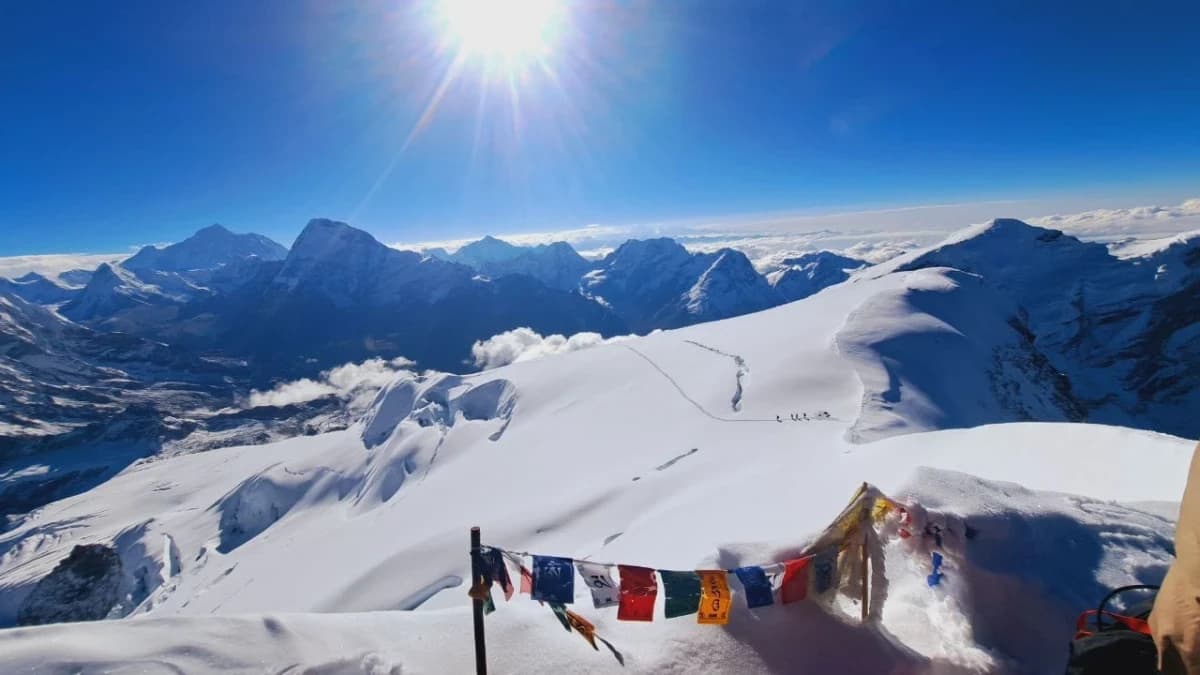
At 6,476 metres (21,247ft), the summit of Mera Peak is a world stripped to its essentials: ice, wind, sky, and silence. You arrive in darkness, having climbed since midnight through steep snow and narrow ridges, your crampons biting into frozen slopes while the headlamp picks out the rope ahead. Then the horizon opens. Five of the world's fourteen 8,000-metre peaks materialise out of the pre-dawn blue, Everest and Lhotse to the north, Makalu to the east, Cho Oyu to the northwest, Kangchenjunga shimmering on the far horizon. The sun hits the summit ridge and the snow turns gold. You are standing on Nepal's highest trekking peak, and the view from here is one of the finest on earth.

Fourteen days from Kathmandu to the summit and back. The route bypasses the main Everest trail entirely, flying into Lukla before turning south into the remote Hinku Valley, a wild, quiet corridor of rhododendron forest, glacial moraines, and high pastures where yaks graze beneath towering walls of rock and ice. You won't see the crowds of the classic Khumbu trail here. Instead, you'll walk through villages where Sherpa families dry cheese on stone rooftops, sleep in teahouses warmed by wood-burning stoves, eat dal bhat cooked by the families who run them, and cross high passes draped in prayer flags. All climbing gear is provided by The Everest Holiday. Your climbing guides hold mountaineering degrees and have stood on this summit dozens of times. No prior climbing experience is needed.

What Makes This Climb Unforgettable

  • Summit Nepal's highest trekking peak at 6,476m (21,247ft), with panoramic views of Everest, Lhotse, Makalu, Cho Oyu, and Kangchenjunga from the top
  • No prior climbing experience required. Your TAAN-certified climbing guide teaches you everything you need during a full training day at Khare before the summit push
  • All climbing gear provided by The Everest Holiday: ropes, harness, ice axe, crampons, helmet, and all technical equipment. You do not need to buy or bring any climbing-specific gear
  • Trek through the remote Hinku and Honku valleys, far from the crowded main Everest route, where the mountains feel truly wild
  • Full acclimatisation day at Khare (5,045m) with technical climbing training, giving your body time and your mind confidence before summit day
  • Climb with TAAN-certified mountaineering guides who hold university degrees in mountaineering. Our team includes Sohel, Manoj, and Samish, all with deep Mera Peak experience
  • Three tiers from USD 1,111 to USD 2,499. Same summit, same climbing team, same gear, three comfort levels. Budget, Standard, or Luxury
  • Every booking supports 70 children's education at the Nagarjun Learning Center, our family-founded charity in rural Nepal
  • Small groups of 2 to 20 people. Your expedition is always private, never merged with strangers
  • Fly into Lukla on one of the world's most dramatic mountain flights, then walk into a valley most trekkers never see
  • Best climbing season: February to June and September to November, with autumn offering the clearest summit views

14-Day Mera Peak Climbing Overview

Fourteen days divides into three clear phases: the approach trek through the Hinku Valley, the acclimatisation and training at base camp, and the summit push. The first phase begins with the flight to Lukla (2,860m / 9,383ft), then heads south on foot through Paiya, Pangkoma, and Ramailo Danda. This is not the well-worn trail to Namche Bazaar. The Hinku Valley route is quieter, greener, and wilder, dropping through dense rhododendron forest before climbing gradually through high alpine terrain towards Chetrakhola and Kothe (3,600m / 11,811ft).

From Kothe, the scenery transforms. The valley narrows, the vegetation thins, and the glacial moraines begin. You trek through Thaknak (4,350m / 14,271ft) to Khare (5,045m / 16,552ft), which serves as Mera Peak Base Camp. Here you spend a full acclimatisation day, and your climbing guide runs a thorough training session: crampon technique, ice axe arrest, rope work, and movement on steep snow. By the time you leave Khare for High Camp (5,780m / 18,963ft), you'll know exactly what to expect on summit day.

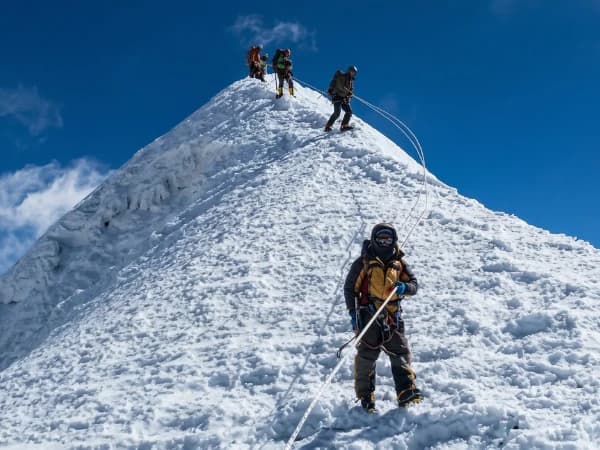
Summit day begins around midnight. You climb by headlamp through steep snow slopes and narrow ice ridges, roped to your climbing guide, using the skills you practised at Khare. The ascent takes 10 to 12 hours round trip. At 6,476 metres, the summit offers what many mountaineers consider the single greatest panorama in the Himalayas: five 8,000-metre peaks visible in a single sweep. After the summit, you descend through Khare, Kothe, and back to Lukla for the flight to Kathmandu. You return not as a trekker, but as a mountaineer who stood on a Himalayan summit.

Before You Arrive

Please arrive in Kathmandu by 4 PM the day before your expedition begins. This gives you time for a final gear check, a climbing briefing with your guide, and a good night's rest before the early morning flight to Lukla.

Your Online Briefing

After you book, we schedule a video call where we walk you through every detail: what to pack for both trekking and climbing, what the summit day is really like, how to prepare physically, what fitness level you need, and anything else on your mind. No question is too small. This is also when we learn about you. Our expedition itinerary does not include your hotel in Kathmandu. During the briefing, share your preferences and budget, and we'll arrange accommodation that fits, whether you want a simple guesthouse in Thamel or a five-star hotel.

Lukla Flight — What You Need to Know

The flight to Lukla is one of the most dramatic in the world, a short ride between mountain peaks that ends on a runway carved into a hillside at 2,860m (9,383ft). It is weather-dependent, and flights can be delayed by fog, cloud, or wind, sometimes for a full day. This is normal in the Himalayas and nothing to worry about, but it is something to plan for. We strongly recommend keeping two buffer days at the end of your trip before your international flight home. Make sure your Nepal visa covers the extra days. During peak season (March to May and October to November), flights may operate from Manthali Airport instead of Kathmandu. All ground transport is included in every package.

Your Climb, Your Way

Every expedition we run is private. Your group only, no strangers added. Whether you choose Budget, Standard, or Luxury, the mountain is yours and your companions' alone. This is not a conveyor belt. This is your personal Himalayan summit.

Your hotel in Kathmandu is not included in the expedition package, and that is intentional. Kathmandu has everything from USD 10 guesthouses in Thamel to five-star hotels with rooftop views. During the online briefing, tell us what you prefer and we'll arrange it for you. Your expedition package begins the moment you leave Kathmandu for the mountains.

Luxury tier clients fly by helicopter from Kathmandu to Lukla and back, skipping the weather-dependent fixed-wing flights entirely. Standard and Budget clients fly by fixed-wing aircraft, with Standard receiving private vehicle transfer to and from the airport, and Budget using local or shared transport.

Climbing Gear and Team

All climbing gear is provided by The Everest Holiday: ropes, harness, ice axe, crampons, helmet, and all technical equipment needed for the summit push. You do not need to bring or buy any climbing-specific gear. You'll need your own trekking clothing and layers (available to buy or rent in Kathmandu), but the mountain-specific equipment is on us.

Your climbing guides are TAAN-certified mountaineering professionals with university degrees in mountaineering. Our team includes Sohel, Manoj, and Samish, all with extensive Mera Peak experience. They grew up in these mountains, they know the routes intimately, and they will teach you everything you need to know during the training day at Khare.

Difficulty: Very Challenging (5 out of 5)

Mera Peak is classified as a trekking peak, but make no mistake: this is a genuine mountaineering expedition. The trekking portion involves 5 to 7 hours of walking per day over mountain trails, through forest, across moraines, and up steep valley sides. The climbing portion adds technical mountaineering: crampon and ice axe work on steep snow slopes, roped travel on glaciated terrain, and an exposed summit ridge at 6,476m. There is no technical rock climbing. The challenge is altitude, endurance, cold, and the sustained physical effort of a midnight summit push lasting 10 to 12 hours. You should be in excellent cardiovascular fitness and comfortable with long days of sustained effort. Previous trekking experience is strongly recommended. Previous climbing experience is helpful but not essential.

Compare Our Three Packages

  Budget Standard Luxury
Price from USD 1,111 USD 1,999 USD 2,499
Meals Choose your own (approx. USD 15-25/day) 3 meals + tea + fruits + 2L water daily All meals + all drinks anytime (except alcohol)
Room Shared teahouse Private twin w/ bathroom Private deluxe w/ bed heater
Porter Not included 1 per 2 trekkers 1 per trekker (carry nothing)
Guide 1 guide, assistant at 8+ 1 guide per 6, assistant at 6+ 1 guide per 2 trekkers
Climbing guide Included — TAAN-certified with mountaineering degree Included — TAAN-certified with mountaineering degree Included — TAAN-certified with mountaineering degree
Climbing gear All provided by TEH All provided by TEH All provided by TEH (premium quality)
High Camp Mountaineering tent Mountaineering tent Mountaineering tent
Transport Local/shared vehicle + flight to Lukla Private vehicle + flight to Lukla Helicopter Kathmandu–Lukla both ways
SIM data SIM only Limited data Unlimited data
Best for Ambitious climbers on a budget First-time summiteers wanting comfort Premium climbing experience

Himalayas for Every Budget — same climbing guides, same gear, same summit, three comfort levels.

Your Climb, Our Family

In the 1960s, Shreejan's grandfather Hari Lal Simkhada helped international travellers experience the Himalayas for the first time, arranging logistics, finding routes, building trust with people who had come halfway around the world on a dream. His son Ganesh went on to hold senior positions in Nepal's tourism and mountaineering institutions. And now Shreejan, the third generation, designs every itinerary you see on this website.

This is not a company that was started in a boardroom. It was started on a mountain trail, three generations ago.

Shreejan hand-picks the guide and climbing team for your group from our roster of TAAN-certified mountaineering professionals, people who grew up in these mountains, who have stood on Himalayan summits dozens of times, and who know exactly how to guide you safely to the top of Mera Peak and back. He briefs your team personally before your expedition begins, because your safety and experience are not something we delegate to a system.

Have a question right now? WhatsApp Shreejan directly: +977 9810351300. No sales team. No chatbot. The person who designed your climb answers personally.

Why Climbers Trust Us

  • 197+ TripAdvisor Reviews — 4.9 out of 5 stars, TripAdvisor Travellers Choice 2024
  • 108+ Google Reviews — 4.9 out of 5 stars
  • TAAN Certified — Member #1586, Government Reg: 147653/072/073
  • Secure 10% Deposit — pay just USD 111 to reserve your Mera Peak expedition, via Himalayan Bank
  • Himalayas for Every Budget — from USD 1,111 including all climbing gear, guides, and permits
  • Three Generations — family guiding in the Himalayas since the 1960s
  • Mountaineering-Degree Guides — your climbing team holds university qualifications in mountaineering, not just trekking certifications

Solo Climbers Welcome

You do not need a climbing partner. Many of our Mera Peak clients book alone, solo climbers looking for their first summit above 6,000 metres. Your climbing guide and trekking guide are with you every step, and if you want company on the expedition, tell us and we'll list your dates as a fixed departure so others can join. Nepal's mandatory guide rule is already covered by our package, so there's nothing extra to arrange.

Our groups are small, 2 to 20 people, because the Himalayas deserve more than a crowd. You book your expedition, and it's yours. We will never add strangers to your group without your permission. Whether you're a solo climber or bringing a group, choosing the right company matters more at 6,476m than anywhere else. Bring Nepali rupees for personal spending along the trail, and budget for tipping your guide and porters at the end.

Difficulty: What Mera Peak Is Really Like

Mera Peak sits at 6,476 metres, making it Nepal's highest trekking peak. The classification "trekking peak" refers to the permit category, not the difficulty. This is a real mountaineering expedition that demands respect.

The approach trek through the Hinku Valley involves 5 to 7 hours of walking per day over mountain trails, through forest, across river crossings, and up steep hillsides. The terrain is rougher and less developed than the classic Everest trail. Teahouses in this region are simpler, the trails quieter, and the sense of remoteness real.

Summit day is the crux. You leave High Camp (5,780m) around midnight, climbing by headlamp through steep snow slopes and narrow ice ridges. The round trip takes 10 to 12 hours. You'll use crampons, an ice axe, and be roped to your climbing guide throughout. There is no technical rock climbing, but the combination of altitude, cold, darkness, and sustained effort on steep snow and ice makes this a serious undertaking. Altitude sickness is a real concern at this elevation, and our guides carry pulse oximeters and altitude medication throughout.

You need excellent cardiovascular fitness. We recommend at least three months of targeted training before your expedition: running, hiking with a loaded pack, stair climbing, and core strength work. The full acclimatisation day at Khare, combined with the gradual altitude gain through the Hinku Valley, gives your body the best possible preparation. Your climbing guide teaches crampon and ice axe technique during the training session at Khare, so you don't need prior experience with this equipment.

Travel insurance with helicopter evacuation cover to 7,000m is mandatory for this expedition. We require confirmation before departure.

Climb With a Purpose — Changing the World, One Step at a Time

In 2019, Shreejan and Shamjhana founded the Nagarjun Learning Center in Saldum Village, one of the most remote communities in Nepal's Dhading District, where children had no school after hours, no computers, and limited healthcare. Today, 70 children receive free education and hot meals every school day. The centre has grown to 7 learning centres across Nepal, providing healthcare for over 600 people, internet access for 65 children, and support programmes for over 275 women.

A portion of every expedition you book funds this work directly. The centre is verified and listed on the United Nations Partner Portal.

When you climb Mera Peak with us, every step, from the first footfall on the trail in the Hinku Valley to the final push on the summit ridge at 6,476 metres, helps change a life in rural Nepal. That is what we mean by Climb With a Purpose. It's also why our responsible trekking practices and porter welfare standards go far beyond what the law requires.

What Trekkers Say About This Trek

"Our guide made sure we acclimatised properly. I never felt rushed. The teahouses were comfortable and the food was surprisingly good at altitude."

— Google Review, 5 stars

"Our guide made sure we acclimatised properly with rest days at Namche and Dingboche. I never felt rushed. The teahouses were comfortable and the food was surprisingly good."

— Google Review, 5 stars

"Our guide made sure we acclimatised properly with rest days at Namche and Dingboche. I never felt rushed. The teahouses were comfortable and the food was surprisingly good."

— Google Review, 5 stars

Read all 320+ reviews →

Short Itinerary
Day 01: Early morning flight from Kathmandu (1,400 m/4,593 ft) to Lukla (2,850m/9,350ft). Trek to Paiya (2,730 m/8,954 ft) is usually around 8 km/5 miles with 4-5 hours and a total elevation change 120m/394ft.
Max Altitude: 2,850m/9,350ft
Day 02: Trek starts with a 6 km / 3.5 mile walk from Paiya (2,730 m / 8,954 ft) to Pangkoma (2,850 m / 9,348 ft), usually around 5-6 hours with a total elevation change of 120 m / 394 ft.
Max Altitude: 2,850 m / 9,348 ft
Day 03: Trek starts with a 7 km/4.3 mile walk from Pangkoma (2,850 m/9,348 ft) to Ramailo Danda (3,276m/10,748ft), usually around 6-7 hours with a total elevation change of 426 m/1,400 ft.
Max Altitude: 3,276m/10,748ft
Day 04: Trek starts with a 10 km/6.2 mile walk from Ramailo Danda (3,276m/10,748ft) to Chetrakhola (3,150m/10,332ft), usually around 7-8 hours with a total elevation change of 126m/416ft.
Max Altitude: 3,276m/10,748ft
Day 05: Trek starts with a 12 km/7.5 mile walk from Chetrakhola (3,150m/10,332ft) to Kothe (3,600m/11,808ft), usually around 6-7 hours with a total elevation change of 450 m/1,476 ft.
Max Altitude: 3,600m/11,808ft
Day 06: Trek starts with an 8 km/5 mile walk from Kothe (3,600m/11,808ft) to Thaknak (4,350 m/14,270 ft), usually around 4-5 hours with a total elevation change of 750 m/2,462 ft.
Max Altitude: 4,350 m/14,270 ft
Day 07: Trek starts with a 6 km/3.7 mile walk from Thaknak (4,350 m/14,270 ft) to Khare (5,045 m/16,552 ft), usually around 4-5 hours with a total elevation change of 695 m/2,282 ft.
Max Altitude: 5,045 m/16,552 ft
Day 08: Acclimatisation day at Khare (5,045 m/16,552 ft).
Max Altitude: 5,045 m/16,552 ft
Day 09: Trek starts with a 5 km / 3.1 mile walk from Khare (5,045 m / 16,552 ft) to Mera High Camp (5,780 m / 18,963 ft), usually around 5-6 hours with a total elevation change of 735 m / 2,411 ft.
Max Altitude: 5,780 m / 18,963 ft
Day 10: Trek starts with a 14 km/8.7 mile walk from Mera High Camp (5,780 m/18,963 ft) to Summit (6,476 m/21,247 ft) and back to Khare (5,045 m/16,552 ft), usually around 10-12 hours with a total elevation change of 874 m/1,609 ft.
Max Altitude: 6,476m/21,247ft
Day 11: Trek starts with a 14 km/8.7 mile walk from Khare (5,045 m/16,552 ft) to Kothe (4,182m/13,716ft), usually around 6-7 hours with a total elevation change of 863 m/-2,836 ft.
Max Altitude: 5,045 m/16,552 ft
Day 12: Trek starts with 10 km/6.2 miles walk from Kothe (4,182m/13,716ft) to Thuli Kharka (3,900m/12,597ft), usually around 5-6 hours with a total elevation change 282 m/-1,119 ft.
Max Altitude: 4,182m/13,716ft
Day 13: Trek starts with a 15 km/9.3 mile walk from Thuli Kharka (3,900m/12,597ft) to Lukla (2,840 m/9,318 ft), usually around 6-7 hours with a total elevation change of -1,060m/-3,279ft.
Max Altitude: 3,900m/12,597ft
Day 14: Fly back to Kathmandu/Manthali (1,400 m/4,593 ft) from Lukla (2,850m/9,350ft).
Max Altitude: 2,850m/9,350ft
Expand
Detailed Itinerary
Day 01:

Early in the morning, you will board a short but thrilling 40-minute flight from Kathmandu’s Tribhuvan International Airport to the famous Tenzing-Hillary Airport in Lukla (2,804m). This flight offers breathtaking views of the Himalayan ranges and lush green hills, giving you a glimpse of the adventure ahead. Once you land at Lukla, our trekking journey begins as we descend through a beautiful forested trail filled with rhododendron and pine trees, heading towards the small village of Surke.

We’ll stop for lunch at Pakhapani, a peaceful spot just beyond Surke, where you can rest and enjoy the surrounding scenery. After a hearty meal, we continue trekking along a path that winds through several traditional Sherpa villages, terraced farmlands, and forested hills. The trail offers a wonderful mix of nature and local culture, as you pass smiling villagers and prayer flags fluttering in the mountain breeze. By late afternoon, we’ll reach Paiya, our stop for the night, where you can relax and enjoy the quiet mountain atmosphere.

Read more:Kathmandu guide | airport arrival guide | Lukla guide | Sherpa people

Max Altitude: 2,850m/9,350ftMeals: Breakfast, Lunch & DinnerAccommodation: Tea House or Local lodgesDuration: 4-5 hoursDistance: 8 km/5 milesElevation: 120m/394ft.
Day 02:

Today’s trek from Paiya to Pangkoma is a long and demanding journey, but it rewards you with incredible scenery and a true taste of Himalayan life. Leaving Paiya behind, we follow an eastern trail that gradually ascends through small settlements, passing the villages of Khari Khola and Bumbari. The path winds through lush forests of rhododendron and bamboo, where you can often hear the chirping of birds and the rustle of leaves in the mountain breeze.

As you make your way along the narrow ridges, the trail offers stunning views of the Dudh Koshi River Valley far below and the snow-covered peaks of the Dudh Kund Himal shining in the distance. The route can be steep and uneven at times, but every step brings new sights of green hills, waterfalls, and terraced farmlands.

After several hours of trekking, you’ll finally arrive at the traditional Sherpa village of Pangkongma, known for its warm hospitality and farming lifestyle. Here, you can rest and enjoy a peaceful evening surrounded by mountains, prayer flags, and the calm rhythm of village life.

Read more:Sherpa people

Max Altitude: 2,850 m / 9,348 ftMeals: Breakfast, Lunch & DinnerAccommodation: Tea House or Local lodgesDuration: 5-6 hoursDistance: 6 km / 3.5 mileElevation: 120 m / 394 ft.
Day 03:

After breakfast, we leave the beautiful village of Pangkoma and continue our journey toward Ramailo Danda. The trail begins with a gradual climb, passing through dense forests filled with rhododendron, pine, and oak trees. Along the way, colorful prayer flags flutter in the wind, and you’ll see beautifully carved mani walls that reflect the deep Buddhist culture of the region.

As we trek higher, we cross the Pangkoma La Pass (3,174m), from where you can enjoy breathtaking views of the surrounding hills and distant snow-capped peaks. The cool mountain air and peaceful sound of nature make the climb truly rewarding. After descending from the pass, we reach the small settlement of Ningsow, a quiet village surrounded by terraced fields and forests.

From Ningsow, the trail becomes steeper and more demanding as we continue toward Ramailo Danda. By the time you arrive at Ramailo Danda, you’ll be greeted with magnificent views of Mera Peak and the Hinku Valley—making all the effort of the day worthwhile.

Read more:trekking preparation guide

Max Altitude: 3,276m/10,748ftMeals: Breakfast, Lunch & DinnerAccommodation: Tea House or Local lodgesDuration: 6-7 hoursDistance: 7 km/4.3 mileElevation: 426 m/1,400 ft.
Day 04:

Leaving Ramailo Danda, the trail leads you through one of the most beautiful sections of the journey. The path winds through dense forests filled with rhododendron, oak, and bamboo trees, and during the spring season, the entire hillside comes alive with colorful rhododendron blooms. The fresh mountain air, the sound of birds, and the peaceful environment make the walk truly refreshing.

As you trek deeper into the forest, keep your eyes open—you might be lucky enough to spot some rare wildlife, including the elusive red panda, along with Himalayan monals and other birds native to the region. The trail offers gentle ups and downs, with occasional open clearings that provide lovely views of the surrounding green hills and valleys.

After several hours of trekking through this quiet and scenic landscape, we gradually descend toward Chetrakhola, a serene riverside area where we will stop for the night. The soothing sound of the river and the calm surroundings make it a perfect place to rest after a fulfilling day on the trail.

Read more:safety guide

Max Altitude: 3,276m/10,748ftMeals: Breakfast, Lunch & DinnerAccommodation: Tea House or Local lodgesDuration: 7-8 hoursDistance: 10 km/6.2 mileElevation: 126m/416ft.
Day 05:

After breakfast, we go from Chetra Khola and head north to Kothe. The track winds through a stunning forest with giant pines, verdant moss, and vivid rhododendrons on each side of the Majang Khola. The top of Mera Mountain is visible in the distance, and the air is clear and chilly.
The path meets the Hinku Khola track, which leads to Mera Peak, as we go. With rivers running and birds singing in the trees, the hike is serene and tranquil. Before gradually ascending to Kothe, we cross small wooden bridges and streams, notably the Sanu Khola.

Kothe is a charming little village that is traversed by the Hinku River. When you arrive, you may unwind and take in the tranquil mountain views after a fantastic hike.

Read more:trekking preparation guide

Max Altitude: 3,600m/11,808ftMeals: Breakfast, Lunch & DinnerAccommodation: Tea House or Local lodgesDuration: 6-7 hoursDistance: 12 km/7.5 mileElevation: 450 m/1,476 ft.
Day 06:

Today’s trek begins from Kothe and continues gradually toward Thaknak. The trail follows the Hinku River valley, offering stunning views of snow-covered peaks and rocky hillsides. As you move higher, the landscape starts to change—trees become fewer, and the surroundings open up with wide pastures and glacial streams.

Along the way, you’ll pass through small yak herding areas and see colorful prayer flags fluttering in the cool mountain breeze. The trail is peaceful, with the distant sound of the river flowing below. When you reach Thaknak, a beautiful village surrounded by towering peaks, you can rest and enjoy the breathtaking views of Mera Glacier and Charpate Himal nearby.

Read more:trekking preparation guide

Max Altitude: 4,350 m/14,270 ftMeals: Breakfast, Lunch & DinnerAccommodation: Tea House or Local lodgesDuration: 4-5 hoursDistance: 8 km/5 mileElevation: 750 m/2,462 ft.
Day 07:

Today, we leave Thaknak and make our way toward Khare. The trail gently climbs along the side of the Hinku Valley, offering magnificent views of the surrounding mountains. As we move forward, the path becomes steeper and more uneven, crossing glacial streams and rocky stretches.
With every step, the air feels cooler and thinner, reminding you that you’re gaining altitude.

The snowy peaks, including the impressive Mera Peak, appear closer and clearer, creating an inspiring mountain scene. After a steady climb, we reach Khare, a small and peaceful settlement set below the Mera Glacier. It’s an ideal spot to relax, enjoy the stunning views, and get ready for the next part of the adventure.

Read more:altitude medication guide | trekking preparation guide

Max Altitude: 5,045 m/16,552 ftMeals: Breakfast, Lunch & DinnerAccommodation: Tea House or Local lodgesDuration: 4-5 hoursDistance: 6 km/3.7 mileElevation: 695 m/2,282 ft.
Day 08:

Since you have already gained high altitude before the climb, you can acclimatize at Khare. Spending the day here helps prevent altitude sickness and prepares you for the challenging summit ahead.

You can take short walks around the area, exploring the stunning surroundings of Mera Peak, glaciers, and snow-covered ridges. The gentle hikes help your body adapt while offering breathtaking views of the Himalayas. This is also a perfect time to rest, hydrate, eat well, and prepare your climbing gear. By the end of the day, you’ll feel energized, focused, and ready for the ascent to Mera Peak.

Read more:acclimatisation tips | altitude medication guide | trekking preparation guide

Max Altitude: 5,045 m/16,552 ftMeals: Breakfast, Lunch & DinnerAccommodation: Tea House or Local lodges
Day 09:

We leave Khare and start the climb up to Mera High Camp. The trail goes up slowly via rocky roads and glacial terrain, giving you amazing views of the peaks around you and the Mera Glacier below.

The air gets thinner and cooler as you go up, so you need to be careful and keep a steady pace. You'll see amazing panoramic views of the tall peaks of the Himalayas, such as Makalu, Baruntse, and Chamlang, along the journey. We finally get to Mera High Camp after a hard but rewarding hike. It's a calm, beautiful place at the foot of Mera Peak. You can rest, get used to the altitude, and get ready for the last push to the top here.

Read more:altitude medication guide | trekking preparation guide

Max Altitude: 5,780 m / 18,963 ftMeals: Breakfast, Lunch & DinnerAccommodation: Tea House or Local lodgesDuration: 5-6 hoursDistance: 5 km / 3.1 mileElevation: 735 m / 2,411 ft.
Day 10:

Summit Day is the most exciting and challenging day of the trek—the summit push to Mera Peak. Starting around 12 a.m. to 1 a.m. at midnight, we leave Mera High Camp and begin the climb toward the summit. The trail is steep and demanding, passing through rocky ridges, snowfields, and icy sections as you approach the top.

The effort is rewarded with breathtaking 360-degree views of some of the highest peaks in the Himalayas, including Everest, Kanchenjunga, Lhotse, Makalu, and Cho Oyu. After taking in the incredible scenery at 6,654 meters, we carefully descend back to Mera High Camp and continue down to Khare for the night.

This is a long and strenuous day, but reaching the summit of Mera Peak is a deeply rewarding experience, marking the highlight of the trek and leaving unforgettable memories of the Himalayas.

Read more:trekking preparation guide

Max Altitude: 6,476m/21,247ftMeals: Breakfast, Lunch & DinnerAccommodation: Tea House or Local lodgesDuration: 10-12 hoursDistance: 14 km/8.7 mileElevation: 874 m/1,609 ft
Day 11:

From Khare, we start descending toward Kothe, following trails that pass steep slopes, glacial streams, and beautiful alpine scenery, offering a new view of the surrounding mountains.

As we move lower, the air grows warmer, and the landscape changes from snowy peaks to green fields and forests. This section of the trek is calm and scenic, allowing you to enjoy the peaceful beauty of the Hinku Valley. The day ends in the quiet village of Kothe, where you can relax and reflect on the amazing experiences of the trek so far.

Read more:safety guide

Max Altitude: 5,045 m/16,552 ftMeals: Breakfast, Lunch & DinnerAccommodation: Tea House or Local lodgesDuration: 6-7 hoursDistance: 14 km/8.7 mileElevation: 863 m/-2,836 ft.
Day 12:

We start early in the morning from Kothe and make our way toward Thuli Kharka. The trail begins with a gentle climb through dense forests, where tall pine and rhododendron trees create a peaceful, shaded path. As we move forward, the trail opens up along the western section of the Hinku Valley, offering wide views of the surrounding mountains, rivers, and valleys.

Thuli Kharka itself is a scenic spot known for its breathtaking mountain panoramas. From here, you can enjoy impressive views of Mera North, Mera Central, and the southern face of Mera Peak. The area is peaceful and quiet, with open pastures that are often used by local herders and their yaks. Spending time here gives trekkers a chance to relax, take photos, and fully appreciate the grandeur of the high Himalayas before continuing the journey.

Read more:trekking preparation guide

Max Altitude: 4,182m/13,716ftMeals: Breakfast, Lunch & DinnerAccommodation: Tea House or Local lodgesDuration: 5-6 hoursDistance: 10 km/6.2 milesElevation: 282 m/-1,119 ft.
Day 13:

The trek begins with a climb up to the Kalo Himal ridge, winding through forests, open hills, and steep paths. Along the way, you’ll enjoy stunning views of the Hinku Valley, distant snow-covered peaks, and terraced fields below.

The highlight of the day is crossing Zatrawa La Pass at 4,600 meters, where the breathtaking mountain and valley views make the effort worthwhile. After the pass, the trail gradually descends toward Chutanga, passing through thick forests, flowing streams, and small traditional villages. The day ends in Lukla, where you will spend your final night in the trekking region. It’s a great opportunity to celebrate your achievement and reflect on the incredible journey you’ve completed.

Read more:Lukla guide

Max Altitude: 3,900m/12,597ftMeals: Breakfast, Lunch & DinnerAccommodation: Tea House or Local lodgesDuration: 6-7 hoursDistance: 15 km/9.3 mileElevation: -1,060m/-3,279ft.
Day 14:

You will take an early morning flight back to Kathmandu if all goes according to plan. throughout the 40-minute journey, you can reflect on all the incredible things you have witnessed and experienced throughout the hike.

The city's vibrant atmosphere, rich cultural heritage, and historic attractions in the valley will welcome you to Kathmandu. You may explore the bustling streets, stop by historic temples and squares, or simply unwind and take in the city's amenities after your journey to the Himalayas.
 

Interactive Route Map

Explore the full trek route on our interactive Google Map. Click markers for altitude details at each stop.

Open Full Route Map in Google Maps

Max Altitude: 2,850m/9,350ft
Couldn't find what you're after?Reach out to our travel experts.
Customise Trip
Route Map
Mera Peak Climbing Route Map Nepal
Altitude Chart
Mera Peak Climbing - 14 Days itinerary
Availability
Book your own private small group trip
No. of travellers
Price per person
2 - 4 pax
US$1111
5 - 8 pax
US$1049
9 - 12 pax
US$999
13 - 20 pax
US$942

Discounts are determined exclusively by the size of your group. We do not add additional members to your group.

Book Now
hbl logo
Secure Payment by Himalayan Bank.
Cost Includes

Transportation

  • Airport Pick-up and Drop-off from Tribhuvan International Airport to the Hotel of your choice.
  • Ground transportation to trek start points and back to Kathmandu.

Accommodation and food

  • During the trek, Food or drinks are not included. 
  • You will stay in a local teahouse and lodge in a shared room during the duration of the trek.

Guide and porter

  • An English-speaking, Nepal government well-trained guide is provided (one guide for your group). For groups of 8 or more trekkers, an additional assistant guide is included. For more than 8 trekkers, 1 assistant guide is added.
  • Porter is not included, only the guide.

Permits and Expenses

  • Mera Peak Permit.
  • Sagarmatha National Park Entry Permit.
  • All government taxes and official expenses.

Medical Assistance

  • First aid kits are provided, including an oximeter to check blood oxygen levels at high altitudes.
  • Arranging rescue operations in case of an emergency health condition. (funded by the trekker's travel insurance)

Complimentary

  • Company's T-shirt and Cap before the trek.
  • At the end of your trip, you'll have a farewell meal at a restaurant in the area.
  • At the farewell dinner after the Mera Peak-14 Days, we will give you a certificate of achievement for successful completion of the trek. 

Benefits

  • Sleeping bags and down jackets: if you do not have your own, please inform us either at your online briefing or after the arrival briefing in Kathmandu before your trek so we can provide you with one for your use during the trek.
  • Free Excess luggage storage at The Everest Holiday store for the duration of the trek.
  • We will arrange a SIM Card for every individual trekker upon arrival in Kathmandu and teach them how to get budget internet packages and top up their services.
Cost Excludes

International Flight

  • International flight cost.

Nepali Visa

  • At Tribhuvan International Airport, you can pay the following fees upon arrival: $30 for a 15-day visa, $50 for a 30-day visa, and $120 for a 90-day visa. Alternatively, you can apply for and receive a Nepal visa from the Nepalese embassy or consulate in your country.

(Note: Anyone having a visa before arrival has an express exit through the immigration line. To obtain a visa upon arrival at TIA Kathmandu, you must have the necessary funds in US dollars.)

Accommodation

  • Accommodation in Kathmandu before and after the trek will not be included in this package. So, please let us know your preferences, budget, and standard of the hotel you would like to stay in Kathmandu during the online meeting. So we can arrange it for you accordingly.

Guide and Porter

  • Tip for guides and porters. (Recommended)

Other expenses

  • Excess luggage charges for an extra porter to carry luggage and also any extra cost charged by the airline for extra luggage, as there is no porter in the budget service package any extra porter service will be charged extra. 
  • All non-alcoholic drinks like bottled water, hot water, soft drinks, juice, tea, coffee and alcoholic drinks are not included, etc.
  • Additional costs due to delays caused by circumstances out of our control, like landslides, unfavourable weather, itinerary modification due to safety concerns, illness, changes in government policies, strikes, etc.

Equipment Lists

Only pack what’s needed for the trek to travel light and comfortably. You can store your excess luggage at The Everest Holiday for free. Porters will carry your main trekking bag, but the weight limit is 10 kg for each trekker. Since one porter carries the luggage for two people, we suggest that you and a trekking partner share one large duffel bag (over 60 Liters).

  • Sun hat (wide-brimmed)
  • Beanie (for warmth)
  • A neck gaiter or buff (for warmth and sun protection)
  • Sunglasses with UV protection
  • Insulated gloves or mittens (for cold weather)
  • Waterproof gloves (for wet conditions)
  • A thick-wool or synthetic pair of moisture-wicking socks
  • waterproof hiking boots with ankle support and excellent traction
  • Sandals (for camp use or river crossings)
  • Gaiters protect
  • Moisture-wicking t-shirts (short and long sleeves)
  • Thermal base layer (for colder conditions)
  • Fleece jacket and down jacket (Mandatory)
  • Lightweight puffy jacket (for extra warmth)
  • Waterproof and windproof jacket (Gore-Tex or similar)
  • Raincoat
  • Lightweight, breathable long-sleeve shirt
  • Polypropylene underwear (four)
  • Quick-drying pants/trousers (convertible or full-length)
  • Insulated pants (for colder conditions)
  • Lightweight cotton pants
  • Wear long underwear or thermal leggings when it is cold.
  • Two pairs of thermal/trekking trousers (pants)
  • Biodegradable bar soap
  • Toothbrush and toothpaste
  • Medium-sized drying towel
  • Wet wipes or hand sanitizers
  • The toilet paper is stored in a Ziplock bag.
  • Feminine hygiene products
  • Travel-sized shampoo
  • Nail clippers
  • Small mirror
  • A duffel bag with a capacity of over 60 litres is intended for porters, with one duffel bag for every trekker.
  • An individual's daypack or backpack with a 20- or 30-litre capacity should be plenty.
  • Adjustable and lightweight poles (preferably collapsible)
  • A two-litre water bladder or bottle (with a protective cover for cold climates)
  • Use water purification methods such as purification tablets, filter bottles, or UV filters.
  • Camera/smartphone (extra memory cards and batteries)
  • A portable charger, spare batteries, or a battery pack
  • Two-pin charging plug
  • Basic first aid supplies include band-aids, antiseptic wipes, pain relievers, and Diamox (which is used to prevent or lessen symptoms related to mountain sickness).
  • Personal medications (inhalers, allergy meds, etc.)
  • Few passport-size photos
  • Passport photocopies
  • Notebook and pen
  • Binoculars
  • Water purification (tablets, filter bottle, UV filter)
  • Energy bar
  • Basic first aid kit (band-aids, antiseptic wipes, pain relievers, etc.)
  • Diamox (for altitude sickness prevention/relief)
  • Personal medications (inhalers, allergy meds, etc.)
  • Lightweight headlamp (with adjustable brightness)
  • Face wipes
  • An extra pair of batteries
Essential Information

Trip information 

Arrival, welcome, and trek start

We kindly ask you to share your flight details once your trip is booked so we can organise a complimentary airport pickup. This service is provided to help you navigate easily in a foreign country. Upon your arrival at Tribhuvan International Airport, our representative will be waiting for you, holding a sign with your name and our company logo. You will be warmly welcomed with a traditional marigold or garland or Khada and then escorted to your hotel in a private vehicle.

Accommodation 

This trip includes 13 nights of accommodation in lodges or camps along the trekking route, staying at the best available options. All lodgings are based on twin-sharing. You will spend one night at a high camp and 12 nights in the finest hotels and lodges in the trekking regions.
You will also need at least two nights in Kathmandu—one before the trek begins and one after it ends. These hotel costs are not included in the package, as Kathmandu offers a wide variety of hotels to suit different preferences, allowing you the freedom to choose where to stay.

Meal 

We provide three standard meals throughout the trek. The menu changes depending on how high you are; at higher altitudes, there will be fewer alternatives. We suggest different teas, garlic soup, and fresh veggies because it's crucial to stay hydrated at high elevations. For your health, we suggest that you stay away from dairy, meat, and drinks that have alcohol or caffeine in them. This bundle does not include hot, cold, or alcoholic drinks.

Luggage 

We will provide two trekkers for one porter during the trek. The total weight limit for the porter is 20 kg, which means each trekker has a 10 kg luggage allowance. Hence, team up with a fellow traveller and pack your things in a duffle bag of over sixty litres. We expect you to only carry a small personal backpack for your essentials like a camera, water, snacks, and valuables. You can leave any extra bags at your hotel or at our Kathmandu office for free.

Facilities and Essentials 

Water 

You can buy a water bottle from shops along the trail or get boiled/filtered water at lodges. It is advised to bring a refillable water bottle and fill it up with boiled water. Avoid drinking untreated tap, well, or river water. For safety, please use a water purifying tablet or you can buy one in the shops along the trail. 

Communication

We will provide you with a SIM card in Kathmandu and teach you how to get data and recharge cash on it, but mobile signals may be weak at higher altitudes. For your safety, our lead guide keeps daily contact with all trekking teams via mobile. We are fully prepared to handle emergencies, and our guides are trained to assist whenever needed. Additionally, we use walkie-talkies and satellite phones in areas with no network to ensure constant communication.

The best time of year to climb Mera Peak 

The best time to climb Mera Peak is during the spring (March to May) and autumn (late September to November) seasons. In spring, the weather is stable, temperatures are moderate, and the rhododendron forests along the trail are in full bloom, creating vibrant landscapes. Autumn offers clear skies and excellent visibility of the Himalayan peaks after the monsoon, with comfortable trekking conditions and calm 
weather.

It is not recommended to attempt Mera Peak during the monsoon season (June to August) because of heavy rains, slippery trails, and the risk of landslides. Winter (December to February) is also challenging due to extremely cold temperatures, strong winds, and snow-covered paths. Spring and autumn remain the most ideal times for a safe and enjoyable climb, offering the best combination of weather, views, and trekking 
conditions.

Acclimatisation 

The route for your Mera Peak trip has been thoughtfully meant to help you get used to the altitude. You will acclimate for a full day at Khare (5,045m/16,486ft). Your climbing guide will show you how to use your climbing equipment and gear correctly on this particular day. To take in the stunning mountain views, you can also decide to go a short distance to a nearby hill.

Altitude Sickness 

Climbing Mera Peak takes you to high elevations, where the air contains less oxygen than at lower altitudes. This makes it possible to experience altitude sickness, which can affect anyone regardless of age or fitness level. Common symptoms include headaches, nausea, dizziness, shortness of breath, loss of appetite, and difficulty sleeping.

In rare but serious cases, altitude sickness can develop into High Altitude Cerebral Edema (HACE) or High Altitude Pulmonary Edema (HAPE). HACE occurs when fluid builds up in the brain, causing confusion, loss of coordination, severe headache, and sometimes hallucinations. HAPE develops when fluid accumulates in the lungs, leading to extreme shortness of breath, a persistent cough, and fatigue. Both conditions are life-threatening and require immediate descent and medical attention.

To reduce the risk of altitude sickness, it is essential to acclimatize properly. The Mera Peak itinerary includes acclimatisation days at key points, such as Khare and Mera High Camp, to allow your body to adjust gradually to higher altitudes. Staying hydrated, eating light meals, avoiding alcohol, and climbing at a steady pace are important preventive measures.

Your guides are trained to monitor your health throughout the trek and will take all necessary precautions to ensure your safety. With proper 
preparation and care, most trekkers can enjoy a safe and successful climb to Mera Peak.

Travel Essentials

Visa 

Except for citizens of India, all foreigners need a visa to enter Nepal. The Kathmandu International Airport can provide visas upon arrival for most nationalities. You will need a passport that is valid for at least 6 months, one passport-sized photo, and cash for the visa fee (US$50 for a 30-day visa).

Travel insurance 

Having comprehensive travel insurance is mandatory for this trek. Your policy must cover medical expenses and emergency helicopter rescue up to an altitude of 6,000 metres. Before the trek begins, you will need to provide us with a copy of your insurance policy.

Currency Exchange

The Nepali Rupee (NPR) is the country's official currency; one US dollar is equivalent to around 130 NPR. In Kathmandu, you may find banks and approved money exchange centres where you can exchange major foreign currencies.  ATMs are widely available to withdraw NPR, but extra service fees may apply. Make sure your notes are new and undamaged, as old or torn bills may be refused. Only the 100 INR note from India is legally accepted in Nepal. In Lukla there are ATMs where you can exchange money, but there is no guarantee. Before travelling to trekking regions, it's best to exchange money in Kathmandu, as there are few exchange options in remote areas.

Extra Expense

While our package covers most of your expenses during the trek, you will need to budget for some personal items like meals and accommodation in Kathmandu, visa fees, snacks, hot showers, personal equipment, tips for the crew, etc. We recommend you budget 
approximately $20 USD per day for these personal expenses during the trek.

Mera Peak Safety 

Your health and safety are our top priorities at The Everest Holiday, and we carefully plan our trips to ensure a secure trekking experience. We provide high-quality climbing equipment, gear, and fully stocked medical kits to handle any situation. Our guides are trained in advanced wilderness first aid to respond effectively in emergencies. All of our trek crew members come from the high Himalayan regions and are well-adapted to high altitudes, for a smooth and safe trekking experience.

We understand that altitude sickness can affect anyone at any time, so our crew is trained to manage such situations. Each team carries an oximeter to monitor blood oxygen levels, which helps in the early detection of altitude-related issues. High-altitude trekking carries inherent risks, so travel insurance is mandatory. Your insurance should cover helicopter rescue at high altitudes, in addition to standard healthcare expenses. In case of any medical emergency, we will use your documents to arrange a quick and safe rescue, so your safety throughout the climb.

Typical day 

We’ll start each morning with an early breakfast. The day’s trek is usually split into two parts: a 5-6 hour trek, followed by a one-hour lunch break, and then a shorter trek in the afternoon. Dinner is served around 7:00 p.m., and our guide will brief you on the plan for the next day. The 
rest of the evening is yours to relax, explore the village, or enjoy some downtime with your fellow trekkers.

Flight Delays 

Flights between Kathmandu and Lukla depend on the weather and can sometimes be delayed or cancelled. If your flight is cancelled, a helicopter is a possible alternative. A helicopter flight usually costs between $500 and $1,000 USD per person; this price depends on weather and flight availability, and this price is based on a group of five people sharing the cost. To be safe, we highly recommend adding one or two extra days to your travel plans just in case there are any flight delays.

Trek booking

Personal trek 

We can only provide a personal trek, so you will only be trekking with your own group. We will never add strangers to your treks. All the treks are customizable per your schedule.

Individual to Group bookings 

Our treks are organised with a minimum of 2 people, so If anyone is alone and does not have a friend or family joining them, we can organise a group trek open for all. If you prefer to join a group, we can also help you connect with other trekkers. Once you confirm, your group trek will be posted on our website, so others can join too. 
This is our policy to make every trek into your own personal holiday in the Himalaya. 

Trust trek booking 

The Everest Holiday is a registered and bonded trekking operator, ensuring a secure booking process. We are proudly members of the Trekking Agency Association of Nepal (TAAN) and the Nepal Mountaineering Association (NMA). Ganesh Prasad Simkhada, Shreejan's father, has held senior positions in Nepal's tourism and mountaineering institutions To confirm your booking, we require a 10% advance payment. Payment options include the Himalayan Bank online portal (on our website), major credit cards, bank transfers, Wise, and Western Union. After your arrival in Kathmandu, you can pay the remaining balance.  Please send us your important travel documents, such as a passport copy, within one week of booking. Please make sure your passport has a minimum of 6 months of validity remaining at your arrival date in Nepal.

Last-minute booking 

We recommend booking your trek in advance. However, we also offer a last-minute booking option, which requires full payment 24 hours before departure. For the last-minute booking, please contact Shreejan at +977-9810351300 or email us at info@theeverestholiday.com Please note that last-minute treks may face delays due to circumstances beyond our control. 

Flexible Schedule 

Our trip schedule is determined by your travel date, and you can make any changes to it. If our scheduled trek dates don't work for you, please let us know, and we will be happy to arrange a trip according to your time and schedule.

Trip Extension 

You can easily extend your stay with other adventures. We can arrange exciting activities for you, such as a jungle safari (Chitwan and Bardiya), Bungee jumping (Pokhara, Bhote koshi, Kushma), Rafting (Bhote koshi, Trishuli, and Seti river) and kayaking(Trishuli, and Pokhara), paragliding (Pokhara and Kathmandu), zip flying (Kathmandu, Pokhara and Kushma) Canyoning(Pokhara and Sukhuta Beach), Hot ballon (Pokhara), according to your interests. We can also set up sightseeing tours around the Kathmandu Valley if you're interested in culture and history. These tours will take you to UNESCO World Heritage sites like Bhaktapur Durbar Square, Patan Durbar Square, Kathmandu Durbar Square, Swayambhunath (Monkey Temple), Boudhanath Stupa, Changunarayan Temple, and Pashupatinath Temple. We suggest a trip to Nagarkot and Dhulikhel, hill stations just outside of Kathmandu, around sunrise for a serene getaway. We can also set up spiritual trips for Buddhists and Hindus that take you to temples, stupas, monasteries, and meditation centres. When you're booking a trip, please have a look at our ADD-ON package for an amazing adventure during the trek.

Ecotourism practices 

We ask that you join our eco-friendly hiking practice because we are very dedicated to keeping the Everest region's fragile beauty safe. At the start of our trek, each person will obtain their own eco-waste bag. Please put all of your rubbish that can't be composted, like snack wrappers, plastic bottles, and batteries, in this bag. Don't leave anything on the trail, please. Instead, take this bag with you as we walk down, and our guides will show you where to find the public trash cans and recycling bins where you can throw it away correctly. We need your help to keep the Himalayas clean and lovely for the next generation.

TEH Family 

We are a family firm that has been in the tourism business in Nepal for three generations. We believe that all of our employees and teams are family. We started as porters and now run an agency. Our professional and experienced guides and Sherpas will be with you the whole time to make sure your trek is safe and memorable. They know how to do first aid in the bush and while rock climbing and how to stay safe in the mountains. They also speak good English. They are from the upper Himalayas, so they know the area well. We take care of their insurance, food, housing, and medical needs. Please treat our workers like family, and don't hesitate to ask for help or have questions at any time. 

Trip conclusion 

Farewell Dinner 

We will celebrate your successful trek with a farewell dinner in Kathmandu after the trek. This is a great opportunity to share stories from your adventure and provide us with your feedback. We will also present you with a certificate of achievement to recognise your incredible accomplishment.

Departure 

To arrange your airport transfer, please let us know your hotel name, room number, and flight departure details. We will take you from your hotel to Tribhuvan International Airport so you may catch your trip home. We sincerely hope you had an amazing journey and hope to see you again soon for another trip in Nepal.

Tipping culture 

Tipping is a common practice in Nepal. We recommend giving a group tip to your guide and porters at the end of the trek. The amount is up to you and can depend on the quality of service, trip length, your budget, and the overall cost of the trek.

FAQs

What is the Mera Peak Trek?
The Mera Peak Trek is a 14-day high-altitude adventure in Nepal, combining scenic trekking through the Hinku and Khare valleys with the thrilling climb to the summit of Mera Peak (6,654m / 21,831ft). It offers spectacular Himalayan views and a mix of cultural and natural experiences.

How difficult is the trek?
The trek is considered moderate to challenging. While the trek itself is manageable for those with some prior hiking experience, the final climb to Mera Peak requires good physical fitness and proper preparation for high-altitude climbing.

What is the highest point of this trek?
The summit of Mera Peak at 6,654 meters is the highest point of the trek, offering panoramic views of Everest, Lhotse, Cho Oyu, Makalu, and other Himalayan giants.

How fit do I need to be for the Mera Peak Trek?
You should be in good physical condition and capable of walking 5–7 hours daily on uneven and steep terrain. The final summit climb requires stamina and endurance.

How can I prepare?
Before the trek, it is helpful to do regular hiking, long walks, cardio exercises, and strength training. Carrying a weighted backpack during practice hikes will also help prepare you for the trek.

What type of training is recommended?
Focus on cardiovascular fitness, leg strength, core stability, and endurance training. Practice hikes on hills or mountains with a backpack will help simulate trekking conditions.

Which permits are needed for Mera Peak?
You will need:
* Sagarmatha National Park Entry Permit
* Mera Peak Climbing Permit
* All government taxes and official expenses.

Who arranges the permits?
Your trekking company will handle all the necessary permits before the trek begins.

Is travel insurance required?
Yes, travel insurance covering trekking, medical emergencies, and helicopter evacuation is mandatory.

What should the insurance cover?
Insurance must include medical care and emergency helicopter evacuation up to the altitude of Mera Peak (6,654m).

Do I need a visa to trek in Nepal?
Yes, all foreign travelers need a visa to enter Nepal except Indian citizens. Most visas can be obtained on arrival at Kathmandu Airport. You will need a passport valid for at least six months, a passport-sized photo, and the visa fee (e.g., $50 for 30 days).

Do I need a guide?
Yes, a licensed guide is required for the Mera Peak Trek, especially for the summit climb.

What do guides and porters do?
Guides manage navigation, logistics, and safety, while porters can carry your luggage (up to 10kg per person).

Are guides trained in first aid and altitude sickness?
Yes, all guides are trained in first aid and altitude sickness management, including the use of oxygen if necessary.

What type of accommodation is provided?
Standard Package: Twin-sharing rooms in lodges and tea houses.
Luxury Package: Private rooms with attached bathrooms and heated blankets where available.
Budget Package: Shared rooms in local teahouses or homestays with basic facilities.

Is electricity available?
Electricity is limited at high altitudes and may require additional payment for charging devices. Luxury packages often include unlimited electricity where available.

Are private rooms available?
Private rooms are limited at higher altitudes. Lower-altitude lodges may provide private or twin-sharing options.

What food is served during the trek?
Meals typically include dal bhat, noodles, soups, rice, potatoes, and tea/coffee. Many lodges also offer simple Western dishes.

Are drinks included?
Drinks are not included in most standard packages. Luxury packages may provide unlimited access to water, tea, coffee, and juices (alcohol is not included).

Are vegetarian options available?
Yes, vegetarian and vegan meals are widely available. Please inform your guide of any dietary requirements in advance.


When is the best time to trek Mera Peak?
The best seasons are spring (March–May) and autumn (September–November), offering clear skies and excellent mountain views.

Can I trek in winter?
Yes, but expect cold temperatures and snow-covered trails, especially near the summit.

Is trekking safe during the monsoon?
Monsoon trekking is possible but challenging due to slippery trails and potential landslides. The views after the rains, however, are spectacular.

Is altitude sickness a concern?
Yes, particularly at Khare, Mera High Camp, and the summit. Proper acclimatisation days are included to reduce risk.

Are medical facilities available?
Only basic health posts are available along the trail. Serious medical emergencies require evacuation to Kathmandu.

What happens in an emergency?
Guides are trained in first aid and altitude sickness. If needed, helicopter evacuation will be arranged through your insurance.

What gear should I bring?
Essential gear includes trekking boots, trekking poles, warm clothing, a down jacket, gloves, hat, sunglasses, and a sleeping bag.

Can gear be rented in Kathmandu?
Yes, most trekking equipment can be rented or purchased in Kathmandu.

Are trekking poles recommended?
Yes, trekking poles help with balance, reduce strain on knees, and improve stability on steep or uneven terrain.

When should I book the trek?
It is recommended to book at least one month in advance to arrange flights and logistics, though last-minute bookings may be possible.

How can I pay for the trek?
A 10% deposit confirms your booking, with the balance payable in Kathmandu. Payments can be made via bank transfer, Wise, Western Union, credit cards, or in cash. Some methods may include additional transaction fees.

Can the itinerary be customized?
Yes, the itinerary can be adjusted based on your preferences and schedule.

How do I reach the starting point of the trek?
You will fly from Kathmandu to Lukla. During peak season, flights may depart from Manthali Airport due to heavy air traffic.

How do I return after the trek?
After completing the trek, you will fly back to Kathmandu from Lukla or Manthali. Transportation from the airport to your hotel in Kathmandu will be arranged.