Bardiya Lumbini and Chitwan Photography Tour- 12 Days Itinerary and Cost

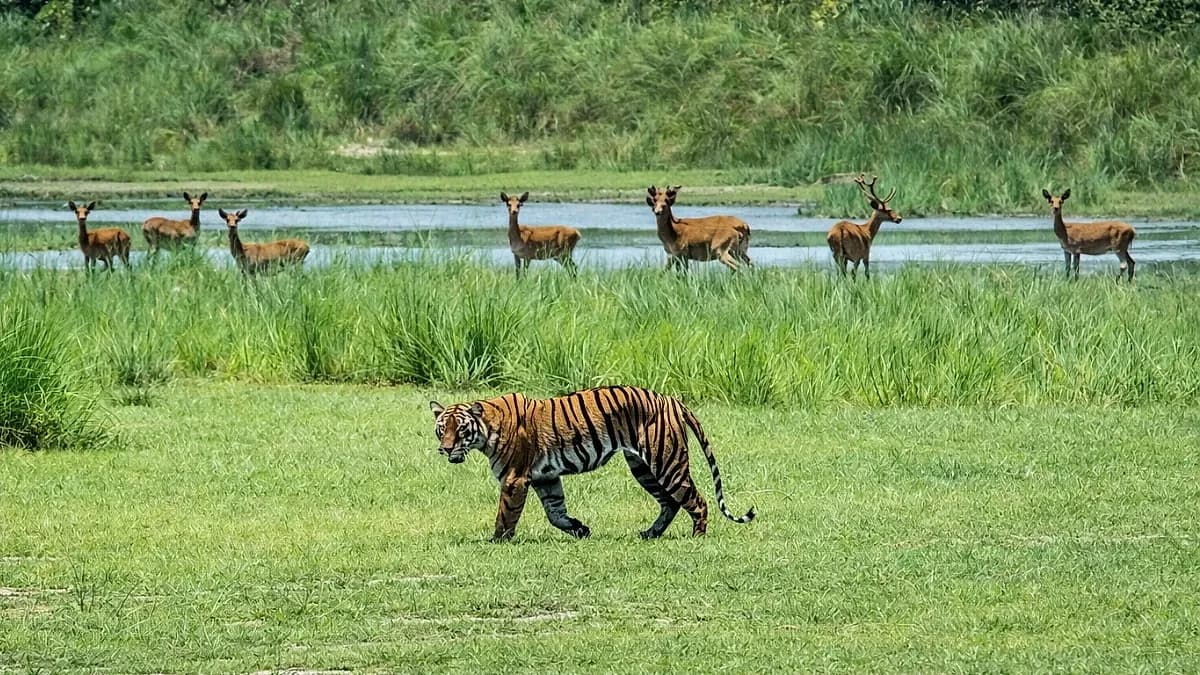
Bengal tiger in grassland at Bardiya National Park, Nepal.
Quick Overview
Duration12 Days
Trip GradeEasy
CountryNepal
Maximum Altitude415m / 1,362ft
Group Size1 - 15
StartsKathmandu
EndsKathmandu
ActivitiesPhotography Tour
Best TimeMarch - May / October - November

The jeep engine cuts and your guide raises a hand. Through the sal forest, where the morning light falls in broken columns, a Bengal tiger moves along the far bank of the Karnali River. It pauses, turns its head, and for three seconds you have a clear shot across open ground. Your shutter fires. Nobody in the vehicle breathes. Then the tiger slips back into the grass and disappears as quietly as it arrived. That's Bardiya — Nepal's largest national park, where the crowds that fill Chitwan haven't arrived yet and the wildlife behaves as though humans are a curiosity rather than a threat. This is the first chapter of a 12-day expedition that will take you from the remote western Terai to the sacred wetlands of Lumbini and into the dense jungles of Chitwan.

By the time this tour ends, you'll have photographed wild elephants and one-horned rhinos in two different national parks, tracked Bengal tigers through riverine grasslands, watched endangered vultures feed at a conservation station, and spent golden-hour mornings in the marshes where the Sarus Crane stands taller than a child. It's not a holiday with a camera. It's a photography expedition across three of Nepal's most important ecosystems, guided by naturalists who know exactly where the light falls and the animals gather.

What Makes This Tour Unforgettable

  • Three full days of intensive tiger tracking in Bardiya National Park, Nepal's largest and most remote protected area, where Bengal tiger sighting rates are among the highest in the subcontinent.
  • Photograph one-horned rhinoceros in two separate national parks — Bardiya's Karnali floodplains and Chitwan's grasslands — giving you twice the opportunity and two distinct habitats to compare.
  • Birdwatching in Lumbini's sacred wetlands, where the marshes around the Maya Devi Temple host Sarus Cranes, Bengal Floricans, and hundreds of migratory waterbirds against the backdrop of a UNESCO World Heritage Site.
  • Visit a vulture conservation feeding station and photograph critically endangered species being brought back from the brink of extinction — a conservation success story happening in real time.
  • Golden-hour and blue-hour shooting sessions planned around each location's best light conditions, with your naturalist guide positioning the vehicle for optimal angles.
  • Cross three distinct ecosystems in a single trip: the Karnali floodplains of Bardiya, the cultural wetlands of Lumbini, and the dense sal forests and grasslands of Chitwan.
  • Wild elephant herds, Gangetic dolphins, gharial crocodiles, and over 500 bird species across all three locations — the full spectrum of Terai biodiversity in 12 days.
  • All park permits, private safari vehicles, professional naturalist guides, and comfortable lodge accommodation handled for you, so you can focus entirely on your camera.
  • Small group sizes mean less noise, less disruption, and better chances of close wildlife encounters. Your guide adjusts the pace around what the animals are doing, not around a fixed schedule.

12-Day Bardiya Lumbini and Chitwan Photography Tour Overview

This expedition begins with an overland journey from Kathmandu to the far-western lowlands, where Bardiya National Park stretches along the Karnali River. For three days, you'll track Bengal tigers, wild elephants, and one-horned rhinos through some of Nepal's most pristine jungle, with Gangetic dolphins surfacing in the river bends below. The park sees a fraction of the visitors that Chitwan receives, which means quieter trails, calmer wildlife, and better photography conditions.

From Bardiya, the route turns east to Lumbini, where the pace shifts completely. The birthplace of the Buddha is ringed by marshes and grasslands that harbour an astonishing variety of birdlife. Mornings here are spent in the wetlands with binoculars and long lenses; afternoons in the temple gardens, where the stillness itself becomes a subject worth photographing.

The final leg brings you to Chitwan National Park, Nepal's most celebrated wildlife reserve. Jeep safaris through the core zone, canoe rides along the Rapti River, and guided jungle walks round out the portfolio with close-up encounters with rhinos, crocodiles, and the extraordinary birdlife of the sal forest. A visit to a vulture feeding station shows conservation at its most practical and moving.

Before You Arrive

We recommend arriving in Kathmandu by 4:00 pm the day before departure. This gives you time for a final gear check, a trip briefing with your naturalist guide, and a chance to ask about lens recommendations for each location.

Your Online Briefing

After you book, we'll send you an email with available times for a video call. This is your chance to discuss your photography goals, preferred subjects, and experience level. We'll go through the daily schedule, advise on camera settings and lens choices for each habitat, and answer every question you have.

Your Tour, Your Way

This is a private tour. Your group travels with your own naturalist guide, at your own pace. We'll never add strangers to your group. Want to spend an extra hour at a waterhole where a tiger was spotted? Prefer to concentrate on bird photography in Lumbini rather than cultural sites? We adjust everything. Your Kathmandu hotel is not included in the package price, giving you the freedom to choose accommodation that suits your budget.

Compare Our Packages

  Standard Luxury
Price from USD 1,599 USD 1,999
Meals All meals included (B/L/D) All meals + all drinks (except alcohol)
Lodge Comfortable jungle lodge, private rooms Premium jungle lodge / resort
Safari vehicle Private tourist vehicle Luxury private vehicle
Guide Professional naturalist guide Senior naturalist guide
Extras Tea, coffee, soft drinks included Seasonal fruits, dry fruits, and all non-alcoholic drinks
Best for Comfortable photography expedition Premium wildlife experience

Looking for a budget option? We can build a custom itinerary to match your budget — contact us for a tailored quote.

Same expert naturalist guides, same national parks, same unforgettable wildlife — choose the comfort level that fits you.

Your Tour, Our Family

When Hari Lal Simkhada helped international travellers experience the Himalayas in the 1960s, he could not have imagined his grandson would be designing wildlife photography expeditions across the Terai six decades later. His son, Ganesh Prasad Simkhada, went on to hold senior positions in Nepal's tourism and mountaineering institutions. Today, Shreejan Simkhada carries that legacy forward as CEO of The Everest Holiday, personally designing every itinerary and hand-picking the naturalist guide for your group.

For this photography expedition, your guide will be one of our experienced naturalists with deep knowledge of Bardiya, Lumbini, and Chitwan's wildlife behaviour and habitats. Shreejan briefs every guide personally before your tour begins.

Need anything? WhatsApp Shreejan directly: +977 9810351300.

Why Photographers Trust Us

Three parks, twelve days, one guide who knows the light. Bardia's dawn mist, Lumbini's golden-hour stupas, Chitwan's afternoon river scenes — our guides know exactly when and where to position you for the shot.

Logistics that serve the lens. Early starts, flexible stops, vehicle access to remote corners. We build the schedule around photographic opportunity, not around lunch times.

320+ five-star reviews. Family-run, government registered, TAAN certified. Your camera is safe. Your memories are safer.

Solo Travellers Welcome

Travelling alone with a long lens and a sense of adventure? You're in good company. Many of our wildlife photographers book solo, and by the second safari drive they're sharing hides and swapping lens tips with the rest of the group. Group size ranges from 1 to 20, and the intimate nature of wildlife photography means smaller groups work best.

You can book privately or let us list your date as a fixed departure so other solo photographers can join you. Either way, the experience stays personal and the wildlife encounters stay unrushed.

Difficulty: Easy (1 out of 5)

This is a vehicle-based photography tour with no strenuous hiking or altitude concerns. Maximum altitude is 415 m (1,362 ft), well within the Terai lowlands. Days involve jeep safaris, boat rides, and short guided walks on flat jungle trails. The pace is set by the wildlife, not by physical effort. You'll need comfortable walking shoes and the stamina to sit quietly in a vehicle for 4-5 hours during safari drives, but no particular fitness level is required. The main physical demand is early mornings — wildlife doesn't wait for a lie-in. Be aware that the Terai is warm and humid, particularly in spring, so bring light, breathable clothing and a good insect repellent.

Trek With a Purpose — Changing Lives, One Frame at a Time

In 2019, Shreejan Simkhada and Shamjhana Basukala founded the Nagarjun Learning Center to give back to the communities that shaped their family. Today, 70 children receive free education and hot meals daily at the flagship centre in Saldum Village, Dhading District. The centre has expanded to 7 locations across Nepal, provided free medical care to over 600 people, and brought internet access to 65 children for the first time in their village's history.

A portion of every booking with The Everest Holiday supports the Nagarjun Learning Center, which is verified and listed on the UN Partner Portal. When you photograph Nepal's wildlife, every frame helps change a life.

Short Itinerary
Day 01: Arriving in Kathmandu, the Himalayan Welcome and Tour Information
Day 02: Drive from Kathmandu to Bardia National Park.
Day 03: Bardiya National Park—A full-day jeep safari and Tiger Tracking Expedition
Day 04: Bardiya National Park—Deep Jungle Exploration and a Special Birdwatching Safari
Day 05: Bardiya—close-up nature walks and views of grasslands
Day 06: Drive to Lumbini – From Wilderness to Spiritual Serenity
Day 07: Lumbini—A Top Birdwatching Spot in Sacred Wetlands
Day 08: Drive to Chitwan by the Vulture Restaurant, where conservation takes place.
Day 09: Full-Day Deep Jungle Jeep Safari in Chitwan National Park
Day 10: Chitwan—Canoe Ride and Jungle Walking Safari
Day 11: Drive back to Kathmandu
Day 12: Final Departure from Nepal
Expand
Detailed Itinerary
Day 01:

You land at Tribhuvan International Airport and step into a city that has been welcoming travelers for centuries. Our team meets you outside arrivals with a silk khada and a warm Nepali greeting, then drives you to your hotel in the Thamel district, about 25 minutes away.

After check-in, your expedition leader sits down with you for a photography briefing. This is not a standard tour orientation. You go through the 12-day route in detail: Bardiya National Park for tiger tracking at dawn, the sacred wetlands of Lumbini for birdlife, and Chitwan National Park for rhino and crocodile photography. Your leader covers the best light conditions for each location, recommended camera settings for wildlife, and what lenses to bring each day.

If you have specific species you want to photograph, this is the time to say so. The guides in Bardiya and Chitwan know the animals' daily movements and can position you in the right spots at the right times. Bengal tigers, one-horned rhinos, gharial crocodiles, and over 500 bird species are all possible across the three parks.

The rest of the evening is yours. Thamel has good restaurants for your first Nepali meal, and the rooftop cafes offer views of the city as the temple lights come on. Tomorrow is an early start for the long drive west to Bardiya, so an early night is a good idea.

Day 02:

The overland journey to western Nepal begins at dawn, your private vehicle heading south from the Kathmandu Valley on the Prithvi Highway before cutting west through the Terai plains. It's a long day — twelve to fourteen hours of driving — but the landscape rewards every mile. You descend from rolling foothills into flat agricultural plains where water buffalo wade through flooded rice paddies and women in bright saris carry brass pots along earthen dykes. The air thickens, warms, and takes on the scent of damp soil and flowering mustard.

Lunch stops in market towns like Butwal or Nepalgunj offer street-food photography opportunities: stacks of fried samosas, pyramids of oranges, and the faces of vendors caught in animated conversation. As the afternoon light softens, the approach to Bardiya National Park transforms the scene once more, flat farmland gives way to dense sal forest, the road narrows, and the calls of unseen birds replace the honking of highway traffic. By evening, you check into your forest lodge on the park's edge, where the jungle chorus of cicadas, barking deer, and distant owls provides the soundtrack for your first night in Nepal's wildest, least-visited national park. This isn't Chitwan, Bardiya is wilder, quieter, and offers the highest density of Bengal tigers in Nepal. Your camera batteries are charged. The forest is listening.

Day 03:

The jungle wakes you before the alarm does — the sharp bark of a chital deer, the screech of a peafowl, and the low, resonant hoot of a great horned owl from the sal canopy overhead. After a quick breakfast, you climb into an open-top 4x4 with your naturalist guide and driver, and the full-day jeep safari begins deep inside Bardiya National Park. The route carries you through cathedral-like sal forests where sunlight slants through the canopy in golden columns, across the vast golden phanta grasslands — some stretching unbroken for kilometres, and down to the sandy banks of the Karnali River, Nepal's longest waterway and the park's lifeblood.

This is a day of dedicated, rigorous animal tracking. Your guide reads the jungle like a text, fresh pugmarks pressed into soft earth, alarm calls from spotted deer that signal a predator's presence, territorial scratch marks on tree trunks. The primary target is the Royal Bengal Tiger in its most natural, undisturbed habitat. Tracking wild elephant herds and solitary Greater One-Horned Rhinoceros is equally thrilling. You'll also photograph chital deer, barking deer, langur monkeys, and marsh mugger crocodiles basking on the riverbanks. Strategic pauses at watchtowers and watering holes provide ideal photography positions, low-angle, unobstructed views in soft, filtered light. The golden hour at Bardiya is extraordinary: the grasslands glow amber, the water catches the sky, and the wildlife moves freely in a landscape far from the crowds of more popular parks. Every frame you capture here tells the story of a wilderness that still operates on its own ancient terms.

Day 04:

Today's second full-day safari explores different, often more remote sectors of the park, building on yesterday's knowledge of animal behaviour and terrain. Bardiya hosts over 400 bird species, making it Nepal's premier birding destination, and your guide now shifts focus to the skies. As you move through marshes, grasslands, and riverine forests, the binoculars rarely leave your hands. The Bengal Florican — internationally endangered — performs its dramatic courtship display above the grasslands, leaping skyward with white wing patches flashing. Sarus Cranes stand in elegant pairs in the wetlands, their crimson heads vivid against the green.

Waterfowl congregate in extraordinary numbers: ruddy shelducks, comb ducks, and gadwalls paddle across oxbow lakes that reflect the sal forest like still mirrors. Raptors patrol overhead, crested serpent eagles riding thermals, Pallas's fish eagles scanning the Karnali from height, and the endangered lesser adjutant stork standing motionless at the water's edge like a feathered gargoyle. Your telephoto lens earns its weight today, pulling distant subjects into sharp focus against blurred backgrounds of gold and green. The day is a masterclass in how Bardiya's interlocking ecosystems support such staggering biodiversity: forest shelters the mammals, grassland feeds the deer, the river nourishes everything, and the birds are the living index of the whole system's health. You return to the lodge at dusk with a memory card full of images and a deeper understanding of what makes this park irreplaceable.

Day 05:

The pace changes today as you swap the vehicle for your feet. The morning guided nature walk follows marked jungle paths near the lodge, and the slower speed reveals an entirely different dimension of Bardiya's ecology. At this intimate range, your naturalist points out medicinal plants used by local Tharu healers, intricate spider webs beaded with morning dew, the tiny tracks of jungle cats in soft mud, and the calls of shy forest birds that the jeep's engine would mask. Macro photography comes into its own here—close-up work on fungi, ferns, bark textures, and the iridescent wings of forest beetles.

In the afternoon, a shorter jeep drive takes you to the scenic Babai Valley or the Churia foothills, where the landscape opens dramatically. Enormous elephant grasslands—the famous phanta—stretch to the horizon in waves of gold and green, and the wide sky above provides the canvas for sweeping landscape compositions. Spotted deer graze in scattered herds, wild boar root at the forest edge, and the occasional raptor hovers against a cumulus cloud that billows like a white mountain. This is the wide-angle Bardiya, vast, luminous, and profoundly peaceful. The contrast between the morning's intimate forest detail and the afternoon's panoramic grandeur gives your portfolio a range that tells Bardiya's complete story: from the smallest dewdrop to the broadest horizon.

Day 06:

Farewell to Bardiya after your last breakfast in the wild. The drive east to Lumbini — approximately six to seven hours — marks a profound shift from untamed forest to spiritual serenity. You traverse the Terai plains through farming regions and bustling market towns, photographing the daily rhythms of lowland Nepal: ox carts carrying sugarcane, children cycling to school in pressed uniforms, and village temples garlanded with marigolds. The flat road passes through a landscape that's been cultivated for millennia, and the human element adds a new layer to your visual narrative.

Arriving in Lumbini by late afternoon, you check into a quiet hotel near the sacred garden. The atmosphere here is entirely different from Bardiya's wild intensity, contemplative, hushed, and suffused with a gentle energy that two and a half thousand years of pilgrimage have distilled into the earth itself. A short walk to the Maya Devi Temple complex introduces you to the site where Siddhartha Gautama was born. The Ashoka Pillar stands in the garden, a carved stone witness erected in 249 BCE, and the eternal flame burns beside a calm reflecting pond. Monks from dozens of countries meditate beneath bo trees, their robes creating splashes of saffron, crimson, and grey against the white stupas and green lawns. The light here is soft and even, ideal for contemplative photography that captures not just architecture but atmosphere. The jungle is behind you; the sacred has begun.

Day 07:

Spend the entire day photographing birds in Lumbini's carefully tended wetlands and grasslands, where the Development Zone's network of ponds, canals, and fields creates a habitat so rich in birdlife that ornithologists rank it among Asia's finest. The iconic Sarus Crane—the tallest flying bird in the world—is frequently spotted in bonded pairs, their elegant grey bodies and crimson heads reflected in still water that serves as a natural mirror for your lens.

Guided walks through the wetland margins reveal a stunning diversity: wintering waterfowl, including pintails, teals, and northern shovelers, crowd the ponds; waders like sandpipers, stints, and black-winged stilts probe the mudflats; and raptors, harriers and kestrels, quarter the grasslands overhead. The absence of engine noise and the flat, open terrain make Lumbini exceptionally easy to work in. You can set up a tripod at the water's edge, wait for the light, and compose images with the kind of patience and precision that crowded parks don't allow. The monastery zone beyond the wetlands adds cultural subjects: prayer halls from countries spanning the globe, each built in its own national architectural style, creating a visual encyclopedia of Buddhist design. By evening, your collection spans wildlife, landscape, and culture, three genres captured in a single day at a site that exists at the intersection of nature and devotion.

Day 08:

The morning drive from Lumbini to Chitwan National Park—approximately four to five hours—includes one of Nepal's most important conservation stops: a "Vulture Restaurant," where you'll witness the remarkable success story of the nation's vulture recovery program. Nepal's vulture populations were devastated by the veterinary drug diclofenac, which poisoned the birds through livestock carcasses. The restaurant provides safe, drug-free carcasses, and watching these magnificent scavengers, white-rumped vultures, slender-billed vultures, and red-headed vultures, descend to feed is both visually spectacular and deeply moving.

Your photography here captures conservation in action: the massive wingspan of a descending vulture, the hierarchy at the feeding site, and the stark beauty of birds that most people overlook but that ecosystems depend upon entirely. Continuing east, the landscape shifts again as you approach Chitwan, Nepal's most famous safari park. Your riverside resort greets you by late afternoon, the sound of the Rapti River replacing the highway hum. The atmosphere here is noticeably different from Bardiya's wild solitude: Chitwan is busier, more established, and carries the buzz of Nepal's premier wildlife destination. After check-in, the distant roar of a tiger or the trumpeting of an elephant may drift across the river as the sun drops behind the sal trees, a preview of what awaits.

Day 09:

The classic Chitwan experience begins with a private full-day jeep safari into the park's most productive wildlife zones. Your open-top 4x4 navigates through a patchwork of habitats: dense sal and riverine forest, vast elephant grasslands, and oxbow lakes where the still water reflects the sky like polished bronze. Chitwan is famous for its high density of Greater One-Horned Rhinoceros — these armour-plated giants are commonly spotted grazing in the grasslands or wallowing in mud pools, their prehistoric silhouettes perfect for dramatic low-angle photography.

Spotted deer move in large herds, their white-dappled coats catching the dappled light. Wild boar root at the forest edge. Langur monkeys lounge in the canopy, their long tails hanging like grey curtains. And the Royal Bengal Tiger — patient naturalist tracking, careful reading of pugmarks and alarm calls, and a measure of luck are what separate a sighting from a story. Your guide's expertise is invaluable: knowing which watering holes the tigers favour, which time of day the rhinos move to open ground, and which forest clearings offer the best combination of light and subject distance. The jeep pauses at each sighting, giving you time to compose, adjust exposure, and capture the moment without haste. This is the full-immersion Chitwan: twelve hours in the jungle, from dawn mist to golden-hour glow, and every frame a potential portfolio piece.

Day 10:

Dawn on the Rapti River is a photographer's dream. You glide downstream in a traditional dugout canoe, the only sounds being the drip of the paddle and the splash of a kingfisher diving for fish. The riverbanks are a gallery of wading birds: great egrets standing motionless in the shallows, grey herons frozen mid-strike, pied kingfishers hovering above the water with wings blurred to a shimmer. Gharial crocodiles—critically endangered, with their impossibly long snouts—bask on sandy banks just meters from the canoe, utterly still, their armored bodies gleaming in the low morning light. Marsh mugger crocodiles share the same stretches, stockier and more alert, and the contrast between the two species makes a compelling photographic study.

After the canoe ride, you step onto the forest floor for a guided jungle walking safari with a naturalist and an armed park ranger. Walking changes everything: the scents sharpen, damp earth, crushed leaves, and animal musk, and the sounds amplify. Every rustle in the undergrowth triggers a heightened awareness, and the slow pace allows photography of details the jeep would miss: the texture of sal bark, the geometric precision of a spider's web, and the footprint of a sloth bear pressed into mud. Your guide tracks fresh rhino prints along the trail, pointing out dung middens that mark territorial boundaries and scratches on tree trunks that tell stories of recent visitors. The jungle walking safari is where the intellectual understanding of the ecosystem becomes a felt, bodily experience, and the photographs you take here carry that visceral quality.

Day 11:

After a final breakfast accompanied by the jungle's morning chorus, the scenic drive back to Kathmandu begins—approximately five to six hours through the Mahabharat foothills, river valleys, and terraced villages that form Nepal's middle hills. The route climbs out of the Terai's flat, humid lowlands and into cooler, greener country, each hairpin turn revealing a new perspective on a landscape that's been sculpted by centuries of human cultivation and monsoon rain.

This is a day for reflection. The images stored on your memory cards span three distinct ecosystems: Bardiya's remote sal forests and tiger-rich grasslands, Lumbini's sacred wetlands and crane-haunted ponds, and Chitwan's dense jungles and rhino-populated riverbanks. Each park offered a different palette, a different rhythm, and a different photographic challenge. Arriving in Kathmandu by early evening, you settle into your Thamel hotel and have the rest of the night to yourself. Perhaps a farewell dinner at a traditional restaurant, a final browse through the spice markets, or simply sitting on the rooftop terrace, scrolling through the day's best shots, and feeling the quiet satisfaction of a journey that covered over a thousand kilometers and captured the wild heart of Nepal across its entire breadth.

Day 12:

Your final morning in Kathmandu is free to spend as you wish. Browse the photography prints in Thamel's galleries, pick up a last roll of Nepali masala tea, or simply sit on the hotel rooftop and watch the city wake up one more time. After breakfast, review your favourite shots from the trip with your guide over a cup of coffee.

Our team transfers you to Tribhuvan International Airport for your departure flight. Twelve days across three national parks, hundreds of species photographed, and a portfolio of images that most wildlife photographers spend years building. Nepal's lowlands do not get the attention they deserve — your photographs will help change that.

Accommodation: N/A (departure day)
Meals: Breakfast

Couldn't find what you're after?Reach out to our travel experts.
Customise Trip
Availability
Book your own private small group trip
No. of travellers
Price per person
2 - 4 pax
US$1599
5 - 8 pax
US$1499
9 - 12 pax
US$1399
13 - 20 pax
US$1299

Discounts are determined exclusively by the size of your group. We do not add additional members to your group.

Book Now
hbl logo
Secure Payment by Himalayan Bank.
Cost Includes

Transportation

  • Airport Pickup and drop-off from Tribhuvan International Airport to the hotel of your choice.

  • Transportation from Kathmandu to Chitwan and Back to Kathmandu. 

  • All ground transport inside the national park 

Accommodation and food

  • During the tour, Three meals (Breakfast, Lunch, and Dinner) will be provided. Tea, coffee, Cold Drinks, juices, and mineral water are provided whenever you need them—everything except Alcoholic drinks.

  • You will stay at a Hotel, private deluxe rooms with attached bathrooms (whenever available). All the expenses for hot showers, charging, bed heaters, and internet (whenever available) are provided.

Experienced Guide

  • A professional, friendly, and experienced photographer tour guide will be with you throughout the trip, so your safety and providing valuable insights into the regions you visit. 

Permit

  • All entrance and National Park fees. 

Medical assistance

  • All riders are provided with first aid kits, including an oximeter to monitor blood oxygen levels at higher altitudes.

  • In case of any medical emergency, rescue operations can be arranged promptly, supported by the traveller’s own insurance coverage.

Complimentary

  • Company's T-shirt and Cap before the tour.

  • At the end of your trip, you'll have a farewell meal at a restaurant in the area. At the farewell dinner after the Bardiya Lumbini and Chitwan Photography Tour – 12 Days, we will give you a certificate of achievement.

Benefits

  • The Everest Holiday store offers free excess luggage storage for the duration of the trek.

  • We will arrange a SIM Card for tourist upon arrival in Kathmandu.

Cost Excludes

International Flight

  • International flight cost.

Nepali Visa

  • At Tribhuvan International Airport, you can pay the following fees upon arrival: $30 for a 15-day visa, $50 for a 30-day visa, and $120 for a 90-day visa. Alternatively, you can apply for and receive a Nepal visa from the Nepalese embassy or consulate in your country.

Accommodation

  • Meals provided during the tour are included, but any additional meals such as in Kathmandu, or special dietary requests are included and are at your own expense.

Insurances

  • Insurnaces which cover, medical, emergency evacuation, lost, etc

Other expenses

  • All drinks outside of mealtimes, including bottled water, soft drinks, juice, and alcoholic drinks, are not included.

  • Additional costs due to delays caused by circumstances out of our control, like landslides, unfavourable weather, itinerary modification due to safety concerns, illness, changes in government policies, strikes, etc.

Equipment Lists

Things you need to pack

Clothes

Long sleeves and slacks that are light and breathable in neutral hues like khaki, beige, or green. A sun hat, sturdy walking shoes, and a warm layer for cold mornings and evenings.
You need binoculars (a must), a good camera with a telephoto zoom lens (like 100–400mm), additional batteries and memory cards, a power bank, and a compact bag.

General

sunscreen, a water bottle that may be used again, a personal first-aid kit, and any medicines you need.

Essential Information

Visa Requirements

All foreigners need a visa, excluding Indians. You may get a tourist visa when you arrive at Tribhuvan International Airport in Kathmandu. You need a passport that is good for at least six months, one passport-sized photo, and the cost in cash (USD 30 for 15 days, USD 50 for 30 days).

Travel Insurance

You must have full travel insurance. Your coverage must clearly cover emergency medical evacuation, adventurous activities, including animal safaris in national parks that are hard to get to. Make sure it covers hospitalization and cancellation of the vacation.

Best Time to Visit

The best times to go on this tour are from March - May to October - November. The weather is nice, the visibility is good, and there are a lot of animals around water sources during these dry months. This makes it the greatest time to see and photograph wildlife.

Money and Currency

The Nepalese Rupee (NPR) is the native currency. You may exchange major currencies at banks or authorized counters in Kathmandu. While cities have ATMs, Bardiya and other distant locations need cash. Bring enough little bills in NPR for tips and other minor expenditures.

Health and Safety

It is a good idea to get shots for tetanus, typhoid, and hepatitis A. It is recommended that people in the Terai region take a course of anti-malarial drugs.
When you're in the jungle, always do what your naturalist guide tells you to do. Wear clothes that aren't too bright and use bug spray.
During the trip, only drink bottled or filtered water.

Trust trek booking

The Everest Holiday is a registered and bonded Travel, tour, and trekking operator, ensuring a secure booking process. We are proudly members of the Trekking Agency Association of Nepal (TAAN) and the Nepal Mountaineering Association (NMA). Our Founder, Ganesh Prasad Simkhada, has held senior positions in Nepal's tourism and mountaineering institutions (NTB) and former General Secretary of the Nepal Mountaineering Association (NMA). To confirm your booking, we require a 10% advance payment. Payment options include the Himalayan Bank online portal (on our website), major credit cards, bank transfers, Wise, and Western Union. After you arrive in Kathmandu, you can pay the remaining balance. Please send us your important travel documents, such as a passport copy, within one week of booking. Please make sure your passport has a minimum of 6 months of validation period remaining at your arrival date in Nepal.

Facilities and Essentials

Water

Bottled water is widely available throughout the tour route. We recommend carrying a reusable water bottle and refilling it at hotels and restaurants. Avoid drinking untreated tap water. Your guide will ensure safe drinking water is accessible at every stop.

Communication

Mobile coverage and Wi-Fi are generally available throughout this programme. We will provide you with a SIM card in Kathmandu and teach you how to get data and recharge. Your guide carries a mobile phone at all times for coordination and emergencies.

Accommodation

All accommodation is pre-booked and confirmed before departure. The type and standard of accommodation depends on your chosen package tier.

(Note:

Budget: Clean, comfortable guesthouses or hotels with private rooms.

Standard: Well-located hotels with good amenities.

Luxury: The best available accommodation at each location.

Luggage

Your luggage will be transported by vehicle, so there are no strict weight restrictions. You will only need a small daypack for daily activities. Extra baggage can be stored for free at your hotel in Kathmandu.

Travel Essentials

Travel Essentials

Bring copies of your passport, visa, insurance policy, and emergency contact details. Keep digital copies on your phone as well. Your guide will brief you on everything before departure.

Currency Exchange

The Nepali Rupee (NPR) is the local currency. ATMs are available in Kathmandu, Pokhara, and major towns. Credit cards are accepted at larger hotels and restaurants but not at smaller shops or on remote trails.

We recommend carrying cash in NPR for daily expenses. USD, GBP, EUR, and AUD can be exchanged at banks and money changers in Kathmandu.

Extra Expense

While the package covers most costs, you should budget for personal expenses such as hot showers (NPR 200-500), device charging (NPR 200-500), drinks, snacks, and souvenirs.

At higher altitudes, prices increase. We recommend carrying NPR 20,000-30,000 in cash for extras along the trail. Tips for your guide and porters are also at your discretion.

TEH Family

The Everest Holiday is more than a trekking company — it is a family. Founded in 2016 by Shreejan Simkhada and Shamjhana Basukala, the company carries forward three generations of Himalayan expertise. Shreejan’s grandfather, Hari Lal Simkhada, arranged logistics and supported Himalayan expeditions in the 1960s and 1970s. His father, Ganesh Prasad Simkhada, has held senior positions in Nepal’s tourism and mountaineering institutions. When you travel with us, you are joining this family tradition.

Trip conclusion 

Farewell Dinner

We will have a farewell meal for you in Kathmandu after the tour, remember. This is a great opportunity to share stories from your adventure and provide us with your feedback. We will also present you with a certificate of achievement to recognise your incredible accomplishment.

Departure

To arrange your airport transfer, please let us know your hotel name, room number, and flight departure details. We will take you from your hotel to Tribhuvan International Airport so you may catch your trip home. We hope you had an amazing time and can't wait to see you back in Nepal for another tour.

Tipping culture

Tipping is a common practice in Nepal. We recommend giving a group tip to your guide and Photographer at the end of the trek. The amount is up to you and can depend on the quality of service, trip length, your budget, and the overall cost of the trek.

FAQs

Q.1. When is the ideal time of year to go on this wildlife and birdwatching trip in Nepal?

The best times are during the dry seasons, which are from October to November and from February to April. During these times, the weather is nice, the visibility is good, and there are a lot of animals around since they gather around water sources. October to March is a great time for birdwatching since many species migrate during this time. The monsoon season (June to September) is not a good time to go because of the heat, humidity, heavy rain, and possible park closures.

Q.2. How challenging is this tour? How fit do you need to be?

This tour is not too challenging. It includes lengthy days of travel (up to 12–14 hours on Day 2), early morning starts, and walking on flat ground on nature walks and birdwatching trips in Lumbini. The jeep excursions aren't hard on the body, although they might be rough. It is best to be in good shape and be comfortable with long trips.

Q.3. What kind of accommodation can I expect?

In Kathmandu and Lumbini, you'll stay in a mix of pleasant tourist-standard hotels and well-run forest lodges in Bardiya and Chitwan. The jungle lodges have simple private rooms with their own toilets (hot water may not be available all the time), clean sheets, and are chosen for their great position near the parks, which gives guests a real wilderness experience.

Q.4. What do I need to bring on this safari Photography tour?

Wear lightweight, breathable long sleeves and slacks in neutral hues like khaki, beige, or green. Also, wear a wide-brimmed hat, sturdy walking shoes, and a warm layer for the cold mornings and evenings.

  • Gear: You need binoculars. A camera with a good telephoto zoom lens (such as 100–400mm), extra batteries and memory cards, a power bank, and a small daypack.

  • Other things: sunscreen with a high SPF, bug spray, a water bottle that can be used again, personal hygiene items, and any prescriptions you need.

Q.5. Do I need travel insurance?

Yes, you must have full travel insurance. Your coverage must clearly cover emergency medical evacuation, adventurous activities, including animal safaris in national parks that are hard to get to. Make sure it also covers trip cancellations and lost luggage.

Q.6. What is the "Vulture Restaurant" visit on the eighth day?

The Vulture Restaurant is a place where vultures may safely eat carrion (dead animals) that has been carefully regulated by scientists. This important conservation effort keeps Nepal's endangered vulture populations safe from being poisoned by veterinary medications. The tour gives you a rare, behind-the-scenes peek at a very effective animal conservation project in Nepal.

Q.7. How likely am I encounter a Bengal Tiger?

Bardiya and Chitwan are two of the greatest places for Bengal Tigers to live, but you can never be sure you'll see one because they are quite good at hiding. Bardiya National Park is less busy and farther away, so you have a better chance of seeing tigers there than in other parks. Our skilled guides utilize their tracking talents to give you the best chances.

Q.8. What is the best thing about birdwatching in Lumbini?

The Sarus Crane, the highest flying bird in the world, is the most popular bird in Lumbini. You may often spot them in couples in the wetlands. It is also one of Nepal's best places to take pictures of birds because it is a key wintering site for many ducks, waders, and raptors.

Q.9. Are all meals included?

Most of the meals are included during the tour. Just look at the package, we have 3 different packages you can chose according to your choice. During activities, you will get bottled or filtered water, but you might want to buy extra beverages or food.

Q.10. What sort of car do you use for lengthy trips and safaris?

For long trips by car or van, such as from Kathmandu to Bardiya or from Lumbini to Chitwan, you will be in a private, air-conditioned, comfortable vehicle. You will ride in open-top, tough 4x4 jeeps that are made for the best animal viewing and photography on all jungle excursions in Bardiya and Chitwan National Parks.

Q.11. Is this trip good for single people?

Of course. When people come alone, they are welcome, and there are often small groups of people who feel the same way. For those who are going alone and want a private room for the whole tour, please remember that there will be an extra charge.

Q.12. Do I need any special permissions?

Yes, the price of your tour includes all the fees and licenses you need to enter the national park and the conservation area. We handle all the paperwork and permissions for you.

What is the Bardiya, Lumbini, and Chitwan Photography Tour?
A 12-day photography-focused tour through Nepal’s finest wildlife parks and the birthplace of Lord Buddha. Bardiya National Park offers the best chance to photograph Bengal tigers and wild elephants in their natural habitat. Lumbini provides ancient Buddhist architecture. Chitwan adds one-horned rhinoceros, gharial crocodiles, and over 500 bird species.

Do I need photography experience?
No. This tour is designed for all levels — from smartphone users to professional photographers. Our guide knows the best angles, lighting times, and hidden spots for stunning shots.

Do I need to be fit?
Basic fitness for walking at wildlife parks and cultural sites. No strenuous hiking involved.

Do I need permits?
National park entry fees and camera permits are included. If you have professional video equipment, let us know in advance as additional permits may be needed.

Is insurance needed?
Recommended, especially for protecting camera equipment. Nepal visa on arrival USD 50.

Will I have a photography guide?
Yes. Our guide is experienced in the region and knows optimal times and locations for photography. They assist with wildlife spotting, cultural photography etiquette, and landscape composition.

Where do I stay?
Comfortable lodges and hotels. In national parks, we use jungle lodges close to wildlife areas for early morning and sunset shoots.

Best time for photography?
Autumn (October-November) for clear skies and golden light. Winter (December-February) for wildlife — animals are more visible in dry grasslands. Spring for wildflowers and bird migration.

What food is available?
Local and international cuisine at lodges. Vegetarian options available. Packed breakfasts provided for early morning shoots.

What camera gear should I bring?
Whatever you have — smartphone, compact, mirrorless, or DSLR. For wildlife, a telephoto lens (200mm+) is helpful. Bring extra batteries, memory cards, and a rain cover for your camera. A lightweight tripod is useful for sunrise/sunset shots.

How do I book?
10% deposit through Himalayan Bank portal. Balance 60 days before departure.

How do I travel?
Private vehicle throughout. Jeep safaris inside national parks. Domestic flights available for longer routes.