The Annapurna Circuit Trek- 12 Days

202 reviews
Annapurna Circuit Trek
Quick Overview
Duration12 Days
Trip GradeStrenuous
Maximum Altitude5,416m / 17,756ft
Group Size2-20
StartsKathmandu
EndsKathmandu
ActivitiesTrekking
Best TimeSpring and Autumn

The wind at Thorong La hits you before the view does. At 5,416 metres (17,769ft), the air is so thin that every breath feels earned, and the cold bites through every layer you are wearing. Then you look up. The entire Annapurna range stretches across the northern horizon — Annapurna I (8,091m), Annapurna II, Annapurna III, Gangapurna, and a dozen unnamed peaks shining white against a sky so blue it looks painted. Behind you, the trail you have climbed since before dawn disappears into shadow. Ahead, the long descent to Muktinath drops into a landscape so different from where you started that it feels like crossing into another country. This is not a photograph. You are standing on the highest point of the Annapurna Circuit, and the Himalayas are yours.

The 12-day Annapurna Circuit Trek takes you around the entire Annapurna massif through a corridor of geography that changes more dramatically than any other trek route in Nepal. You will walk through subtropical rice paddies and banana groves in the Marsyangdi valley, climb through dense rhododendron forests where Gurung and Magar villages cling to terraced hillsides, cross the high-altitude desert of the Manang valley where Tibetan Buddhist monasteries stand against barren brown cliffs, summit Thorong La Pass at 5,416 metres, and descend through the deepest gorge on earth into the apple orchards and whitewashed streets of Marpha and Jomsom. You will sleep in teahouses warmed by wood stoves, eat dal bhat cooked by families who have lived in these mountains for generations, and wake each morning to views that shift from jungle canopy to glacial moraine to arid Mustang plateau. No other trek in the Himalayas packs this much variety into twelve days.

What Makes This Trek Unforgettable

  • Cross Thorong La Pass (5,416m / 17,769ft), one of the highest trekking passes in the world, with 360-degree views of the Annapurna and Dhaulagiri ranges
  • Walk through four distinct climate zones in twelve days — from subtropical lowlands to alpine meadows, high-altitude desert, and the world’s deepest gorge between Annapurna I and Dhaulagiri I
  • Visit Muktinath Temple (3,710m), a sacred pilgrimage site for both Hindus and Buddhists, where 108 water spouts and an eternal natural flame burn side by side
  • Acclimatise in Manang (3,540m), a centuries-old trading village set below Gangapurna Glacier, where yak herders and Tibetan Buddhist monks share the same stone streets
  • Explore Chame, the district headquarters of Manang, with hot springs, apple orchards, and your first close-up views of Annapurna II and Lamjung Himal
  • Walk through Marpha, often called the most beautiful village on the Circuit, famous for apple brandy, cobbled streets, and flat-roofed whitewashed houses
  • Trek the Kali Gandaki gorge between Annapurna I (8,091m) and Dhaulagiri I (8,167m), the deepest gorge on earth, where the wind funnels through with a roar you feel in your chest
  • Experience Gurung, Magar, and Thakali cultures in villages where traditional customs, dress, and hospitality have remained largely unchanged for centuries
  • All permits included (ACAP and TIMS), so you spend zero time queuing at government offices in Kathmandu
  • Every booking directly supports education for 70 children in rural Nepal through the Nagarjun Learning Center

12-Day Annapurna Circuit Overview

Twelve days. That is all it takes to walk a complete loop around one of the highest mountain massifs on earth, crossing a 5,416-metre pass and dropping into a landscape that looks nothing like where you started. Most trekkers call it the most varied trek they have ever done.

Your journey begins and ends in Kathmandu, but the trail starts beyond Pokhara, at Besisahar, the gateway town to the Marsyangdi valley. From here, the route climbs steadily through terraced hillsides and Gurung villages, past waterfalls and suspension bridges, through Chame (2,670m) and onward into the high dry valley around Manang (3,540m). You spend a rest day in Manang to acclimatise before the big push to Thorong La. The pass day begins in darkness, climbing from Thorong Phedi (4,450m) or High Camp (4,850m) to the prayer-flag-draped summit at 5,416 metres. The descent to Muktinath drops nearly 1,600 metres in a single day. From Muktinath, the trail follows the Kali Gandaki valley through Jomsom and Marpha, past apple orchards and the yawning depth of the world’s deepest gorge. You return to Pokhara by vehicle and then back to Kathmandu.

One acclimatisation day is built into the itinerary at Manang, because rushing altitude is dangerous and we will never compromise your safety for schedule. This rest day is not wasted. You can hike to Gangapurna Lake, visit the ancient Braga Monastery, or simply sit on a rooftop terrace with a cup of hot lemon and watch Gangapurna Glacier calve ice into the valley below.

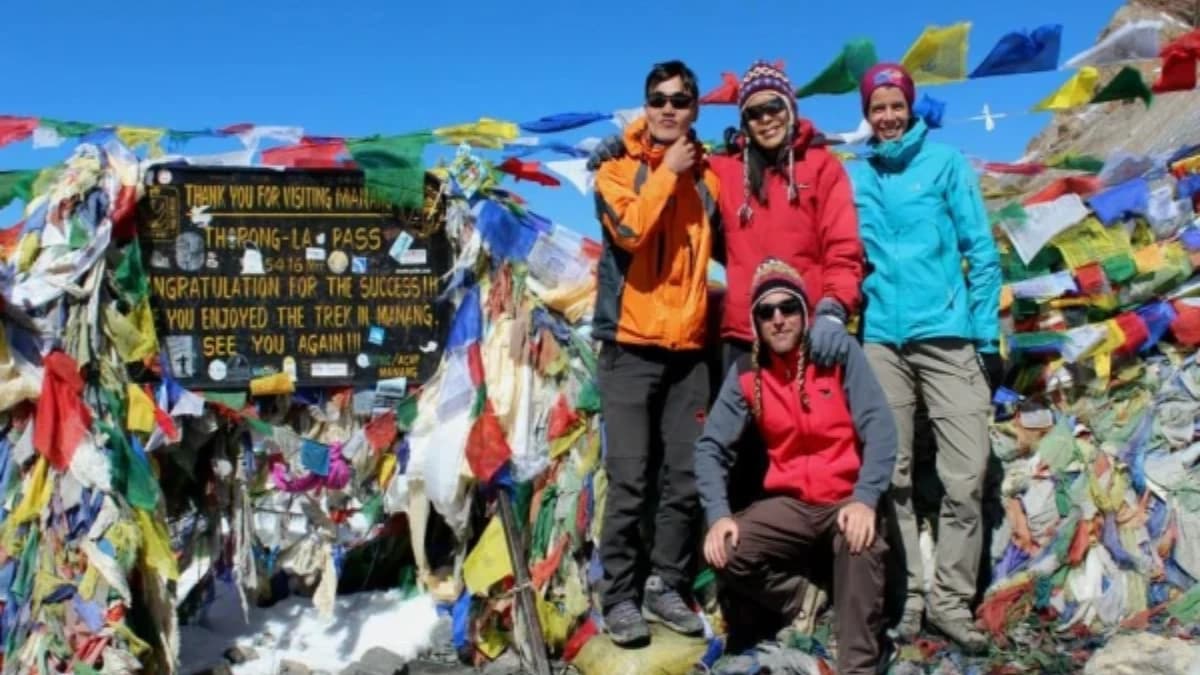
The pass day is the summit of your trek — literally and emotionally. You leave Thorong Phedi before dawn, headtorch on, climbing switchbacks through frozen scree. The altitude is real. The cold is real. But when you stand at the top, surrounded by prayer flags snapping in the wind and the Himalayas stretching in every direction, every hard step is worth it.

The descent through the Kali Gandaki is a study in contrasts. Within hours of standing on snow at 5,416 metres, you are walking through apple orchards in Marpha, tasting locally distilled apple brandy, and watching Dhaulagiri glow orange at sunset. The final day in Pokhara is for resting lakeside, looking back at the Annapurna range you just walked around, and letting it sink in.

Before You Arrive

Please arrive in Kathmandu the day before your trek starts. This gives you time to recover from your international flight, meet your guide, and do any last-minute gear shopping in Thamel if needed. Make sure your Nepal visa and trekking insurance are in order before you fly, and bring enough Nepali rupees for personal spending on the trail. ATMs are available in Kathmandu and Pokhara but not beyond Besisahar, so draw cash before you leave civilisation behind.

Online Briefing

Think of this as our first conversation together. After you book, we schedule a video call where we walk you through everything: what to wear and pack, what the teahouses are really like on the Circuit, how acclimatisation works on this route, what to expect on pass day, and anything else on your mind. No question is too small.

This is also when we learn about you. Our trek itinerary does not include your hotel in Kathmandu — during the briefing, share your preferences and budget, and we will arrange accommodation that fits. Whether you want a simple guesthouse in Thamel or a five-star hotel with a rooftop pool, we will set it up for you.

Transport

All three tiers travel the same route: Kathmandu to Pokhara by road (approximately 6–7 hours), then Pokhara to Besisahar (approximately 4–5 hours) to reach the trailhead. On the return, you travel from Jomsom back to Pokhara by vehicle. The difference between tiers is the vehicle itself. Budget trekkers travel by local tourist bus, which is safe and well-used by Nepalis and travellers alike. Standard trekkers ride in a private tourist vehicle with more legroom and air conditioning. Luxury trekkers get a premium private vehicle. There are no internal flights on this itinerary; everything is by road, which keeps costs down and gives you more of Nepal’s countryside through the window. For a full breakdown of what trekking in Nepal actually costs, see our complete cost guide.

Your Trek, Your Way

Every trek we run is arranged privately for your group. You will not be paired with strangers unless you choose to join a public departure. Whether you book as a solo trekker, a couple, or a group of friends, this itinerary belongs to you. Want to add a rest day? Extend to include Tilicho Lake? Spend an extra night in Manang? We can adjust. Our three tiers (Budget, Standard and Luxury) give you genuine choice over accommodation, meals, porter support and transport without affecting the route itself. Same expert guides. Same safety standards. Three comfort levels. Read more about what the price difference actually buys or explore budget trekking in Nepal.

Difficulty: Very Challenging (5 out of 5)

This trek earns its 5/5 rating. Thorong La Pass at 5,416 metres is the highest point most trekkers will ever reach on foot. The pass day involves 8–10 hours of walking, starting before dawn at around 4,450 metres and ascending over 900 metres of altitude before descending nearly 1,600 metres to Muktinath. Altitude sickness is a genuine concern above Manang, and the combination of cold, thin air, and sustained effort on pass day demands real physical and mental resilience. Daily walking ranges from 5 to 8 hours over uneven terrain, river crossings, and steep ascents. Our guides carry a pulse oximeter and monitor your oxygen levels daily. We also recommend consulting your doctor about Diamox before departure. If you can comfortably walk 6–8 hours a day on hilly terrain and have a reasonable level of fitness, you can do this trek. If you have concerns, read our beginner’s guide.

Compare Our Three Packages

Feature Budget Standard Luxury
Price from USD $572 USD $920 USD $1,400
Meals Not included (order and pay at teahouses) 3 meals daily + tea, fruits and 2L water All meals + all drinks (except alcohol)
Room Shared teahouse room Private twin with attached bathroom Private deluxe with bed heater
Porter Not included 1 porter per 2 trekkers 1 porter per trekker (carry nothing)
Guide 1 guide per group (assistant at 8+) 1 guide per 6 trekkers (assistant at 6+) 1 guide per 2 trekkers
Transport Local vehicle Private tourist vehicle Luxury private vehicle
SIM & Data SIM card only SIM with limited data SIM with unlimited data (see our SIM card guide)
Best for Backpackers and independent travellers Comfort trekkers, couples, families Premium experience seekers

Himalayas for Every Budget. Same expert guides, same safety, three comfort levels. Every tier includes all permits, a Nepal government well-trained guide, airport transfers and 24/7 emergency support. The only things that change are the comfort details. Read our full comparison of what the price difference actually buys or explore luxury trekking in Nepal. Note: in Pokhara, only breakfast is included at your hotel across all tiers; other meals in Pokhara are at your own expense, giving you the freedom to explore the city’s lakeside restaurants. Check our guide on WiFi and charging on the trail so you know what to expect beyond Chame.

Your Trek, Our Family

The Everest Holiday is not a faceless agency. It is a family.

Hari Lal Simkhada, Shreejan’s grandfather, arranged logistics and supported Himalayan expeditions in the 1960s and 1970s, back when reaching Nepal’s high mountains required weeks of approach marching and a willingness to solve problems nobody had solved before. Ganesh Prasad Simkhada, Shreejan’s father, has held senior positions in Nepal’s tourism and mountaineering institutions, helping shape the industry that now brings over 200,000 trekkers to Nepal each year.

Today, Shreejan Simkhada runs The Everest Holiday as CEO and third-generation guide. He personally designs every itinerary, selects every guide, and remains available to trekkers before, during and after their trip. This is not a company where you are handed off to a call centre. When you message us on WhatsApp (+977 9810351300), you are talking to the family.

Our Credentials

  • 196 TripAdvisor Reviews — rated 4.9 out of 5, TripAdvisor Travellers Choice 2024
  • 108+ Google Reviews — rated 4.9 out of 5
  • TAAN Certified — Member #1586, Government Registration: 147653/072/073
  • Secure 10% Deposit — processed through Himalayan Bank Limited, Nepal’s most trusted commercial bank
  • Himalayas for Every Budget — three tiers, one standard of care
  • Three Generations — family guiding in the Himalayas since the 1960s

Solo Trekkers Welcome

Most of our trekkers book alone. It is the single most common booking type we receive, and if you are wondering whether it is strange to trek solo in Nepal, it is not. Nepal’s mandatory guide rule means nobody treks without professional support, and our small groups (2–20 people) mean you will be walking with a handful of like-minded travellers, not a convoy. By day three on the trail, most groups feel like family.

You can book a private departure if you prefer to walk with just your guide, or join a public group to share costs and meet people. Either way, you are not alone out there. Read our solo female trekking guide (the advice applies to everyone, not just women), our notes on Nepal travel etiquette, and our guide to tipping your guide and porter.

Difficulty: Very Challenging (5 out of 5)

Very Challenging (5 out of 5). Here is what that means in practical terms for the Annapurna Circuit.

The maximum altitude is 5,416 metres (17,769ft) at Thorong La Pass. This is well above the threshold where altitude sickness can occur, and the rapid altitude gain from Manang (3,540m) to the pass summit over two trekking days demands respect. The pass day itself is the most physically demanding day most trekkers will experience in Nepal: you start walking between 3:00 and 4:00 AM, climb relentlessly for 4–5 hours through frozen switchbacks, stand briefly at the summit in biting wind, then descend for another 4–5 hours on tired legs to Muktinath. Our guides monitor your oxygen saturation with a pulse oximeter and know when to slow down, when to push on, and when to turn back. We also recommend consulting your doctor about Diamox before departure.

The terrain varies enormously. The early days involve well-maintained trails through villages with stone steps, suspension bridges, and gradual climbs. Above Manang, the trail becomes rockier, more exposed, and less sheltered. The approach to Thorong La is loose scree and frozen ground. The Kali Gandaki section after the pass is flat but notoriously windy, with strong afternoon gusts that can make walking hard work. Bring proper layers, trekking poles, and be prepared for temperatures ranging from 25°C in the lower valleys to minus 15°C at the pass.

Daily walking hours range from 5 to 8 hours, with the pass day stretching to 8–10 hours. You should be comfortable walking uphill for extended periods and ideally have done some hill training before arrival. If you are unsure whether this trek is right for you, our beginner’s guide covers what fitness level is genuinely required, and you can always message Shreejan on WhatsApp for an honest conversation about your readiness.

Trek With a Purpose — Changing the World, One Step at a Time

In 2019, Shreejan Simkhada and Shamjhana Basukala founded the Nagarjun Learning Center in one of Nepal’s most remote communities. Today, 70 children receive free education and hot meals every school day at the centre’s flagship branch in Saldum Village, Dhading District. More than 600 people have received free medical care through annual health camps. 275 women have been reached through support and skills programmes. Seven learning centres now operate across Nepal.

The Nagarjun Learning Center is verified and listed on the UN Partner Portal.

When you trek with us, you are not just crossing a mountain pass. You are building futures. A portion of every booking goes directly to the centre, funding teachers, meals, and internet access for children who had none before. Every trek also upholds our commitment to responsible trekking and porter welfare. You can learn more at nepallearningcenter.com.

What Trekkers Say About This Trek

"Shreejan helped us plan a pace that worked for our fitness level. We never felt pushed beyond our limits and the views exceeded our expectations every single day."

— Google Review, 5 stars

"Shreejan helped us plan a pace that worked for our fitness level. We never felt pushed beyond our limits and the views exceeded our expectations every single day."

— Google Review, 5 stars

Read all 320+ reviews →

Short Itinerary
Day 01: Drive from Kathmandu to Bhulbhule (845m / 2,815ft)
Max Altitude: 845m / 2,815ft
Day 02: Trek from Bhulbhule to Jagat (1,300m / 4,265ft)
Max Altitude: 1,300m / 4,265ft
Day 03: Trek from Jagat to Dharapani (1,860m / 6,102ft)
Max Altitude: 1,860m / 6,102ft
Day 04: Trek from Dharapani to Chame (2,610m / 8,563ft)
Max Altitude: 2,610m / 8,563ft
Day 05: Trek from Chame to Upper Pisang (3,300m / 10,826ft)
Max Altitude: 3,300m / 10,826ft
Day 06: Trek from Upper Pisang to Manang (3,540m / 11,614ft)
Max Altitude: 3,540m / 11,614ft
Day 07: Acclimatisation day in Manang (3,540m / 11,614ft)
Max Altitude: 3,540m / 11,614ft
Day 08: Trek from Manang to Ledar (4,250m / 13,943ft)
Max Altitude: 4,250m / 13,943ft
Day 09: Trek from Ledar to Thorong High Camp (4,925m / 16,158ft)
Max Altitude: 4,925m / 16,158ft
Day 10: Cross Thorong La Pass (5,416m) to Muktinath (3,800m / 12,467ft)
Max Altitude: 3,800m / 12,467ft
Day 11: Drive from Muktinath via Jomsom to Pokhara (820m / 2,690ft)
Max Altitude: 820m / 2,690ft
Day 12: Drive from Pokhara to Kathmandu (1,400m / 4,593ft)
Max Altitude: 1,400m / 4,593ft
Expand
Detailed Itinerary
Day 01:

The journey from Kathmandu takes you west along the Prithvi Highway, following the Trisuli River through deep gorges and terraced hillsides before turning north at Dumre toward the Marsyangdi Valley. The drive is long, approximately eight to nine hours depending on road conditions, but the scenery transforms constantly: from Kathmandu's red-brick sprawl to subtropical lowlands, through riverside market towns, and finally into the narrow valley that marks the beginning of the Annapurna Conservation Area. Budget trekkers travel by local bus, Standard by private vehicle, and Luxury by premium private transport.

Bhulbhule sits at 845 metres beside the Marsyangdi River, surrounded by rice paddies and banana trees. The air is warm and humid here, a world away from the high passes you'll cross in ten days' time. Your teahouse is simple but comfortable, and the dining room serves dal bhat and noodle soup while the river roars through the gorge below. This is your first night on the trail, and your guide will brief you on what lies ahead: twelve days that will take you from subtropical forest to the highest trekking pass in the Annapurna range.

If your route passes through Pokhara en route, only breakfast at your hotel is included. All other meals during drives are at your own expense and choice, giving you freedom to stop at whichever roadside restaurant catches your eye.

Annapurna Circuit Trek — 12 Days — Full Interactive Route Map on Google Maps

Max Altitude: 845m / 2,815ftMeals: Breakfast, Lunch & DinnerAccommodation: Teahouse in BhulbhuleDuration: 7-8 hours
Day 02:

The first full trekking day follows the Marsyangdi River upstream through a gorge that narrows and widens like a breathing chest. The trail crosses the river multiple times on suspension bridges that bounce gently with each step, and passes through villages where stone houses sit among mango and banana trees. The subtropical heat is real today, and you'll be glad of the shade when the trail dips into forest.

Between Bhulbhule and Jagat, you pass through Ngadi and several smaller settlements where the ethnic composition begins to shift. Down here, the villages are predominantly Gurung and Magar, with Hindu temples alongside Buddhist prayer flags. Children in school uniforms wave from doorways, and farmers drive goat herds along the trail. The Annapurna Conservation Area checkpoint at the start of the trail is where your permits are checked for the first time.

Jagat sits at 1,300 metres in a tight section of the gorge, its stone buildings pressed against the cliff face. The village has a distinctly Tibetan feel that hints at the cultural transition ahead: as you gain altitude over the coming days, the Hindu lowlands will gradually give way to Buddhist highland communities. Your teahouse has views down into the gorge, and the sound of the river is a constant companion at this elevation. Drink plenty of water today. The subtropical humidity makes dehydration easy to miss.

Max Altitude: 1,300m / 4,265ftMeals: Breakfast, Lunch & DinnerAccommodation: Teahouse in JagatDuration: 5-6 hoursDistance: 16km / 9.9miles hikeElevation: 445 m/ 1,492 ft.
Day 03:

The trail continues climbing through the Marsyangdi gorge, and today the landscape begins its most dramatic transformation. The subtropical vegetation thins, replaced by temperate oak and rhododendron forests. Waterfalls cascade down cliff faces on both sides of the valley, and the river narrows into rapids that foam white over boulders. You'll pass through Tal, a beautiful village on a flat plain created by an ancient landslide dam, where the river has carved a wide, calm lake that reflects the peaks above.

Between Tal and Dharapani, the trail passes through several small villages where Tibetan Buddhist culture becomes increasingly visible. Mani walls line the path, their stones carved with mantras by generations of pilgrims. Prayer flags stretch between buildings, and small gompas sit on hilltops above the trail. The transition from Hindu lowlands to Buddhist highlands is one of the most fascinating aspects of the Annapurna Circuit, and it happens gradually enough that each village feels like a new chapter.

Dharapani sits at the confluence of the Marsyangdi and Dudh Khola rivers, at the gateway to the Manang district. The village marks the point where the trek leaves the narrow gorge and enters a wider, more open valley. From here, the peaks of the Annapurna range begin to appear above the ridgelines, and the air carries a crispness that tells you the highlands are close. Your guide will check your acclimatisation tonight and discuss the altitude profile for the days ahead.

Max Altitude: 1,860m / 6,102ftMeals: Breakfast, Lunch & DinnerAccommodation: Teahouse in DharapaniDuration: 5-6 hoursDistance: 13 km / 8 mileElevation: 560 m - 1,935ft.
Day 04:

Today the mountains arrive. The trail follows the Marsyangdi upstream through pine forests and past apple orchards, and the peaks of the Annapurna range emerge from behind the ridgelines one by one. Annapurna II (7,937m) appears first, its massive south face catching the morning light. Then Lamjung Himal, then Annapurna IV, until the entire northern skyline is a wall of ice and rock that seems impossibly close.

You'll pass through Bagarchap, where the flat-roofed stone houses and carved wooden windows are distinctly Tibetan in style. Apple orchards line the trail, and if you're trekking in autumn, the trees are heavy with fruit. Local apple brandy is a speciality of this region, and your guide may stop at a farmhouse where you can taste it. The trail crosses the Marsyangdi on a high bridge with views up and down the valley, and the walking alternates between forest sections and open stretches with mountain views.

Chame is the district headquarters of Manang, a proper town with shops, a bank, hot springs, and even a small internet cafe. It sits at 2,610 metres in a wide section of the valley, with Annapurna II looming directly above. The hot springs on the edge of town are free and well worth a soak after the day's walking. Your teahouse in Chame is one of the more comfortable on the circuit, and this is a good place to charge your devices and check WiFi while it's still reliable.

Max Altitude: 2,610m / 8,563ftMeals: Breakfast, Lunch & DinnerAccommodation: Teahouse in ChameDuration: 5-6 hoursDistance: 15.5  km  /  9.6  milesElevation: 750m - 2,460ft.
Day 05:

The trail from Chame enters a magnificent pine forest that runs along the north bank of the Marsyangdi. The trees are enormous, their trunks straight and their canopy filtering the sunlight into shafts of gold. The path is flat and well-maintained through this section, and the walking feels almost effortless after the steeper days below. Then the forest opens, and Annapurna II appears directly ahead, so close and so large that your neck aches looking up at the summit.

You'll pass through Bratang, where a famous apple orchard produces some of the best fruit in the Manang valley. The trail then crosses a high, exposed section where the valley widens dramatically and the first views of the Paungda Danda rock face appear. This sheer cliff, over 1,500 metres high, is one of the most impressive natural walls in the Himalayas. The scale is difficult to process until your guide points out a bird circling halfway up and you realise the wall is twice as high as it looks.

Upper Pisang sits on a hillside at 3,300 metres, overlooking the Marsyangdi valley with a panoramic view that stretches from Annapurna II to Pisang Peak. The village is dominated by a beautiful gompa (Buddhist monastery) perched on the ridge above, and the flat-roofed stone houses are classic Manang architecture. You're above 3,000 metres now, and altitude awareness becomes important. Drink at least three litres of water today, avoid alcohol, and tell your guide immediately if you feel headache or nausea. Your guide carries a pulse oximeter and will check your oxygen levels tonight.

Max Altitude: 3,300m / 10,826ftMeals: Breakfast, Lunch & DinnerAccommodation: Teahouse in Upper PisangDuration: 5-6 hoursDistance: 13.2 km / 8.2 milesElevation: 690m - 2,264 ft.
Day 06:

Today offers two route options, and your guide will recommend the best one based on weather and group fitness. The high route via Ghyaru and Ngawal is longer and more strenuous but rewards you with some of the finest views on the entire circuit: the Annapurna range spread across the southern horizon, Gangapurna glacier glinting in the sun, and the arid, almost Tibetan landscape of the upper Manang valley stretching north. The low route follows the river and is easier but still beautiful, passing through Humde (which has an airstrip) and several small villages.

Either way, you arrive in Manang, the largest settlement in the upper valley and the last significant village before Thorong La. Manang is a fascinating place. The flat-roofed stone houses are stacked up a hillside below Gangapurna (7,455m), whose glacier feeds a turquoise lake at the edge of town. The people here are Manangis, an ethnic group with a unique trading culture that historically held special privileges from Nepal's kings to trade across borders. You'll see this heritage in the well-stocked shops and the cosmopolitan feel of a village at 3,540 metres.

Tomorrow is your acclimatisation day, and Manang is the perfect place for it. There's a Himalayan Rescue Association aid post that offers free daily talks on altitude sickness, a small cinema showing mountain films, bakeries serving surprisingly good cinnamon rolls, and enough cultural sites to fill an entire rest day. The gompa above the village is worth the twenty-minute climb for the views alone.

Max Altitude: 3,540m / 11,614ftMeals: Breakfast, Lunch & DinnerAccommodation: Teahouse in ManangDuration: 6-7 hoursDistance: 16 km / 9.9 milesElevation: 240 m - 787ft
Day 07:

This rest day is not optional. It is built into the itinerary because your body needs time to adjust to the altitude before you climb higher. You've gained nearly 2,700 metres since Bhulbhule, and the next four days will take you above 5,000 metres. Skipping acclimatisation is how altitude sickness happens, and we take it seriously.

The best way to acclimatise is to climb high and sleep low. Your guide will lead an optional hike to the Gangapurna viewpoint (approximately 3,800m) or to the ice lake above Manang (4,600m for the ambitious). Either option gives your body a taste of higher altitude while returning to sleep at 3,540 metres. The views from the viewpoint are exceptional: Gangapurna glacier in the foreground, Annapurna III behind it, and the vast brown expanse of the Manang valley below.

If you prefer a gentler day, the Himalayan Rescue Association aid post runs a free lecture on altitude sickness every afternoon that is genuinely worth attending. The doctors who staff the post during trekking season have seen everything, and their practical advice on hydration, pacing, and when to turn back could save your life. We also recommend consulting your doctor about Diamox before departure.

Manang has reliable WiFi and charging, so this is a good day to contact home, update your social media, or simply sit in a sunny bakery with a coffee and a cinnamon roll and watch the clouds drift around the peaks. Tomorrow, you leave civilisation behind.

Max Altitude: 3,540m / 11,614ftMeals: Breakfast, Lunch & DinnerAccommodation: Teahouse in Manang
Day 08:

You leave Manang on a trail that climbs steadily through an increasingly barren landscape. The apple orchards and pine forests are behind you now, replaced by dry scrub, wind-scoured ridges, and occasional yak herds grazing on sparse grass. The trail follows the Jharsang Khola valley northward, and the mountains close in on both sides. To the east, the Chulu peaks rise in a line of ice. To the west, the Annapurna massif blocks the sky. Ahead, somewhere above the clouds, Thorong La is waiting.

You'll pass through Yak Kharka (3,800m), a seasonal yak herding settlement where stone corrals and a few teahouses sit on a wind-blasted plateau. The air is noticeably thinner now, and the walking pace that felt comfortable at 2,000 metres requires conscious effort here. Your guide will set a deliberate pace, stopping frequently and monitoring the group for any signs of altitude distress. Drink water constantly. Eat well at lunch even if your appetite has diminished. The calories matter up here.

Ledar sits at 4,250 metres in a narrow valley with views up toward the pass. The settlement is small, just a handful of teahouses built to serve Circuit trekkers, and the facilities are basic. Nights are cold, often dropping below minus ten, and you'll be grateful for the sleeping bag and down jacket included with all our tiers. Your guide will check oxygen levels tonight and discuss tomorrow's plan: the final approach to Thorong La High Camp. From this point forward, every step takes you deeper into serious mountain territory.

Max Altitude: 4,250m / 13,943ftMeals: Breakfast, Lunch & DinnerAccommodation: Teahouse in LedarDuration: 5-6 hoursDistance: 9.1 km / 5.6 mileElevation: 710 m - 2,329ft.
Day 09:

Today is short in distance but significant in altitude. You gain approximately 675 metres in just three to four hours of walking, and by the time you reach Thorong High Camp you'll be sleeping at nearly 5,000 metres. The trail follows the valley floor through a landscape of rock and ice, with glacial streams cutting across the path and the pass visible as a snow-dusted notch on the ridge above. Every breath feels like it contains slightly less oxygen than the last.

Thorong Phedi (4,450m) is the traditional base for the pass crossing, a cluster of stone lodges in a hollow below the final climb. Some groups stop here, but our itinerary pushes to High Camp (4,925m), roughly an hour higher up the slope. The advantage is significant: starting from High Camp tomorrow means a shorter, less exhausting crossing day, and less total altitude gain when you're at your most vulnerable. Your guide has made this calculation many times, and it is the right one.

High Camp is exposed and basic. The teahouse is a stone building with a metal roof, and the wind can be relentless. Your sleeping bag and down jacket are essential tonight. Dinner is early because you need to sleep by seven or eight to be ready for a four or five AM start tomorrow. Your guide will brief you on the crossing: headlamps on, warm layers, slow and steady pace, and an absolute commitment to turning back if anyone shows serious altitude symptoms. The pass is not negotiable with the mountain. You go when conditions allow and your body cooperates.

Try to sleep. The altitude makes it difficult, and the cold doesn't help, but whatever rest you can get matters. Tomorrow is the biggest day of the trek.

Max Altitude: 4,925m / 16,158ftMeals: Breakfast, Lunch & DinnerAccommodation: Teahouse at High CampDuration: 7-8 hoursDistance: 7.3km/4.5 milesElevation: 675 m/2,215 ft
Day 10:

You wake in darkness. Headlamp on, boots laced, down jacket zipped to the chin. The air is thin enough to make tying your shoelaces feel like exercise. Your guide has tea ready, and after a light breakfast you step outside into a sky thick with stars. The trail climbs from High Camp toward the pass in a series of switchbacks across loose rock and frozen scree. The pace is deliberately slow. One step, breathe. Another step, breathe. The altitude strips away everything except the next footfall and the next breath.

Thorong La is reached in approximately three to four hours from High Camp. At 5,416 metres (17,769 feet), it is the highest point on the Annapurna Circuit and one of the highest trekking passes in the world. The pass itself is a wide, windswept saddle marked with prayer flags that snap in the wind like applause. On a clear day, you can see Dhaulagiri (8,167m) to the west and the peaks of the Annapurna massif stretching south. You made it. Stand there. Breathe. Let the moment register before the cold and the altitude remind you that you can't stay.

The descent to Muktinath drops 1,600 metres in roughly four hours, and it is as dramatic as the climb was gruelling. The landscape transforms from high-altitude scree to dry alpine meadows, then to the brown, wind-eroded terrain of the Mustang corridor. Muktinath is a sacred pilgrimage site for both Hindus and Buddhists, home to the Jwala Mai temple where natural gas flames burn behind a waterfall, and 108 stone water spouts that pilgrims bathe beneath. After the intensity of the pass, Muktinath feels like a reward. Warm beds, proper meals, and the deepest sleep of the entire trek.

Max Altitude: 3,800m / 12,467ftMeals: Breakfast, Lunch & DinnerAccommodation: Teahouse in MuktinathDuration: 5-6 hoursDistance: 15.6 km/9.6 mileElevation: 491 m/1,601 ft and a descent of 1,656 m/5,429 ft
Day 11:

The drive from Muktinath to Pokhara follows the Kali Gandaki gorge, one of the deepest in the world, with Dhaulagiri on one side and the Annapurna massif on the other. The road passes through Jomsom, the district headquarters of Mustang, where the wind that funnels through the gorge can rattle windows and sandblast exposed skin. Beyond Jomsom, you'll drive through Marpha, a whitewashed village famous for its apple orchards and apple brandy, and Tatopani, where natural hot springs steam beside the river.

The drive takes approximately eight to ten hours depending on road conditions. The road surface varies from paved to rough gravel, and some sections are carved directly into cliff faces above the river. It is adventurous driving, but the scenery is extraordinary. You'll see the landscape change from the brown arid highlands of Mustang to the green, forested hills of the Annapurna foothills, a geological and cultural transition compressed into a single day.

Arriving in Pokhara, the warm lakeside air and the sound of restaurant music feel like a different country after the silence of the high passes. Your hotel is in the Lakeside district, and the evening is free. Breakfast is included at your Pokhara hotel across all tiers. Lunch and dinner are at your own choice and expense, giving you freedom to explore Pokhara's excellent restaurant scene. After twelve days on the trail, a lakeside pizza or a Nepali thali set tastes extraordinary.

Max Altitude: 820m / 2,690ftMeals: Breakfast, Lunch & DinnerAccommodation: Hotel in PokharaDuration: 8-9 hoursDistance: 174 km/108 mileElevation: 2,936m - 9,632ft.
Day 12:

After breakfast at your Pokhara hotel, you'll start the seven to eight hour drive back to Kathmandu along the Prithvi Highway. The road follows the Trisuli River through gorges and past terraced hillsides, and the journey feels different now that you've crossed Thorong La and walked through every climate zone Nepal has to offer. The mountains you see from the highway are mountains you've walked through, and that changes how they look from a car window.

Your driver will stop at riverside restaurants for lunch (at your own expense) and tea breaks. The drive passes faster than you expect when you're trading stories about the pass crossing, comparing photographs, and watching the countryside scroll past in shades of green and gold.

Back in Kathmandu, the farewell dinner with your guide and the team is where certificates are handed out, contact details are swapped, and everyone tries to describe what crossing Thorong La felt like. The words never quite capture it, but the attempt is part of the ritual. If you have time in Kathmandu, consider a Dhulikhel Namobuddha day hike, a visit to Bhaktapur, or a flight to Chitwan National Park.

You crossed the highest trekking pass on the Annapurna Circuit. You walked from rice paddies to glaciers and back. Whatever comes next, that stays with you.

Interactive Route Map

Explore the full trek route on our interactive Google Map. Click markers for altitude details at each stop.

Open Full Route Map in Google Maps

Max Altitude: 1,400m / 4,593ftDuration: 7-8 hoursDistance: 200 km/124milesElevation: 528 m-1,732 ft.
Couldn't find what you're after?Reach out to our travel experts.
Customise Trip
Route Map
Annapurna Circuit Trek Route Map Nepal
Altitude Chart
The Annapurna Circuit Trek- 12 Days
Availability
Book your own private small group trip
No. of travellers
Price per person
2 - 4 pax
US$555
5 - 8 pax
US$520
9 - 12 pax
US$480
13 - 20 pax
US$390

Discounts are determined exclusively by the size of your group. We do not add additional members to your group.

Book Now
hbl logo
Secure Payment by Himalayan Bank.
Cost Includes

Transportation

  • Airport Pick-up and Drop-off from Tribhuvan International Airport to the Hotel of your choice. 
  • Transportation from Kathmandu to Bhulbhule  (trek start point) and from Muktinath  to Pokhara  (trek end point) back to Kathmandu by local transportation. 

Accommodation and food

  • Accommodation in Pokhara at a tourist hotel with breakfast. 
  • No meals are provided during the drive from Kathmandu to Pokhara and back.

Guide and porter

  • An English-speaking, Nepal government well-trained guide is provided (one guide for your group). For groups of 8 or more trekkers, an additional assistant guide is included. For more than 8 trekkers, 1 assistant guide is added.
  • Porter is not included, only the guide.

Permits and Expenses

  • Annapurna Conservation Area Permit (ACAP) Fee.
  • Trekkers Information Management System (TIMS) card fee.
  • All government taxes and official expenses.

Medical Assistance

  • First aid kits are provided, including an oximeter to check blood oxygen levels at high altitudes.
  • Arranging rescue operations in case of an emergency health condition (funded by the trekker's travel insurance)

Complimentary

  • Company's T-shirt and Cap before the trek.
  • At the end of your trip, you'll have a farewell meal at a restaurant in the area. At the farewell dinner after the Annapurna Circuit Trek—12 Days, we will provide you a certificate of achievement for successful completion of the trek. 

Benefits

  • Sleeping bags and down jackets: if you do not have your own, please inform us either at your online briefing or after the arrival briefing in Kathmandu before your trek so we can provide you with one for your use during the trek.
  • Free Excess luggage storage at The Everest Holiday store for the duration of the trek.
  • We will arrange a SIM Card for every individual trekker upon arrival in Kathmandu and teach them how to get budget internet packages and top up their services.
Cost Excludes

International Flight

  • International flight cost.

Nepali Visa

  • At Tribhuvan International Airport, you can pay the following fees upon arrival: $30 for a 15-day visa, $50 for a 30-day visa, and $120 for a 90-day visa. Alternatively, you can apply for and receive a Nepal visa from the Nepalese embassy or consulate in your country.

(Note: Anyone having a visa before arrival has an express exit through the immigration line. To obtain a visa upon arrival at TIA Kathmandu, you must have the necessary funds in US dollars.)

Accommodation

  • Accommodation in Kathmandu before and after the trek will not be included in this package. So, please let us know your preferences, budget, and standard of the hotel you would like to stay in Kathmandu during the online meeting. So we can arrange it for you accordingly.

Guide and Porter

  • Tip for guides and porters. (Recommended)

Other expenses

  • Excess luggage charges for an extra porter to carry luggage and also any extra cost charged by the airline for extra luggage, as there is no porter in the budget service package; any extra porter service will be charged extra. 
  • All non-alcoholic drinks like bottled water, hot water, soft drinks, juice, tea, coffee and alcoholic drinks are not included, etc.
  • Additional costs due to delays caused by circumstances out of our control, like landslides, unfavourable weather, itinerary modification due to safety concerns, illness, changes in government policies, strikes, etc.

Equipment Lists

Only pack what’s needed for the trek to travel light and comfortably. You can store your excess luggage at The Everest Holiday for free. Porters will carry your main trekking bag, but the weight limit is 10 kg for each trekker. Since one porter carries the luggage for two people, we suggest that you and a trekking partner share one large duffel bag (over 60 Liters).

  • Sun hat (wide-brimmed)
  • Beanie (for warmth)
  • A neck gaiter or buff (for warmth and sun protection)
  • Sunglasses with UV protection
  • Insulated gloves or mittens (for cold weather)
  • Waterproof gloves (for wet conditions)
  • A thick-wool or synthetic pair of moisture-wicking socks
  • waterproof hiking boots with ankle support and excellent traction
  • Sandals (for camp use or river crossings)
  • Gaiters protect
  • Moisture-wicking t-shirts (short and long sleeves)
  • Thermal base layer (for colder conditions)
  • Fleece jacket and down jacket (Mandatory)
  • Lightweight puffy jacket (for extra warmth)
  • Waterproof and windproof jacket (Gore-Tex or similar)
  • Raincoat
  • Lightweight, breathable long-sleeve shirt
  • Polypropylene underwear (four)
  • Quick-drying pants/trousers (convertible or full-length)
  • Insulated pants (for colder conditions)
  • Lightweight cotton pants
  • Wear long underwear or thermal leggings when it is cold.
  • Two pairs of thermal/trekking trousers (pants)
  • Biodegradable bar soap
  • Toothbrush and toothpaste
  • Medium-sized drying towel
  • Wet wipes or hand sanitizers
  • The toilet paper is stored in a Ziplock bag.
  • Feminine hygiene products
  • Travel-sized shampoo
  • Nail clippers
  • Small mirror
  • A duffel bag with a capacity of over 60 litres is intended for porters, with one duffel bag for every trekker.
  • An individual's daypack or backpack with a 20- or 30-litre capacity should be plenty.
  • Adjustable and lightweight poles (preferably collapsible)
  • A two-litre water bladder or bottle (with a protective cover for cold climates)
  • Use water purification methods such as purification tablets, filter bottles, or UV filters.
  • Camera/smartphone (extra memory cards and batteries)
  • A portable charger, spare batteries, or a battery pack
  • Two-pin charging plug
  • Basic first aid supplies include band-aids, antiseptic wipes, pain relievers, and Diamox (which is used to prevent or lessen symptoms related to mountain sickness).
  • Personal medications (inhalers, allergy meds, etc.)
  • Few passport-size photos
  • Passport photocopies
  • Notebook and pen
  • Binoculars
  • Basic first aid kit (band-aids, antiseptic wipes, pain relievers, etc.)
  • Diamox (for altitude sickness prevention/relief)
  • Personal medications (inhalers, allergy meds, etc.)
  • Water purification (tablets, filter bottle, UV filter)
  • Energy bar
  • Lightweight headlamp (with adjustable brightness)
  • Face wipes
  • An extra pair of batteries
Essential Information

Annapurna Circuit Trek 12-day information

Welcome, Arrival, and Start of the 12-day 

When you arrive at Tribhuvan International Airport,our representative will be there to greet you.They will be holding a sign with your name on it and will welcome you with a traditional marigold garland or Khada. Afterward, they will drive you to your hotel in a private car. Please make sure you get to Kathmandu at least one day before your trek so you can get ready and go over the details.On the first day, we'll go on a jeep  or bus and have a beautiful 7–9 hour journey. On the trek departure day, you’ll head to Bhulbhule on a local bus or jeep.

For detailed information about accommodation, food, gear, permits, weather, and costs, please see the Frequently Asked Questions section below and the What's Included section above.

Currency Exchange

The Nepali Rupee (NPR) is the local currency. ATMs are available in Kathmandu, Pokhara, and major towns. Credit cards are accepted at larger hotels and restaurants but not at smaller shops or on remote trails.

We recommend carrying cash in NPR for daily expenses. USD, GBP, EUR, and AUD can be exchanged at banks and money changers in Kathmandu.

Personal trek

We can only provide a personal trek, so you will only be trekking with your group. We will never add strangers to your treks. All the treks are customizable per your schedule.

Flexible Schedule

Our trip schedule is determined by your travel date, and you can make any changes to it. If our scheduled trek dates don't work for you, please let us know, and we will be happy to arrange a trip according to your time and schedule.

Trip Extension

You can easily extend your stay with other adventures. We can arrange exciting activities for you, such as a jungle safari (Chitwan and Bardiya), bungee jumping (Pokhara, Bhote Koshi, and Kushma), rafting (Bhote Koshi, Trishuli, and Seti River), kayaking (Trishuli and Pokhara), paragliding (Pokhara and Kathmandu), zip-flying (Kathmandu, Pokhara, and Kushma), canyoning (Pokhara and Sukhuta Beach), and hot air ballooning (Pokhara), according to your interests. We can also set up sightseeing tours around the Kathmandu Valley if you're interested in culture and history.

These tours will take you to UNESCO World Heritage sites like Bhaktapur Durbar Square, Patan Durbar Square, Kathmandu Durbar Square, Swayambhunath (Monkey Temple), Boudhanath  Stupa,  Changunarayan  Temple,  and  Pashupatinath  Temple.  We  suggest  a  trip  to Nagarkot  and  Dhulikhel,  hill  stations  just  outside  of  Kathmandu,  around  sunrise  for  a  serene getaway. We can also set up spiritual trips for Buddhists and Hindus that take you to temples, stupas, monasteries, and meditation centres. When you're booking a trip, please have a look at our ADD-ON package for an amazing adventure during the trek.

Ecotourism practices

We ask that you join our eco-friendly hiking practice because we are very dedicated to keeping the Annapurna region's fragile beauty safe. At the start of our excursion, each person will obtain their  own  eco-waste  bag.  Please  put  all  of  your  rubbish  that  can't  be  composted,  like  snack wrappers, plastic bottles, and batteries, in this bag. Don't leave anything on the trail, please. Instead, take this bag with you as we walk down, and our guides will show you where to find the public trash cans and recycling bins where you can throw it away correctly. We need your help to keep the Himalayas clean and lovely for the next generation.

TEH Family 

We are a family firm that has been in the tourism business in Nepal for three generations. We believe that all of our employees and teams are family. we started as porters and now run an agency. Our professional and experienced guides and Sherpas will be with you the whole time to make sure your trek is safe and memorable. They know how to do first aid in the bush and rock climbing and how to stay safe in the mountains. They also speak good English. They are from the upper Himalayas, so they know the area well. We take care of their insurance, food, housing, and medical. Please treat our workers like family, and don't hesitate to ask for help or have questions at any time.

Trip conclusion 

Farewell Dinner 

We will have a farewell meal for you in Kathmandu after the trek to remember your trek.  This is a great opportunity to share stories from your adventure and provide us with your feedback. We will also present you with a certificate of achievement to recognise your incredible accomplishment.

Departure 

To arrange your airport transfer, please let us know your hotel name, room number, and flight departure details. We will take you from your hotel to Tribhuvan International Airport so you may catch your trip home. We hope you had an amazing time and can't wait to see you back in Nepal for another trek.

Accommodation

The Annapurna Circuit is a 12-day trek with lodge-to-lodge accommodation. You will stay at local teahouses and lodges along the trail. Facilities vary by altitude — lodges in lower areas like Besisahar and Chame have hot showers, electricity, and Wi-Fi, while higher lodges near Thorong La have more basic facilities. You will need at least two additional nights in Kathmandu, but our package does not cover them.

Each tier (Budget, Standard, Luxury) includes different accommodation, meals, and extras. Full details in the What’s Included section above.

Meal

The menu primarily includes traditional Nepali, Asian, and Western dishes on the trek. We highly recommend sticking to healthy and hydrating options like fresh vegetables, green tea, hot lemon, ginger tea, and garlic soup. For a hearty and energising meal, try the local favourite, Dal Bhat Tarkari (lentil soup, rice, and vegetable curry). The package does not include personal expenses such as alcoholic drinks, tea, coffee, cold drinks, or snacks at teahouses or cafes.

Facilities and Essentials

Hot showers, electricity for charging devices, and Wi-Fi are available at most lodges along the Annapurna Circuit, but these may cost extra (around NPR 200-500 per use). At higher altitudes near Thorong La and Muktinath, facilities are more basic. Charging your devices may cost USD 2-5 per charge above 3,500m.

Travel Essentials

Travel Essentials

Bring copies of your passport, visa, insurance policy, and emergency contact details. Keep digital copies on your phone as well. A good headlamp, reusable water bottle, and layered clothing system are essential. Your guide will brief you on everything before departure.

Visa

Foreigners require a visa to enter Nepal, but Indians do not. Most people can get a visa when they arrive at Kathmandu International Airport. The current fee is USD 50 for 30 days, payable in cash. Citizens of China and SAARC countries receive a free visa. We also recommend you inform your country’s embassy or consulate of your visit to Nepal and your travel partner here.

Travel Insurance

This trek crosses Thorong La Pass at 5,416m, so there is a real risk of altitude sickness and other hazards. Travel insurance is mandatory. Your policy must cover medical expenses and emergency helicopter rescue up to an altitude of 6,000 metres. We ask our clients to provide detailed insurance information within a week of booking. In case of an emergency, we will use your insurance details to arrange a quick evacuation and transfer to medical facilities in Kathmandu.

Extra Expense

While the package covers most costs, you should budget for personal expenses such as hot showers (NPR 200-500), device charging (NPR 200-500), drinks, snacks, and souvenirs.

At higher altitudes, prices increase. We recommend carrying NPR 20,000-30,000 in cash for extras along the trail. Tips for your guide and porters are also at your discretion.

Trek Season and Weather Conditions

The best time to do the Annapurna Circuit is during spring (March to May) and autumn (September to November). During these months, the weather is generally clear, with warm days and cool nights, offering the best views of the Annapurna range, Dhaulagiri, and Manaslu.

In spring (March to May), the weather is mild, rhododendrons bloom along the trail, and the landscape is colourful. Autumn offers the clearest skies with little chance of rain.

During winter (December–February), the trail is quieter but Thorong La Pass may be closed due to heavy snowfall. Summer (June–August) is monsoon season with heavy rain, leeches on lower trails, and limited visibility, though the rain shadow area of Upper Manang stays relatively dry.

Typical Day

We will start each morning with an early breakfast. The day’s trek is usually split into two parts: 4-5 hours of trekking in the morning, followed by a one-hour lunch break, and then a shorter trek in the afternoon. Dinner is served around 7:00 p.m., and our guide will brief you on the plan for the next day. The rest of the evening is yours to relax, explore the village, or enjoy some downtime with your fellow trekkers.

Trek Booking

Trek Booking

To confirm your Annapurna Circuit booking, we require a 10% advance payment. The balance is due 60 days before your departure date. Payment is processed securely through Himalayan Bank Limited’s online portal on our website.

Individual to Group Booking

Our treks are organised with a minimum of 2 people. If you are travelling alone and do not have a friend or family member joining, we can organise a group trek open to all. If you prefer to join a group, we can help you connect with other trekkers. Once you confirm, your group trek will be posted on our website so others can join too. This is our policy to make every trek into your own personal holiday in the Himalayas.

Trust Trek Booking

The Everest Holiday is a registered and bonded trekking operator, ensuring a secure booking process. We are proudly members of the Trekking Agency Association of Nepal (TAAN) and the Nepal Mountaineering Association (NMA). Ganesh Prasad Simkhada, Shreejan’s father, has held senior positions in Nepal’s tourism and mountaineering institutions. To confirm your booking, we require a 10% advance payment.

Payment options include the Himalayan Bank online portal (on our website), major credit cards, or bank transfer via Wise. The remaining balance is due at least 60 days before your departure.

Last-Minute Booking

We recommend booking your trek in advance. However, we also offer a last-minute booking option, which requires full payment 24 hours before departure. For last-minute bookings, please contact Shreejan at +977-9810351300 or email us at info@theeverestholiday.com. Please note that last-minute treks may face delays due to circumstances beyond our control.

Tipping

Tipping is a common practice in Nepal. We recommend giving a group tip to your guide and porters at the end of the trek. The amount is up to you and can depend on the quality of service, trip length, your budget, and the overall cost of the trek.

Facilities and Essentials

Water

You can buy bottled water from shops along the trekking route or drink boiled or filtered water provided at the lodges. We strongly recommend bringing a reusable water bottle and refilling it with boiled water to help reduce plastic waste. Avoid drinking untreated tap, river, or well water, as it may cause sickness. For added safety, carry water purification tablets or buy them at local shops on the trail. Drinking plenty of water at high altitudes is essential to avoid altitude sickness and keep your energy up.

Budget: A SIM card will be provided, and you will be taught how to take a data package and recharge, but the data is not included.

Standard: A SIM card with a limited data package already set up for you.

Luxury: A SIM card with an unlimited data package already set up for you.

Luggage

We provide one porter for every two trekkers. Each trekker’s luggage limit is 10 kg, so a porter will carry no more than 20 kg in total. We never overload our porters. You will still need to carry a small backpack for your valuables. We recommend bringing only essentials. Extra baggage can be stored for free at your hotel or with us. All luggage and gear will be checked before the trek begins.

Budget: There are no porters, so you will need to carry your own backpack and belongings throughout the trek.

Standard: There will be one porter for every two trekkers, who carry up to 20 kg (10 kg per person).

Luxury: Each trekker has their own personal porter, so you don’t need to carry anything.

FAQs

Q1. How far do you walk on the Annapurna Circuit hike over 14 days?
The trek usually covers around 160–230 km, depending on the route variations and whether side trips are included. Distances vary because of new roads that shorten certain sections. On average, trekkers walk 6–7 hours daily, covering 10–15 km per day.

Q2. How challenging is it to cross the Thorong La Pass (5,416 m/17,769 ft), and how is it done?
The highest and most challenging part of the circuit is Thorong La, which requires starting early in the morning and keeping a steady pace. To lower the hazards of high altitude, trekkers generally become used to the area in Manang before crossing. Guides help keep you safe and make sure you get to the pass at the right time.

Q3. Is this trek good for those who are going alone and don't have much expertise at high altitudes?
Yes, although it's harder than shorter hikes like Poon Hill or ABC. People who hike alone need to be ready for long days of trekking, different weather, and the dangers of being at high altitudes. For safety and assistance, it is highly advised that you hire a guide or join a group.

Q1. How can I get to the start of the trek?
The trip normally starts with a journey from Kathmandu to Besisahar or even further to Dharapani.  There are buses and private jeeps you may hire. Jeeps are speedier and more comfortable.

Q2. What is the plan for getting back from the conclusion of the circuit?
From Jomsom, hikers may either fly to Pokhara (if the weather is good) or drive there through Tatopani and Beni.  A lot of people like the road trip since it's more reliable.

Q3. Are there any parts of the road that might change the usual trekking route?
Yes, roads have made some portions of the lower circuit shorter, including the ones between Besisahar and Manang and Muktinath and Jomsom. A lot of hikers now avoid the road parts and focus on the beautiful trail parts.

Q1. How far in advance should I book this popular trek?
You need to deposit 10% to finalize a booking. Booking early is a good idea during peak times. You can make last-minute plans, but they are less adaptable.

Q2. Do prices for the Annapurna Circuit change with the seasons?
Yes, prices are slightly higher during peak seasons (spring and fall) due to increased demand. Treks in the winter and monsoon are cheaper but not as popular. The cost of accommodation is very much the same all year round.

Q3. What ways may foreign hikers pay?
Agencies will take bank transfers, credit cards, and cash in either USD or NPR. You may only pay in cash (Nepali rupees) during the hike. You can find ATMs in larger towns, such as Jomsom and Besisahar.

Q1. What kind of gear do you need to cross the Thorong La Pass?
You need warm layers, a down jacket, a windproof outer shell, and thermal gloves. For steep parts, trekking poles are really helpful. On ice paths, good footwear with grip is helpful.

Q2. What should I bring on this walk to deal with the different weather?
 Wear layers: light garments for warm lowlands and warm ones for chilly high passes. Bring hats, sunscreen, and rain clothing for different weather. It is best to use a sleeping bag that can handle temperatures as low as -10°C.

Q3. Can I rent gear throughout the circuit?
Yes, you may rent gear in either Kathmandu or Pokhara. You can also find certain things in Manang, but they cost more, and there aren't as many options. Before you start, it's best to set up your gear.

Q1. What is the timeline for getting used to this trek?
 Most travel plans have at least one day of relaxation and acclimatisation in Manang (3,500 m).  Some people additionally add a day in Pisang or beyond the pass, depending on how fast they go.  This lowers the chance of becoming sick from being at a high altitude.

Q2. How do you deal with AMS (Acute Mountain Sickness) in the high-altitude areas?
Rest, drink plenty of water, and go up slowly if you have mild symptoms. If symptoms get worse, the best thing to do is to go down. Guides have first-aid supplies, and anybody who is really hurt needs to be evacuated.

Q3. What steps have been taken to make the Thorong La Pass crossing safe?
People who hike start early in the morning to avoid severe winds and snow. Guides keep a watchful eye on the weather and change the pace. It is important to know how to layer your clothes, stay hydrated, and be mindful of your altitude.

Q1. What months are optimal for traversing Thorong La Pass?
The best times to visit are in the spring (March to May) and fall (September to November), when the weather is consistent and the sky are clear. Crossing in the winter is doable, but it's dangerous because of the snow and cold. During the monsoon months, landslides and bad visibility happen.

Q2. What are the differences in weather between the northern and southern parts of the circuit?
The southern part is wetter and greener because of the monsoon. The northern part, notably Manang and Mustang, is drier and less fertile, with better sky. This makes the landscapes look very different from each other.

Q3. What do you do if the weather is severe and you can't cross Thorong La Pass?
People who are trekking frequently wait in Thorong Phedi or High Camp for better weather. If the weather stays bad, guides may suggest going back the same way. Safety always comes before finishing the crossing.

Q1. What happens to the diversity of meals as we go up the circuit?
There are a lot of different dishes on the menus in the lower villages, such as Nepali, Tibetan, and Western foods. As you go higher, there are fewer choices for meals, such as dal bhat, noodles, and soups.  Fresh meat and veggies are harder to find.

Q2. Are there any special dietary needs for those who live at high altitudes?
For energy, it's best to eat warm meals with many carbs. Stay away from heavy meat dishes since digestion slows down at high altitudes. Staying hydrated is also important for keeping your energy up.

Q3. What are some good ways to stay hydrated in arid, high-altitude areas?
Drink three to four liters of water every day and use filters or pills to clean it. Hot soups and drinks are also good for keeping you hydrated. Don't drink alcohol at high altitudes.

Q1. How good is the lodging in settlements at higher altitudes, like Manang?
 Manang boasts some of the greatest lodges on the circuit. They provide individual rooms, cooked meals, and bakeries. As you get higher, the facilities are simpler, but they are still pleasant for hikers. In tiny settlements, people often share restrooms.

Q2. Are there places to charge your phone throughout the circuit?
 Yes, most tea places let you charge your phone and camera, but the higher you go, the more it costs. Some places that are far away get their power from solar panels; thus, charging may take longer. It is a good idea to bring a power bank.

Q3. What are the differences in accommodations between the east and west sides of the circuit?
The eastern side (Besisahar to Manang) is less developed and has simpler tea shops. The western side, from Muktinath to Jomsom, is more developed and has better cuisine, housing, and even roads. After the pass, comfort usually goes up.

Q1. How much experience do guides have with high-altitude crossings like Thorong La?
 In this area, licensed guides are quite knowledgeable and skilled in crossing Thorong La. They know the best ways to get used to the weather, the best ways to be safe, and the best ways to get used to the weather. Their knowledge is very important for a safe and successful pass day.

Q2. What kind of help do hikers get on the day of the pass crossing?
Guides decide when to leave, keep the group moving at a steady pace, and look for signs of altitude sickness. Porters carry things for trekkers so they can save energy. For further help, bigger groups frequently move with guides.

Q3. Are there more staff members to help with this difficult hike for bigger groups?
Yes, bigger groups usually have more than one guide, porter, and occasionally even an assistant leader. This makes sure that hikers are safe and get personal attention. It also lets the gang break up if they need to keep up.

Q1. What elevation coverage do you need for insurance on this journey, especially for Thorong La?
Since Thorong La lies at 5,416 m, your insurance should cover hiking up to 5,500 m. Before you buy, make sure to confirm that your policy covers at least 4,000 m. Helicopter evacuation should also be included.

Q2. Do you need a longer visa for this longer trek?
The trip will take from 14 to 18 days, including travel time; therefore, a 30-day tourist visa for Nepal is a good idea. If you require one, you can get a visa extension in Kathmandu or Pokhara. Most people who go on the journey finish it easily within this time limit.

Q3. Does my insurance need to cover getting me out of high-altitude places in an emergency?
Yes, it is very important to have helicopter evacuation coverage. In rural places, medical facilities are few and far between, and helicopter rescue is the only safe way to get help in an emergency. Your policy should say that trekking in Nepal is covered.

Q1. What extra permissions do you need for the Annapurna Circuit that you don't need for other treks?
The Annapurna Conservation Area Permit (ACAP) and the Trekkers' Information Management System (TIMS) card are both needed. These are the same as the ones for most hikes in the area. You don't need any more permits to climb to the top.

Q2. Do we need any more permissions to go to the Manang or Mustang areas?
Manang is in ACAP, thus you don't need a special permit. You need a special restricted area pass to get into Upper Mustang, though. This permit is different and costs extra. Most of the normal Annapurna Circuit routes don't go into Upper Mustang.

Q3. How do you deal with the permits at the many checkpoints around the circuit?
At places like Besisahar, Dharapani, and Jomsom, permits are verified at a number of entry and departure points. You have to have them with you at all times. Guides normally take care of them, but people who go alone should keep them close by.

Q1. What kind of fitness training should I do to cross Thorong La Pass?
 Hiking, jogging, and biking are all good cardio workouts that get your lungs ready for high altitudes. Strength training for your legs and core stability can help you climb and descend difficult hills. Carry a backpack around to become acquainted with the circumstances you'll be walking in.

Q2. What should I do to get ready for the big variations in elevation on this trek?
To build up your stamina, hike farther and higher during your exercise. Plan for acclimatisation days, especially in Manang, so that you can acclimate safely. Also, learning to pace yourself and drink enough water will help you deal with the strain of being at a high altitude.

Q3. Are there any age limits or suggestions for this trek?
 There are no formal age limits; however, hikers should be in excellent health.  With the right training, kids over 5 and adults up to 85 have been able to finish the walk.  Before going on a walk, older people should see a doctor.

How far do you walk on the Annapurna Circuit hike over 14 days?
The trek usually covers around 160–230 km, depending on the route variations and whether side trips are included. Distances vary because of new roads that shorten certain sections. On average, trekkers walk 6–7 hours daily, covering 10–15 km per day.

How challenging is it to cross the Thorong La Pass (5,416 m/17,769 ft), and how is it done?
The highest and most challenging part of the circuit is Thorong La, which requires starting early in  the  morning  and  keeping  a  steady  pace.  Trekkers generally acclimatize to the area in Manang before crossing to reduce the hazards of high altitude. Guides help keep you safe and make sure you get to the pass at the right time.

Is  this  trek  good  for  those  who  are  going  alone  and  don't  have  much  expertise  at  high altitudes?
Yes, although it's harder than shorter hikes like Poon Hill or ABC. People who hike alone need to be ready for long days of trekking, different weather, and the dangers of being at high altitudes. For safety and assistance, it is highly advised that you hire a guide or join a group.

How can I get to the start of the trek?
The trip typically begins with a journey from Kathmandu to Besisahar, or even further to Dharapani. There  are  buses  and  private  jeeps  you  may  hire.  Jeeps  are  speedier  and  more comfortable.

What is the plan for getting back from the conclusion of the circuit?
From Jomsom, hikers may either fly to Pokhara (if the weather is good) or drive there through Tatopani and Beni. Many people like the road trip since it's more reliable.

Are there any parts of the road that might change the usual trekking route?
Yes, some roads have shortened certain sections of the lower circuit, specifically between Besisahar and Manang, as well as between Muktinath and Jomsom. Many hikers now avoid the road parts and focus on the beautiful trail parts.

How far in advance should I book this popular trek?
You need to deposit 10% to finalize a booking. Booking early is a good idea during peak times. You can make last-minute plans, but they are less adaptable.

Do prices for the Annapurna Circuit change with the seasons?
Yes, prices are slightly higher during peak seasons (spring and fall) due to increased demand. Treks in the winter and monsoon are cheaper but not as popular. The cost of accommodation is very much the same all year round.

What ways may foreign hikers pay?
Agencies will take bank transfers, credit cards, and cash in either USD or NPR. You may only pay in cash (Nepali rupees) during the hike. You can find ATMs in larger towns, such as Jomsom and Besissahar.

What kind of gear do you need to cross the Thorong La Pass?
You need warm layers, a down jacket, a windproof outer shell, and thermal gloves. For steep parts, trekking poles are really helpful. On ice paths, good footwear with grip is helpful.

 What should I bring on this walk to deal with the different weather?
 Wear layers: light garments for warm lowlands and warm ones for chilly high passes. Bring hats,  sunscreen,  and  rain  clothing  for  different  weather.  A  sleeping  bag  that  can  handle temperatures as low as -10°C is best.

Can I rent gear throughout the circuit?
Yes,  you  may  rent  gear  in  either  Kathmandu  or  Pokhara.  You  can  also  find  certain  things  in Manang, but they cost more, and there aren't as many options. Before you start, it's best to set up your gear.

What is the timeline for getting used to this trek?
Most travel plans have at least one day of relaxation and acclimatisation in Manang (3,500 m).  Some people additionally add a day in Pisang or beyond the pass, depending on how fast they go. This lowers the chance of becoming sick from being at a high altitude.
 

How do you deal with AMS (Acute Mountain Sickness) in the high-altitude areas?
Rest, drink plenty of water, and go up slowly if you have mild symptoms. If symptoms get worse, the best thing to do is to go down. Guides have first-aid supplies, and anybody who is really hurt needs to be evacuated.

What steps have been taken to make the Thorong La Pass crossing safe?
People  who  hike  start  early  in  the  morning  to  avoid  severe  winds  and  snow. The guides closely monitor the weather conditions and adjust the pace accordingly. It is important to know how to layer your clothes, stay hydrated, and be mindful of your altitude.

What months are optimal for traversing Thorong La Pass?
The best times to visit are in the spring (March to May) and fall (September to November), when the weather is consistent and the skies are  clear.  Crossing  in  the  winter  is  doable,  but  it's dangerous  because  of  the  snow  and  cold.  During  the  monsoon  months,  landslides  and  bad visibility happen.

What  are  the  differences  in  weather  between  the  northern  and  southern  parts  of  the circuit?
The southern part is wetter and greener because of the monsoon. The northern part, notably Manang and Mustang, is drier and less fertile, with better sky. This makes the landscapes look very different from each other.

What do you do if the weather is severe and you can't cross Thorong La Pass?
People who are trekking frequently wait in Thorong Phedi or High Camp for better weather. If the  weather  stays  bad,  guides  may  suggest  going  back  the  same  way.  Safety  always  comes before finishing the crossing.

What happens to the diversity of meals as we go up the circuit?
There are a lot of different dishes on the menus in the lower villages, such as Nepali, Tibetan, and  Western  foods.  As  you  go  higher,  there  are  fewer  choices  for  meals,  such  as  dal  bhat, noodles, and soups.  Fresh meat and veggies are harder to find.

Are there any special dietary needs for those who live at high altitudes?
For energy, it's best to eat warm meals with a lot of carbs. Stay away from heavy meat dishes since digestion slows down at high altitudes. Staying hydrated is also important for keeping your energy up.

 What are some good ways to stay hydrated in arid, high-altitude areas?
Drink three to four liters of water every day and use filters or pills to clean it. Hot soups and drinks are also good for keeping you hydrated. Don't drink alcohol at high altitudes.

How good is the lodging in settlements at higher altitudes, like Manang?
Manang  boasts  some  of  the  greatest  lodges  on  the  circuit.  They  provide  individual  rooms, cooked  meals,  and  bakeries.  As  you  get  higher,  the  facilities  are  simpler,  but  they  are  still pleasant for hikers. In tiny settlements, people often share restrooms.

Are there places to charge your phone throughout the circuit?
Yes, most tea places let you charge your phone and camera, but the higher you go, the more it costs. Some places that are far away get their power from solar panels; thus, charging may take longer. It is a good idea to bring a power bank.

What  are  the  differences  in  accommodations  between  the  east  and  west  sides  of  the circuit?
The  eastern  side  (Besisahar  to  Manang)  is  less  developed  and  has  simpler  tea  shops.  The western side, from Muktinath to Jomsom, is more developed and has better cuisine, housing, and even roads. After the pass, comfort usually goes up.

How much experience do guides have with high-altitude crossings like Thorong La?
In this area, licensed guides are quite knowledgeable and skilled in crossing Thorong La. They know the best ways to get used to the weather, the best ways to be safe, and the best ways to get used to the weather. Their knowledge is very important for a safe and successful pass day.

What kind of help do hikers get on the day of the pass crossing?
Guides decide when to leave, keep the group moving at a steady pace, and look for signs of altitude  sickness.  Porters  carry  things  for  trekkers  so  they  can  save  energy.  For  further  help, bigger groups frequently move with guides.

Are there more staff members to help with this difficult hike for bigger groups?
Yes, bigger groups usually have more than one guide, porter, and occasionally even an assistant leader. This makes sure that hikers are safe and get personal attention. It also lets the gang break up if they need to keep up.

What elevation coverage do you need for insurance on this journey, especially for Thorong La?
Since Thorong La lies at 5,416 m, your insurance should cover hiking up to 5,500 m. Before you buy, make sure to confirm that your policy covers at least 4,000 m. Helicopter evacuation should also be included.

Do you need a longer visa for this longer trek?
The trip will take from 14 to 18 days, including travel time; therefore, a 30-day tourist visa for Nepal is a good idea. If you require one, you can get a visa extension in Kathmandu or Pokhara. Most people who go on the journey finish it easily within this time limit.

Does my insurance need to cover getting me out of high-altitude places in an emergency?
Yes, it is very important to have helicopter evacuation coverage. In rural places, medical facilities are few and far between, and helicopter rescue is the only safe way to get help in an emergency. Your policy should say that trekking in Nepal is covered.

What  extra  permissions  do  you  need  for  the  Annapurna  Circuit  that  you  don't  need  for other treks?
The Annapurna Conservation Area Permit (ACAP) and the Trekkers' Information Management System (TIMS) card are both needed. These are the same as the ones for most hikes in the area. You don't need any more permits to climb to the top.

Do we need any more permissions to go to the Manang or Mustang areas?
Manang is in ACAP; thus, you don't need a special permit. You need a special restricted area pass to get into Upper Mustang, though. This permit is different and costs extra. Most of the normal Annapurna Circuit routes don't go into Upper Mustang.

How do you deal with the permits at the many checkpoints around the circuit?
At places like Besisahar, Dharapani, and Jomsom, permits are verified at a number of entry and departure points. You have to have them with you at all times. Guides normally take care of them, but people who go alone should keep them close by.

What kind of fitness training should I do to cross Thorong La Pass?
 Hiking,  jogging,  and  biking  are  all  good  cardio  workouts  that  get  your  lungs  ready  for  high altitudes.  Strength  training  for  your  legs  and  core  stability  can  help  you  climb  and  descend difficult hills. Carry a backpack around to become acquainted with the circumstances you'll be walking in.

What should I do to get ready for the big variations in elevation on this trek?
To build up your stamina, hike farther and higher during your exercise. Plan for acclimatisation days, especially in Manang, so that you can acclimate safely. Also, learning to pace yourself and drink enough water will help you deal with the strain of being at a high altitude.

Are there any age limits or suggestions for this trek?
There are no formal age limits; however, hikers should be in excellent health.   With the right training, kids over 5 and adults up to 85 have been able to finish the walk. Before going on a walk, older people should see a doctor.