Island Peak Climbing - 14 Days Expedition | Everest Region Summit

151 reviews
Island Peak Climbing - 14 Days Expedition | Everest Region Summit
Quick Overview
Duration14 Days
Trip GradeStrenuous
CountryNepal
Maximum Altitude6,183m at Island Peak
Group Size2-20
StartsKathmandu
EndsKathmandu
Activitiespeak climbing
Best TimeFeb, Mar, April, May, June, Sep, Oct, & Nov

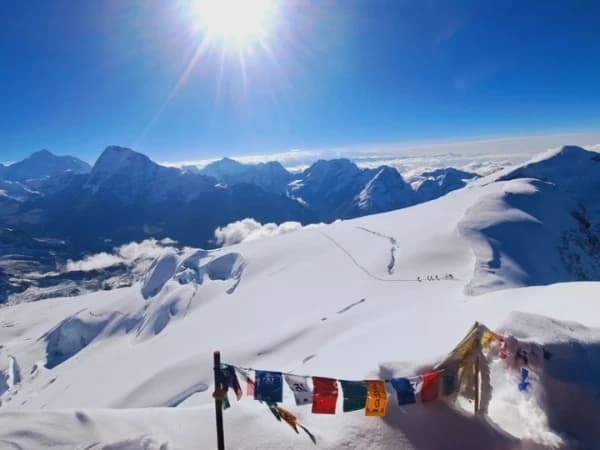
The summit ridge of Island Peak narrows to a blade of snow and ice at 6,189 metres (20,305ft). Your boots punch through the crust with each step, the rope stretches taut between you and your climbing Sherpa, and the world drops away on both sides — the Khumbu Glacier to the west, the Imja valley to the east, and the summit pyramid of Lhotse filling the sky directly ahead. This is the moment you cross the line from trekker to mountaineer. This is Island Peak.

Fourteen days from Lukla to the summit and back. The route follows the classic Everest trail through Phakding, Namche Bazaar, Tengboche, and Dingboche, then turns east to Chhukung and the base camp of Island Peak (Imja Tse). You will walk the same Sherpa trails and sleep in the same teahouses as every EBC trekker, eat dal bhat in dining rooms warmed by yak-dung stoves, cross prayer flag–draped suspension bridges over the Dudh Koshi River, and then — when the trekkers turn back — you keep going. Up onto the glacier. Up onto the headwall. Up onto the summit ridge where Nepal unfolds beneath you in every direction. All climbing gear is provided by The Everest Holiday. Your climbing Sherpas are expedition-qualified professionals from the Khumbu region.

What Makes This Climb Unforgettable

  • Summit Island Peak (6,189m / 20,305ft) — your first peak above 6,000 metres, with panoramic views of Everest, Lhotse, Makalu, Ama Dablam, and Baruntse
  • Combine the classic Khumbu trek with real mountaineering — trekking through the Everest region before climbing a Himalayan summit
  • All climbing gear provided by The Everest Holiday — ropes, harness, ice axe, crampons, helmet, and all technical equipment
  • Climb with experienced TEH climbing Sherpas from the Khumbu region — expedition-qualified mountaineers who know this peak intimately
  • Acclimatise through the classic Everest corridor — Namche Bazaar, Tengboche, Dingboche — giving your body the best preparation for the summit push
  • Visit Tengboche Monastery, the spiritual heart of the Khumbu, with Everest and Ama Dablam framed behind it
  • Trek to Chhukung (4,730m / 15,518ft) — a quiet, spectacular valley beneath the south face of Lhotse, away from the main EBC trail crowds
  • At USD 1,111 for the Budget tier — one of the most affordable 6,000m peak climbing packages available from any reputable operator
  • Hike to the Everest View Hotel (3,880m / 12,730ft) on your Namche rest day — your first clear view of the summit
  • Cross suspension bridges draped in prayer flags over the Dudh Koshi River — some of the highest in the world
  • Experience the transformation from trekker to climber — the moment you clip into the fixed rope on the headwall, everything changes

14-Day Island Peak Climbing Overview

Fourteen days splits neatly into three phases: the approach, the acclimatisation, and the climb. The first phase follows the Everest trail from Lukla through Phakding (2,610m / 8,563ft), Namche Bazaar (3,440m / 11,286ft), Tengboche (3,860m / 12,664ft), and Dingboche (4,410m / 14,468ft). This is the same trail walked by EBC trekkers — the suspension bridges, the Sherpa villages, the slowly transforming landscape from rhododendron forest to glacial moraine — and it serves as your acclimatisation corridor.

At Dingboche, you turn east. While EBC trekkers continue north towards Lobuche, you head into the Chhukung valley (4,730m / 15,518ft), a quieter, less-travelled arm of the Khumbu that sits beneath the immense south face of Lhotse. From Chhukung, you climb to Island Peak Base Camp (5,087m / 16,689ft), where your climbing team sets up camp and you prepare for the summit push.

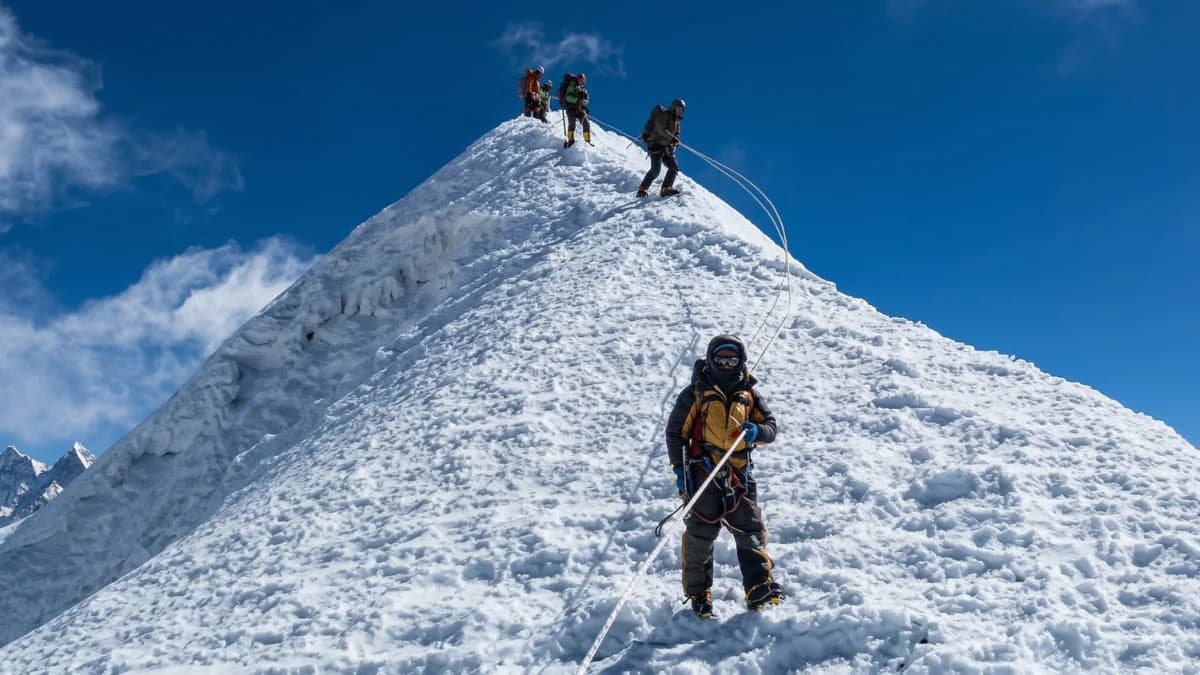
Summit day begins well before dawn. You climb the glacier in the dark, headlamp illuminating the ice, then ascend the headwall on fixed ropes — ice axe and crampons biting into the slope — before emerging onto the summit ridge. The ridge is narrow and exposed, with the Khumbu on one side and the Imja valley on the other. At the top, 6,189 metres above sea level, you see Everest, Lhotse, Makalu, Ama Dablam, Baruntse, and a horizon of Himalayan peaks stretching in every direction. It is the moment that separates this trip from every other Everest region trek.

After the summit, you descend to Chhukung and retrace the classic trail through Namche to Lukla, then fly back to Kathmandu. You return not just as a trekker, but as a climber who stood on a Himalayan summit.

Before You Arrive

Please arrive in Kathmandu by 4 PM the day before your trek. This gives you time for a final gear check, a climbing briefing with your guide and climbing Sherpa, and a good night’s rest before the early morning start.

Your Online Briefing

Think of this as our first coffee together — but online. After you book, we schedule a video call where we walk you through every detail: what to pack for both trekking and climbing, what the summit day is really like, how to prepare physically, what climbing experience (if any) you need, and anything else on your mind. No question is too small.

This is also when we learn about you. Our trek itinerary does not include your hotel in Kathmandu — during the briefing, share your preferences and budget, and we will arrange accommodation that fits. Whether you want a simple guesthouse in Thamel or a five-star hotel, we will set it up for you.

Lukla Flight — What You Need to Know

The flight to Lukla is one of the most dramatic in the world — a short ride between mountain peaks that ends on a runway carved into a hillside at 2,860m (9,383ft). It is weather-dependent, and flights can be delayed by fog, cloud, or wind, sometimes for a full day. This is normal in the Himalayas and nothing to worry about — but it is something to plan for.

We strongly recommend keeping two buffer days at the end of your trip before your international flight home. During peak season (March–May and October–November), flights may operate from Manthali Airport instead of Kathmandu. All ground transport is included in every package.

Your Trek, Your Way

Every trek we run is private — your group only, no strangers added. Whether you choose Budget, Standard, or Luxury, the mountains are yours and your companions’ alone. This is not a conveyor belt. This is your personal Himalayan experience.

Your hotel in Kathmandu is not included in the trek package — and that is intentional. Kathmandu has everything from USD 10 guesthouses in Thamel to five-star hotels with rooftop views. During the online briefing, tell us what you prefer and we will arrange it for you. Your trek package begins the moment you leave Kathmandu for the mountains.

Climbing Gear and Team

All climbing gear is provided by The Everest Holiday — ropes, harness, ice axe, crampons, helmet, and all technical equipment needed for the summit push. You do not need to bring or buy any climbing-specific gear.

Your climbing Sherpas are expedition-qualified professionals from the Khumbu region. Our team includes Sohel, Manoj, and Samish — all with mountaineering qualifications and deep experience on Island Peak and other Himalayan summits. If our primary team is unavailable, we deploy climbing Sherpas from the Khumbu who live a day below the peak and are always ready.

Difficulty: Very Challenging (5 out of 5)

This is the hardest package we offer in the Everest region. The trekking portion is equivalent to the classic EBC route — 5-8 hours of walking per day over mountain trails. The climbing portion adds technical mountaineering: glacier travel, fixed rope ascent on a steep headwall, crampon and ice axe use, and an exposed summit ridge. Previous trekking experience is strongly recommended. Previous climbing experience is helpful but not essential — your climbing Sherpa will teach you everything on a training session before summit day. Excellent cardiovascular fitness is required.

Compare Our Three Packages

  Budget Standard Luxury
Price from USD 1,111 USD 1,800 USD 3,500
Meals Choose your own (approx. USD 15-25/day) 3 meals + tea + fruits + 2L water daily All meals + all drinks anytime (except alcohol)
Room Shared teahouse Private twin w/ bathroom Private deluxe w/ bed heater
Porter Not included 1 per 2 trekkers 1 per trekker (carry nothing)
Guide 1 guide, assistant at 8+ 1 guide per 6, assistant at 6+ 1 guide per 2 trekkers
Climbing Sherpa Included — expedition-qualified Included — expedition-qualified Included — expedition-qualified, 1:2 ratio
Climbing gear All provided by TEH All provided by TEH All provided by TEH (premium quality)
Transport Local vehicle + flight to Lukla Private vehicle + flight to Lukla Helicopter Kathmandu–Lukla both ways
SIM data SIM only Limited data Unlimited data
Best for Ambitious climbers on a budget Comfort climbers, first-time summiteers Premium climbing experience

Himalayas for Every Budget — same climbing Sherpas, same gear, same summit, three comfort levels.

Your Trek, Our Family

In the 1960s, Shreejan’s grandfather Hari Lal Simkhada helped international travellers experience the Himalayas for the first time — arranging logistics, finding routes, building trust with people who had come halfway around the world on a dream. His son Ganesh went on to hold senior positions in Nepal’s tourism and mountaineering institutions. And now Shreejan, the third generation, designs every itinerary you see on this website.

This is not a company that was started in a boardroom. It was started on a mountain trail, three generations ago.

Shreejan hand-picks the guide and climbing Sherpa for your group from our team of TAAN-certified mountaineering professionals — people who grew up in these mountains, who have stood on Himalayan summits dozens of times, and who know exactly how to guide you safely to the top of Island Peak and back. He briefs your team personally before your trek begins, because your safety and experience are not something we delegate to a system.

Have a question right now? WhatsApp Shreejan directly: +977 9810351300. No sales team. No chatbot. The person who designed your climb answers personally.

Our Credentials

  • 197+ TripAdvisor Reviews — 4.9 out of 5 stars, TripAdvisor Travellers Choice 2024
  • 108+ Google Reviews — 4.9 out of 5 stars
  • TAAN Certified — Member #1586, Government Reg: 147653/072/073
  • Secure 10% Deposit — pay just $111 to reserve, via Himalayan Bank
  • Himalayas for Every Budget — from USD 1,111 including all climbing gear and Sherpa
  • Three Generations — family guiding in the Himalayas since the 1960s

Solo Trekkers Welcome

You do not need a climbing partner. Many of our Island Peak clients book alone — solo climbers looking for their first 6,000m summit. Your climbing Sherpa and trekking guide are with you every step, and if you want company on the trek, tell us and we will list your dates as a fixed departure so others can join.

Our groups are small — 2 to 20 people — because the Himalayas deserve more than a crowd. You book your climb, and it is yours. We will never add strangers to your group without your permission.

Difficulty: Very Challenging (5 out of 5)

Island Peak combines a full multi-day Himalayan trek with technical mountaineering. The trekking section (Days 1-8) involves 5-8 hours of walking per day over mountain trails with significant altitude gain. The climbing section (Days 9-11) involves glacier travel, fixed rope ascent on a steep ice headwall, crampon and ice axe technique, and an exposed summit ridge at 6,189m. You should be in excellent cardiovascular condition and comfortable with sustained physical effort at altitude. Previous climbing experience is helpful but not essential — your climbing Sherpa provides training and guides you through every technical section. Two acclimatisation days are built into the itinerary, and our guides carry first aid kits, altitude medication, and pulse oximeters.

Trek With a Purpose — Changing the World, One Step at a Time — Changing the World, One Step at a Time

In 2019, Shreejan and Shamjhana founded the Nagarjun Learning Center in Saldum Village — one of the most remote communities in Nepal’s Dhading District, where children had no school after hours, no computers, and limited healthcare. Today, 70 children receive free education and hot meals every school day. The centre has grown to 7 learning centres across Nepal, providing healthcare for 600 people, internet access for 65 children, and support programmes for over 275 women.

A portion of every trek you book funds this work directly. The centre is verified and listed on the United Nations Partner Portal.

When you climb these mountains with us, every step — from the first footfall on the trail to the final push on the summit ridge — helps change a life in rural Nepal. That is what we mean by Trek With a Purpose — Changing the World, One Step at a Time — changing the world, one step at a time.

What Trekkers Say About This Trek

"Our guide made sure we acclimatised properly. I never felt rushed. The teahouses were comfortable and the food was surprisingly good at altitude."

— Google Review, 5 stars

"Our guide made sure we acclimatised properly with rest days at Namche and Dingboche. I never felt rushed. The teahouses were comfortable and the food was surprisingly good."

— Google Review, 5 stars

"Our guide made sure we acclimatised properly with rest days at Namche and Dingboche. I never felt rushed. The teahouses were comfortable and the food was surprisingly good."

— Google Review, 5 stars

Read all 320+ reviews →

Short Itinerary
Day 01: Fly to Lukla (2,850m / 9,350ft), Trek to Phakding (2,650m / 8,694ft)
Max Altitude: 2,850/9,350 ft
Day 02: Phakding to Namche Bazaar (3,440m / 11,286ft)
Max Altitude: 3,440 m/11,285 ft
Day 03: Acclimatization Day in Namche Bazaar
Day 04: Namche Bazaar to Tengboche (3,860m / 12,664ft)
Max Altitude: 3,855 m/12,850 ft
Day 05: Tengboche to Dingboche (4,360m / 14,304ft)
Max Altitude: 4360m/14,290ft
Day 06: Acclimatisation Day in Dingboche
Max Altitude: 4,735m / 15,535 ft
Day 07: Dingboche to Chhukung (4,730m / 15,518ft)
Max Altitude: 4,735m / 15,535ft
Day 08: Chhukung to Island Peak Base Camp (5,087m / 16,690ft)
Max Altitude: 5,200m / 17,060 ft
Day 09: Island Peak Summit Day (6,189m / 20,305ft)
Max Altitude: 6,183m / 20,295 ft
Day 10: Base Camp to Dingboche (4,360m / 14,304ft)
Day 11: Dingboche to Namche Bazaar (3,440m / 11,286ft)
Max Altitude: 4,730m 15,518 ft
Day 12: Namche Bazaar to Lukla (2,850m / 9,350ft)
Max Altitude: 3,855 m/12,850 ft
Day 13: Contingency Day in Lukla
Max Altitude: 3,440 m/11,285 ft
Day 14: Fly Lukla to Kathmandu, Transfer to Hotel
Expand
Detailed Itinerary
Day 01:

The twin-engine aircraft lifts off from Kathmandu's domestic terminal, climbs above the valley's brown haze, and within minutes the world below becomes a crumpled green map of terraced hillsides, silver rivers, and scattered villages clinging to ridgelines. The flight to Lukla lasts thirty-five minutes, and for most of that time the northern horizon is a wall of snow peaks so bright against the blue sky that they look painted. Then the plane drops between two ridges, the runway appears ahead — short, steep, ending at a stone cliff — and the wheels touch down at Tenzing-Hillary Airport with a firmness that draws nervous laughter from the cabin. You step onto the tarmac at 2,850 metres, and the cool mountain air carries the smell of juniper smoke and pine resin. This is the Khumbu, and for the next two weeks it is home.

Your guide meets you at the small terminal, introduces the team, porters, assistant guide, climbing Sherpa who will be with you all the way to the summit of Island Peak, and after a quick tea in Lukla the group sets off. The trail descends gently along the Dudh Koshi river, passing mani walls carved with Buddhist mantras and prayer wheels that spin in the breeze. You walk on the left side of each wall, keeping the sacred stones to your right, and the habit becomes instinctive within an hour. The forest is dense, blue pine, rhododendron, fir, and the river below runs milky turquoise with glacial silt.

After three to four hours the trail arrives at Phakding, a small settlement at 2,650 metres strung along the river. The teahouses here are simple but welcoming, with wood-panelled dining rooms warmed by a central stove and menus offering everything from dal bhat to pizza. Tonight is about settling in: unpack, dry your boots, eat well, hydrate aggressively, and let the reality of the expedition sink in. Island Peak is still more than a week away, and the journey to its summit starts with these quiet, measured first steps through the valley.

If you have energy after dinner, step outside and look up. The Milky Way arches overhead with a clarity that no city dweller ever sees, and the silence, broken only by the river, is the deep, total kind that resets something in the brain. Your climbing Sherpa may join you and point out the stars the Sherpa people navigate by. It is a good moment to ask questions about what lies ahead; the team are experienced, generous with their knowledge, and they want you to feel prepared.

Max Altitude: 2,850/9,350 ftMeals: Breakfast, Lunch & DinnerAccommodation: Tea House or Local lodgesDuration: 3 hoursDistance: 6.2km/ 3.8milesElevation: 2,650 m / 8,562 ft
Day 02:

The morning begins early — breakfast at six-thirty, on the trail by seven — and the pattern that will define the next twelve days establishes itself: porridge, eggs, strong Nepali tea, and then boots on dirt. The trail from Phakding follows the Dudh Koshi river north through forest, crossing it several times on high suspension bridges strung with prayer flags that snap in the updraft. Each bridge is a small event, the metal swaying underfoot, the river a white ribbon far below, and the mountains framing the scene on both sides. Yak trains clatter past in the opposite direction, their bells creating a melody that carries through the valley long after they have disappeared around the next bend.

The first hours are gentle, passing through the villages of Benkar and Monjo where permits are checked at the Sagarmatha National Park entrance. Your guide handles the paperwork while you sit on a stone wall and watch the river carve its way through a gorge below. After Monjo the trail begins to climb, steeply and without respite for roughly two hours, through switchbacks cut into the hillside. This is the hardest sustained ascent of the trek phase, and at altitude you feel every metre of it: your breathing is heavy, your pace slow, and your heart rate higher than it would be at sea level. But your guide sets a rhythm that keeps the group together, and the Sherpa saying "bistaarai, bistaarai", slowly, slowly, becomes the mantra of the morning.

Then the trees thin, the trail crests a ridge, and Namche Bazaar opens below you in a vast horseshoe amphitheatre at 3,440 metres. It is a real town: bakeries, coffee shops, gear stores, a weekly market, Wi-Fi, and hot showers that cost a few hundred rupees but feel priceless. On a clear afternoon the peaks of Kongde Ri and Thamserku tower above the rooftops, and if the clouds part you catch your first glimpse of Everest, a dark pyramid with a plume of spindrift streaming from its summit, visible above the Lhotse-Nuptse wall.

Check into your teahouse, drop your bags, and explore. Namche is the social capital of the Khumbu, the place where climbers heading for Everest, Lhotse, and Ama Dablam mingle in the bakeries with trekkers and Sherpa families who have called this valley home for generations. There is a museum, several excellent restaurants, and a view from every terrace that justifies the climb. Drink plenty of water, eat a full dinner, and get to bed early. The next two weeks will test your body in ways it has not been tested before, and the foundation is laid here, in the discipline of hydration, rest, and patience.

Max Altitude: 3,440 m/11,285 ftMeals: Breakfast, Lunch & DinnerAccommodation: Tea House or Local lodgesDuration: 6 hoursDistance: 7.4 km/4.6 miles.Elevation: 790m / 2,723 ft
Day 03:

The acclimatisation day in Namche is built around one principle: climb high, sleep low. You gain altitude during the morning, stress the body gently, then descend back to your sleeping elevation to recover. It is one of the most important days of the entire expedition, and on a climbing trip like this — where you will eventually push above six thousand metres — getting it right at three thousand is not optional.

The morning hike climbs from Namche to the Everest View Hotel at 3,880 metres, a ninety-minute walk that gains roughly four hundred vertical metres through scrubby juniper and dwarf rhododendron. The view from the terrace is the one that appears on postcards and screensavers and still manages to stop you mid-sentence when you see it in person: Everest, Lhotse, Nuptse, Ama Dablam, Thamserku, and Kangtega, lined up across the northern horizon like a museum display of the world's finest mountains. Have tea, photograph everything, and let your body do its quiet work of producing the extra red blood cells that will carry you higher in the days to come.

The descent passes through Khumjung, a village built on the legacy of Sir Edmund Hillary's Himalayan Trust, where a school still educates Sherpa children and a monastery displays what the monks claim is a yeti scalp in a glass case. Whether or not you believe it, the monastery interior is worth the visit, vivid murals, the smell of butter lamps, a silence that feels centuries deep. Back in Namche by early afternoon, the rest of the day is yours.

This is also a good time for your climbing Sherpa to begin the technical briefing for Island Peak. Over tea in the teahouse dining room, they will walk you through the route: the approach from Chhukung, the base camp at 5,087 metres, the pre-dawn start, the headwall, the fixed ropes, and the summit ridge. They will check your gear, harness, crampons, ice axe, helmet, ascender, and make sure everything fits and functions. If you have never used an ascender on a fixed rope, they will teach you the technique here at low altitude, which is far better than learning it at five-eight in the dark. The briefing is practical, calm, and confidence-building, and by the end of it the summit feels not easy but achievable. If altitude symptoms are present, mild headache, fatigue, they are normal at this stage and will ease as your body adapts. Hydrate, eat well, and trust the process.

Meals: Breakfast, Lunch & DinnerAccommodation: Tea House or Local lodges
Day 04:

The trail from Namche to Tengboche is one of the most celebrated stretches of trekking in the Himalayas, and the first thirty minutes explain why. From the upper edge of Namche the path contours along the hillside above the Dudh Koshi valley, and the panorama of Everest, Lhotse, Ama Dablam, and half a dozen other peaks shifts and sharpens with every step. The morning light catches the snow from below, turning it pale gold against a sky so blue it looks unreal, and the sound of the river far below provides a constant low note beneath the birdsong.

The trail descends to the river, crosses a suspension bridge, and then climbs steadily through dense rhododendron forest to Tengboche at 3,860 metres. In spring the rhododendrons bloom crimson, pink, and white, and even outside the flowering season the forest has a cathedral quality — moss-draped trunks, filtered light, the occasional flutter of a Himalayan monal pheasant with its iridescent plumage. The climb is long but not steep, and after roughly five hours the forest opens onto a broad grassy ridge with the largest monastery in the Khumbu at its centre and the entire south face of Ama Dablam behind it.

Tengboche Monastery was rebuilt after a fire in 1989 and stands as a living centre of Buddhist practice in the Everest region. If you arrive in time for the late-afternoon prayer ceremony, the experience is extraordinary: deep horns, rhythmic chanting, the flicker of butter lamps, incense thick in the dim interior. The monks are welcoming to visitors who observe the customs — remove shoes, turn clockwise, sit quietly, and the ceremony creates a stillness that contrasts sharply with the physical effort of getting here. Step outside afterwards and the sunset on Ama Dablam is the kind of light that photographers travel the world to find: pink, orange, and finally a deep violet that fades to starlight.

Your teahouse tonight sits within sight of the monastery, and dinner is eaten to the sound of prayer bells drifting across the clearing. The mood in the group is shifting now, the trek phase is well under way, bodies are acclimatising, and the climbing phase is drawing closer. Your climbing Sherpa may use the evening to discuss layering systems for the summit push, when temperatures can drop to minus twenty and the wind on the ridge strips heat from exposed skin in seconds. It is practical knowledge delivered in a matter-of-fact way that makes the challenge feel manageable rather than intimidating. Eat well, hydrate, and sleep deeply, the trail ahead climbs above four thousand metres tomorrow, and every good night's rest is an investment in summit day.

Max Altitude: 3,855 m/12,850 ftMeals: Breakfast, Lunch & DinnerAccommodation: Tea House or Local lodgesDuration: 5 hoursDistance: 9.2 km/5.7 miles.Elevation: 415m – 1,565 ft
Day 05:

The trail from Tengboche descends through forest into the Imja Khola valley, crosses a river on a narrow bridge, and then climbs steadily to Dingboche, a stone-walled village at 4,360 metres where the landscape shifts decisively from green to grey. The trees are behind you now. Above Dingboche the terrain is high-altitude steppe: brown grass, grey rock, yak pastures enclosed by low stone walls, and a sky that seems to take up more space than the land. The air is thinner here, noticeably so, and conversation on the uphill sections becomes shorter and more direct as lungs work harder to extract oxygen from each breath.

The walk takes roughly five hours, passing through Pangboche — one of the oldest settlements in the Khumbu, home to a monastery dating back three centuries and a community of Sherpa families who farm potatoes and tend yaks at an altitude where most agriculture would fail. The trail beyond Pangboche climbs above the treeline into an increasingly stark landscape, and the views open up dramatically: Ama Dablam behind you, Island Peak's summit pyramid visible for the first time to the northeast, and the massive wall of Lhotse dominating the northern skyline.

Dingboche itself sits in a broad valley at the junction of the Imja and Khumbu glacier systems, and the afternoon light plays across its stone houses in shades of gold and amber. The teahouses here are well-stocked — this is a major stopping point for Everest and Island Peak expeditions, and the food is surprisingly varied for the altitude. Dal bhat remains the best option: carbohydrate-rich, easy to digest, and served with unlimited refills that your body will need as it burns through calories faster than at sea level. Garlic soup is the other local favourite, believed to help with acclimatisation, and whether or not the science supports the claim, the warmth and flavour are welcome at the end of a cold day.

Tomorrow is a rest day here in Dingboche, which is essential at this altitude. Your body has climbed from 2,850 metres to 4,360 metres in five days, and the overnight stay allows your cardiovascular system to catch up. The climbing Sherpa may use this evening to review the fixed-rope technique one more time, practising the jumar clip-on and clip-off sequence that you will repeat dozens of times on summit day. The rehearsal is methodical and patient, and by the end of it the movement feels natural. Outside, the temperature drops sharply after sunset, minus ten is common here in the shoulder seasons, and the teahouse stove becomes the centre of the universe. Huddle close, drink hot lemon, and let the altitude do its quiet work.

Max Altitude: 4360m/14,290ftMeals: Breakfast, Lunch & DinnerAccommodation: Tea House or Local lodgesDuration: 5 hoursDistance: 12km/ 7.45milesElevation: 505m / 1,440 ft.
Day 06:

The second acclimatisation day of the expedition, and by now you understand why these rest days matter more than the walking days. At 4,360 metres your body is manufacturing red blood cells at an accelerated rate, your breathing pattern has adjusted to extract more oxygen from thinner air, and the mild headache that followed you up from Pangboche is fading. The morning hike climbs to Nagarjun Hill above Dingboche, gaining roughly three hundred metres to a viewpoint at 4,660 metres where the panorama is extraordinary: the Lhotse wall to the north, Ama Dablam to the south, Makalu to the east, and the Imja valley stretching towards Chhukung and Island Peak.

This is the first time you see the full approach route to Island Peak laid out before you, and your climbing Sherpa will use the viewpoint to trace the line: the valley floor to Chhukung, the moraine beyond to base camp, the glacier approach, the headwall, and the summit ridge silhouetted against the sky. Seeing it in context — understanding the scale, the distance, the altitude gain — is both humbling and clarifying. The mountain is serious, but the route is logical, and every day of the approach has been designed to bring you here in the best possible condition to climb it.

Back in Dingboche by midday, the afternoon is genuinely free. Wander through the village, photograph the yaks grazing against the mountain backdrop, or sit in the teahouse dining room with a book and a pot of tea. Some trekkers use the afternoon to wash clothes (they dry fast in the thin, dry mountain air), reorganise their packs, or write in a journal. Others simply rest, and there is wisdom in that, the next four days are the hardest of the expedition, and every hour of recovery counts.

Your guide may use this day to discuss the safety protocols for the climbing phase: the turnaround time on summit day, the weather check procedure, the emergency descent plan, and the helicopter evacuation options if anything goes wrong. It is not meant to frighten, it is meant to prepare, and knowing that every contingency has been planned for is one of the things that allows you to focus entirely on the climb when the time comes. The evening meal is the usual communal affair, and the conversation has shifted from trekking stories to climbing anticipation. You can feel the energy in the group changing: quieter, more focused, more aware that something significant is approaching. Early bed, warm sleeping bag, the sound of wind on the roof tiles, and the stars through the frost-rimmed window. Chhukung tomorrow.

Max Altitude: 4,735m / 15,535 ftMeals: Breakfast, Lunch & DinnerAccommodation: Tea House or Local lodgesDuration: 3–4 hoursDistance: 7 km / 4.3 milesElevation: 375m / 1,230 ft.
Day 07:

The trail from Dingboche to Chhukung follows the Imja Khola valley east, leaving the main Everest Base Camp route behind and entering a quieter, wilder landscape that fewer trekkers see. The path crosses the valley floor — flat, brown, dotted with yak dung and low stone walls — and climbs gently along the moraine of the Lhotse Glacier. To your left, the south face of Lhotse rises in a continuous wall of ice and rock that is almost four thousand metres from base to summit, and the scale of it makes the valley feel like a corridor in a cathedral built by giants.

The walk to Chhukung takes roughly three hours and gains 370 metres, arriving at 4,730 metres, the highest you have slept so far. The village is small, just a handful of teahouses clustered around a flat patch of ground, but the setting is extraordinary: Lhotse to the north, Island Peak to the east, Ama Dablam to the south, and the Imja Glacier spilling down from the col between Lhotse Shar and Island Peak. The air is thin enough that walking upstairs leaves you breathless, and the afternoon light has a quality you only find above four thousand metres, sharp, crystalline, almost brittle.

This is your last night in a teahouse before base camp, and the climbing Sherpa uses the afternoon for a final gear check. Every item is laid out on the dining room table: harness, helmet, crampons, ice axe, ascender, figure-eight descender, carabiners, slings, and the double boots that will keep your feet warm on the glacier. Each piece is inspected, adjusted, and packed into the summit bag in the order it will be needed. The climbing Sherpa is meticulous about this, because at 5,800 metres in the dark with numb fingers is not the time to discover that a crampon strap does not fit your boot. If you are renting any gear, this is the moment to confirm it works.

Dinner is dal bhat again, the calories are essential, and the evening briefing covers the next two days in detail: the approach to base camp tomorrow, the early night, the 1 a.m. wake-up call, the glacier crossing, the headwall, the fixed ropes, and the summit ridge. Your climbing Sherpa has summited Island Peak many times and describes each section with the calm authority of someone who knows the mountain intimately. They answer questions honestly: yes, the headwall is steep; yes, the cold is real; yes, the altitude will slow you down. But the route is well-established, the ropes are fixed by professional teams, and with the right pace and the right preparation, the summit is within reach. Sleep comes slowly tonight, anticipation and thin air are a potent combination, but the warm food and the weight of the past week's walking eventually pull you under.

Max Altitude: 4,735m / 15,535ftMeals: Breakfast, Lunch & DinnerAccommodation: Tea House or Local lodges
Day 08:

The walk from Chhukung to Island Peak Base Camp takes four to five hours and crosses some of the most dramatic terrain of the entire expedition. The trail leaves the village heading east, following the Imja Glacier's lateral moraine through a landscape of grey rock, glacial debris, and turquoise meltwater pools. The vegetation is gone entirely now — nothing grows at this altitude — and the world is reduced to its most elemental components: stone, ice, sky, and the thin sharp air that makes every uphill step an exercise in controlled breathing.

The route climbs steadily, skirting the edge of the glacier and crossing several meltwater streams on improvised rock bridges. The glacial landscape is both beautiful and alien: seracs of blue-green ice tilt at impossible angles, moraines of shattered rock form ridgelines of their own, and the sound of running water is everywhere, hidden beneath the rubble. To the north, the Lhotse wall continues its domination of the skyline, and ahead the pyramid of Island Peak grows steadily larger, its summit ridge catching the sun while the lower slopes remain in shadow.

Base camp sits on a rocky plateau at 5,087 metres, sheltered from the wind by a moraine wall and facing directly up the mountain. The camp is basic, tents on flat ground, a cooking tent, water drawn from the glacier stream, and at this altitude even simple tasks feel effortful. Your guide and the climbing team set up camp, prepare hot drinks, and give you time to rest, eat, and absorb the surroundings. Island Peak is directly above you now, its south face a patchwork of ice gullies and rock bands that leads to the steep headwall and the narrow summit ridge beyond. Looking up at it from base camp, the route is visible as a line of footprints and fixed ropes on the snow, and the reality of what you are about to do crystallises in a way that no briefing or photograph can match.

The afternoon climbing briefing is the final one. Your climbing Sherpa walks through the route in detail: the 1 a.m. departure, the two-hour approach across the glacier, the crampon-on point at the base of the headwall, the fixed-rope ascent to the summit ridge, the exposed traverse to the top, and the descent. They discuss altitude management, turnaround time, weather contingencies, and the importance of honest self-assessment, if you are not feeling right, say so early, because descending from 5,500 metres is far easier than descending from 6,000. After the briefing, the evening meal is early, soup, noodles, tea, and the camp settles into silence by seven o'clock. You lie in your sleeping bag, headtorch and summit layers organised beside you, and wait for sleep. The alarm is set for one in the morning. The mountain waits.

Max Altitude: 5,200m / 17,060 ftMeals: Breakfast, Lunch & DinnerAccommodation: Tea House or Local lodgesDuration: 4–5 hoursDistance: 5 km / 3.1 milesElevation: 465m / 1,525 ft.
Day 09:

The alarm goes off at one in the morning and the world is pure cold and darkness. You pull on the layers that were laid out the night before — thermal base, fleece mid-layer, down jacket, windproof shell, double boots, gaiters — and step out of the tent into air so cold it feels solid. The stars are extraordinary, the Milky Way a dense band overhead, and the beam of your headtorch picks out the footprints of the climbing Sherpa who is already heating water in the cook tent. Breakfast is minimal: hot tea, biscuits, chocolate. Your stomach may not want much at 5,087 metres in the dark, and that is normal. Eat what you can and trust the energy bars in your summit pack for later.

The group sets off at two, headtorches cutting white lines through the darkness, crampons biting into the frozen glacial surface. The approach across the glacier takes roughly two hours, navigating between crevasses and over ice ridges that the climbing Sherpa knows by memory. The pace is deliberately slow, at this altitude, even a moderate effort sends the heart rate soaring, and the silence is broken only by the crunch of metal on ice and the sound of heavy breathing. Ahead, the headwall of Island Peak is a dark wall against the stars, and the fixed ropes are visible as faint lines catching the torch beams of climbers who started earlier.

At the base of the headwall you clip into the first fixed rope and begin the steep ascent. This is the crux of the climb: roughly four hundred metres of forty-to-fifty-degree ice and mixed terrain, climbed on front points with an ascender sliding up the rope above you. The technique is simple, step, slide, breathe, step, but the altitude makes everything harder, and the cold bites at exposed skin. Your climbing Sherpa climbs beside you, monitoring your pace, checking your clips, and offering encouragement in a calm voice that cuts through the effort and the dark. Dawn breaks somewhere during the headwall, and the light transforms the world: the glacier below turns from black to blue to gold, the peaks appear one by one along the horizon, and the summit ridge above begins to glow.

The ridge is the final challenge. It is narrow, exposed on both sides, and at 6,100 metres the air holds barely half the oxygen of sea level. You move carefully, clipped to the fixed rope, placing each foot on the packed snow with precision. And then the ridge levels, the rope ends, and you are standing on the summit of Island Peak at 6,189 metres. The view is a three-hundred-and-sixty-degree panorama of the greatest peaks on earth: Everest, Lhotse, Nuptse, Makalu, Baruntse, Ama Dablam, and a hundred unnamed summits stretching to the horizon. The feeling is beyond words, a compound of exhaustion, elation, cold, and a quiet, stunned gratitude that your body and mind have carried you here. Photographs are taken with frozen fingers, the climbing Sherpa grins, and the moment is yours. The descent begins quickly, you do not linger at altitude, and by early afternoon you are back at base camp, warm, fed, and processing what you have just done.

Max Altitude: 6,183m / 20,295 ftMeals: Breakfast, Lunch & DinnerAccommodation: Tea House or Local lodgesDuration: 10–12 hoursDistance: 7 km / 4.3 milesElevation: 983m / 3,225 ft.
Day 10:

The morning after summit day has a quality that every climber recognises: deep fatigue, sore muscles, and a contentment so thorough it feels physical. You wake at base camp with the memory of the summit still vivid — the cold, the darkness, the headwall, the ridge, and then that view — and the descent ahead feels like a gift rather than a chore. The trail drops from 5,087 metres back to Dingboche at 4,360 metres, losing over seven hundred metres of altitude, and with every step the air thickens, the breathing eases, and the body begins to recover.

The route retraces yesterday's approach, crossing the glacier moraine and following the Imja valley back through Chhukung and then south towards Dingboche. What took careful, measured hours on the way up now flows downhill in half the time, and the landscape you walked through with such focus on the ascent now reveals details you missed: the colour of the meltwater pools, the way the moraine ridges cast long shadows in the morning light, the sound of a Himalayan chough calling from a boulder. The tension of the climbing phase has lifted, and in its place is a lightness that makes the walking feel effortless.

Back in Dingboche by early afternoon, the teahouse feels luxurious after two nights in a tent: a real bed, a warm dining room, hot food that someone else has cooked. The celebration dinner is one of the highlights of the expedition. Your guide orders the best the kitchen can offer, dal bhat with all the sides, fried noodles, spring rolls, and a cake that appears from nowhere with your name on it (a tradition that the Khumbu teahouse owners have perfected for returning summit teams). The conversation flows easily, fuelled by the shared experience of having stood on a six-thousand-metre summit together, and the stories get longer and funnier as the evening goes on.

If you have phone signal, Wi-Fi is available in most Dingboche teahouses for a small fee, this is the moment to send the summit photo home. The reaction from family and friends tends to arrive in a flood of messages that makes the achievement feel real in a different way: not just the physical act of climbing, but the human connection that surrounds it. Shamjhana and the team at The Everest Holiday will already know you summited, the climbing Sherpa called it in from the top, and their congratulations will be waiting. Sleep comes fast tonight, deep and dreamless, earned in the most literal sense.

Meals: Breakfast, Lunch & DinnerAccommodation: Tea House or Local lodges
Day 11:

The long descent from Dingboche to Namche Bazaar covers ground that took three days on the way up, and walking it in a single day gives the descent a cinematic quality — the landscape scrolling past like a film played at double speed. The trail drops through Pangboche, where the ancient monastery sits quietly among its prayer flags, and continues through the forest to Tengboche, where the monastery clearing offers one final panoramic view of Ama Dablam, Everest, and the peaks you now know by name and by feel.

From Tengboche the trail descends steeply through rhododendron forest to the river, crosses the suspension bridge, and then climbs back up to Namche. It is a long day — roughly seven to eight hours of walking, and by the end your knees will know they have worked, but the altitude is behind you and the thicker air makes every step feel powered by an engine you did not have a few days ago. The forest returns, green and lush after the grey and brown of the upper valley, and the birdsong is startlingly loud after the silence above five thousand metres.

Namche in the late afternoon is exactly the welcome you need. The bakeries are open, the Sherpa-run lodges have hot showers, and the upper terraces offer a sunset view that you now appreciate with the authority of someone who has seen these mountains from their summits as well as their valleys. Find a bakery, order the biggest piece of apple pie on the menu, and sit with a coffee watching the clouds roll through the valley below. The simple pleasure of eating well at a comfortable altitude after days of effort is one of trekking's finest rewards.

The evening in Namche has a valedictory feel. The expedition is effectively over, the climbing done, the descent under way, and the group is starting to process the transition back to normal life. Your guide may organise a small ceremony to thank the climbing Sherpa, the porters, and the assistant guides whose work made the summit possible. Tipping is customary and genuinely appreciated, forming a significant part of the team's income, and your guide can advise on appropriate amounts. The shared meal that follows is warm, loud, and full of the kind of easy laughter that comes from mutual respect and shared hardship. It is one of the best evenings of the trip, and the mountain stories told around the teahouse stove will be the ones you retell at home for years.

Max Altitude: 4,730m 15,518 ftMeals: Breakfast, Lunch & DinnerAccommodation: Tea House or Local lodgesDuration: 6 hoursDistance: 12.9km / 8 milesElevation: 860 m / 2,814 ft.
Day 12:

The final day on the trail drops from Namche to Lukla, retracing the path you walked on Days 1 and 2. The descent is fast — roughly three hours of walking — and the trail that felt so new and exciting two weeks ago now carries a personal geography. You recognise the suspension bridges, the mani walls, the teahouse in Phakding where you spent your first night, and the forest that was your introduction to the Khumbu. The river is still the same milky turquoise, the prayer flags still flutter in the same updraft, and the mountains behind you are still impossibly large, but you are not the same person who walked this trail two weeks ago. You have stood on a summit above six thousand metres, and that changes the way you move through the world, not in a dramatic way, but in a quiet one, a new understanding of what your body and mind can do when the terrain demands it.

The walk into Lukla is quick, and the town feels familiar and welcoming. Your teahouse is close to the runway, and the afternoon is free to wander, shop, eat, and decompress. The gear shops sell summit patches for Island Peak, which make satisfying souvenirs, and the small cafes serve proper coffee and cold drinks that taste extraordinary after two weeks of altitude and teahouse fare.

Lukla is also a good place to sort and send laundry, repack your bags, and charge every device you own, the Wi-Fi and electricity here are reliable by Khumbu standards. Your guide will confirm tomorrow's flight schedule, though with a contingency day built into the itinerary there is no pressure even if weather delays strike. The town fills up in the late afternoon as other trekking groups arrive from the north, and the small restaurants become sociable spots where stories are swapped and recommendations exchanged.

The final group dinner in Lukla carries a weight that is hard to describe. You have walked, climbed, suffered, celebrated, and lived together for almost two weeks, and the bonds formed on a climbing expedition run deeper than those made on a standard trek. The food is good, the conversation is better, and by the time the evening winds down the table is covered in scribbled email addresses and promises to stay in touch. Some of those promises will be kept, and the friendships forged at altitude have a habit of lasting. Sleep comes early and easy tonight, with the sound of the river and the occasional bark of a teahouse dog providing the familiar Khumbu lullaby one last time.

Max Altitude: 3,855 m/12,850 ftMeals: Breakfast, Lunch & DinnerAccommodation: Tea House or Local lodgesDuration: 5 hoursDistance: 9.2 km / 5.7 milesElevation: 415m – 1565 ft.
Day 13:

The contingency day in Lukla exists for one reason: weather. The runway at Tenzing-Hillary Airport sits at 2,850 metres between two ridgelines, and the approach requires visual flight rules — meaning the pilots need to see the runway, and if cloud, fog, or rain obscures it, the flights do not operate. During peak season, weather delays of a day or more are common enough that any responsible itinerary builds in a buffer, and that is what today is. If the weather cooperated yesterday and your flight is confirmed for this morning, your guide will get you to the terminal early and you will be airborne by mid-morning. If not, today becomes a bonus day in the Khumbu, and there are worse places to be stranded.

Lukla without the pressure of a departure schedule is a pleasant place. The town has a small monastery above the runway that is worth visiting — a quiet, incense-filled space with views down the valley and the constant soundtrack of aircraft engines warming up below. The Sherpa families who run the teahouses have stories to tell if you are willing to listen, and a conversation over butter tea with a lodge owner whose grandparents helped build the original airstrip can be one of the most memorable moments of the trip. These are the people who make the Khumbu what it is, and their warmth and hospitality is the thread that runs through every day of the expedition.

If you are a photographer, the morning light on the surrounding peaks is excellent, and the runway itself, with its steady stream of small aircraft banking in between the ridgelines, makes for dramatic shots. The market stalls sell last-minute souvenirs: prayer flags, singing bowls, hand-knitted hats, and the ubiquitous "I survived the Lukla flight" t-shirts that are cheesy but earned. Your guide monitors the flight schedule throughout the day and will keep you informed of any changes.

The contingency day also serves a psychological purpose that is easy to underestimate. After twelve days of constant movement, walking, climbing, ascending, descending, a day with nowhere to be and nothing to do allows the mind to begin processing the experience. You might find yourself sitting on a lodge terrace with a pot of tea, staring at the mountains, and feeling a wave of emotion that catches you off guard. That is normal. Climbing a six-thousand-metre peak is a significant physical and mental achievement, and the body and brain need time to absorb it. Let the feeling come, write it down if you are the journalling type, and know that the quiet satisfaction you feel now is the most honest measure of what you have accomplished. Whether you fly out today or tomorrow, the insurance covers weather delays, and the team has everything in hand.

Max Altitude: 3,440 m/11,285 ftMeals: Breakfast, Lunch & DinnerAccommodation: Tea House or Local lodgesDuration: 6-7 hoursDistance: 13.5km/ 8.3milesElevation: 590m – 1935ft.
Day 14:

The final flight from Lukla to Kathmandu is a thirty-five-minute journey that compresses two weeks of mountain experience into a single aerial reel. The aircraft climbs out of the valley, and through the window the landscape you have walked through scrolls past in reverse: the Dudh Koshi gorge, the green foothills, the terraced farmland, and then the sprawl of the Kathmandu Valley emerging through the haze. You can pick out the trail, the river crossings, the ridge where you first saw Namche, and somewhere in the distant white peaks the summit where you stood in the darkness and watched the sunrise from 6,189 metres. It is a strange compression of time and space, and most climbers sit in silence for the duration, watching and remembering.

At Kathmandu airport your transfer is waiting. The drive to the hotel cuts through streets that feel impossibly loud and colourful after two weeks in the mountains — car horns, motorbikes, incense from streetside temples, the smell of frying momos, the density of people and noise that is the Kathmandu signature. The contrast is not unpleasant; it is vivid, and most returning climbers find they see the city with fresh eyes, noticing beauty in the chaos that they missed on the way through.

The hot shower at your hotel is a defining moment. Two weeks of bucket washes, wet wipes, and teahouse trickles are washed away in a single glorious cascade of hot water, and the clean sheets on a proper bed feel like a reward from the universe. If your international flight is not until tomorrow, the afternoon and evening are yours to explore the city. Kathmandu beyond Thamel is a city of ancient courtyards, hidden temples, rooftop terraces, and some of the best street food in South Asia. Patan Durbar Square is a twenty-minute taxi ride, Boudhanath stupa is a meditation in circular motion, and the garden restaurants of Lazimpat serve cold beer and wood-fired pizza that taste like civilisation itself.

The farewell dinner — if the group can gather one last time, is a celebration of everything the past two weeks have contained: the walking, the climbing, the cold, the views, the laughter, the dal bhat, and the summit. Your guide proposes a toast, the climbing Sherpa smiles, and the mood is that particular blend of pride and bittersweetness that marks the end of any significant journey. Shamjhana and the team at The Everest Holiday will follow up in the days ahead to make sure you arrive home safely and that the currency exchange went smoothly, because looking after you does not end when the trek does. Island Peak is one of those experiences that reshapes the way you think about yourself, not because of the difficulty, but because of the quiet proof that you are capable of more than you assumed. Welcome back to the world. You have earned it.

Interactive Route Map

Explore the full trek route on our interactive Google Map. Click markers for altitude details at each stop.

Open Full Route Map in Google Maps

Distance: 20/40 minElevation: 1616 m–5006 ft.
Couldn't find what you're after?Reach out to our travel experts.
Customise Trip
Route Map
Island Peak Climbing Route Map Nepal
Altitude Chart
Island Peak Climbing - 14 Days Expedition | Everest Region Summit
Availability
Book your own private small group trip
No. of travellers
Price per person
2 - 4 pax
US$1099
5 - 8 pax
US$999
9 - 12 pax
US$949
13 - 20 pax
US$909

Discounts are determined exclusively by the size of your group. We do not add additional members to your group.

Book Now
hbl logo
Secure Payment by Himalayan Bank.
Cost Includes

Transportation

  • Airport Pick-up and Drop-off from Tribhuvan International Airport to the Hotel of your choice.
  • Round-trip flight from Kathmandu/Manthali to Lukla. (local bus or jeep  ground transportation to manthali and back to kathmandu are also included if the flight is rescheduled.)

Accommodation and food

  • During the trek, Food or drinks are not included. 
  • You will stay in a local teahouse and lodge in a shared room during the duration of the trek.

Guide and porter

  • An English-speaking, Nepal government well-trained guide is provided (one guide for your group). For groups of 8 or more trekkers, an additional assistant guide is included. For more than 8 trekkers, 1 assistant guide is added.
  • Porter is not included, only the guide.

Permits and Expenses

  • Island peak Permit.
  • Khumbu Pasang Lhamu Rural Municipality fees.
  • Sagarmatha National Park Entry Permit.
  • All government taxes and official expenses.

Medical Assistance

  • First aid kits are provided, including an oximeter to check blood oxygen levels at high altitudes.
  • Arranging rescue operations in case of an emergency health condition. (funded by travel insurance of the trekker)

Complimentary

  • Company's T-shirt and Cap before the trek.
  • At the end of your trip, you'll have a farewell meal at a restaurant in the area.
  • At the farewell dinner after the Island peak-14 Days, we will give you a certificate of achievement for successful completion of the trek. 

Benefits

  • Sleeping bags and down jackets: if you do not have your own, please inform us either at your online briefing or after the arrival briefing in Kathmandu before your trek so we can provide you with one for your use during the trek.
  • Free Excess luggage storage at The Everest Holiday store for the duration of the trek.
  • We will arrange a SIM Card for every individual trekker upon arrival in Kathmandu and teach them how to get budget internet packages and top up their services.
Cost Excludes

International Flight

  • International flight cost.

Nepali Visa

  • At Tribhuvan International Airport, you can pay the following fees upon arrival: $30 for a 15-day visa, $50 for a 30-day visa, and $120 for a 90-day visa. Alternatively, you can apply for and receive a Nepal visa from the Nepalese embassy or consulate in your country.

(Note: Anyone having a visa before arrival has an express exit through the immigration line. To obtain a visa upon arrival at TIA Kathmandu, you must have the necessary funds in US dollars.)

Accommodation

  • Accommodation in Kathmandu before and after the trek will not be included in this package. So, please let us know your preferences, budget, and standard of the hotel you would like to stay in Kathmandu during the online meeting. So we can arrange it for you accordingly.

Guide and Porter

  • Tip for guides and porters. (Recommended)

Other expenses

  • Excess luggage charges for an extra porter to carry luggage and also any extra cost charged by the airline for extra luggage, as there is no porter in the budget service package, and any extra porter service will be charged extra. 
  • All non-alcoholic drinks like bottled water, hot water, soft drinks, juice, tea, coffee and alcoholic drinks are not included, etc.
  • Additional costs due to delays caused by circumstances out of our control, like landslides, unfavourable weather, itinerary modification due to safety concerns, illness, changes in government policies, strikes, etc.
Add-Ons and Trip Extension

Take a break from Kathmandu for a day and enjoy the spiritual and natural beauty of Nepal on this rewarding walk. Start with panoramic views of the Himalayas at sunrise from Dhulikhel. Then follow a scenic trail through traditional villages and terraced fields to the holy Namobuddha Stupa, one of Nepal’s most significant Buddhist pilgrimage destinations. Visit the peaceful Thrangu Monastery, hear the extraordinary story of Prince Mahasattva’s sacrifice, and spend the day surrounded by culture, nature, and quiet. This gentle 3–4 hour hike is perfect for anyone who wants a memorable day in the Himalayas.

Major Highlights

  • Himalayan sunrise views from Dhulikhel, with peaks from Langtang to Everest in full view.
  • A sacred pilgrimage to Namobuddha Stupa, one of the most important Buddhist monuments in Nepal.
  • A cultural walking trail through terraced farmland and rural communities.
  • A peaceful visit to Thrangu Tashi Yangtse Monastery.
  • Complete nature immersion in the pristine Himalayan foothills.

Dhulikhel Namobuddha Day Hike

The Dhulikhel Namobuddha day hike is a short day adventure that takes you to the historic town of Dhulikhel, located at 1,550m on the Araniko Highway, approximately 30 km east of Kathmandu. The town is known for its traditional Newari temples and houses, and is home to Newar, Brahmin, Tamang, Chhetri, and Dalit communities. We start at 08:00 with a one-hour drive to Dhulikhel, followed by a 4-hour hike to Namobuddha, returning to Kathmandu in the late afternoon around 4–5 pm.

The pilgrimage site of Namobuddha lies about 40 kilometres (25 miles) from Kathmandu, in the Kavre District. It sits on gently elevated land at 1,750m — a quiet, clean place with fresh mountain air and no pollution. According to Buddhist legend, a young prince named Mahasattva offered his body to a starving tigress and her cubs at this very spot, making Namobuddha one of the holiest sites in Buddhist tradition. The surrounding hillside is famous for terraced farms growing rice, mustard, and millet, which you’ll walk through during the hike.

Dhulikhel Namobuddha Day Hike Detailed Itinerary

Day 1: Morning start with a 40 km / 25 mile drive to Dhulikhel, hike to Namobuddha, and drive back to Kathmandu.

Your day starts with an early morning drive from Kathmandu to the historic town of Dhulikhel. The drive takes you through beautiful valleys and typical Nepalese countryside. From Dhulikhel, you’ll walk through terraced fields and peaceful woodlands to the holy pilgrimage site of Namobuddha. The famous Buddhist stupa is rich in history and offers wonderful views of the Himalayan foothills — a place where spirituality and nature come together naturally.

Namobuddha is a revered Buddhist pilgrimage site in the hills of Kavre District. According to tradition, a previous incarnation of the Buddha gave his body to a famished tigress and her cubs at this spot. An ancient stupa with prayer flags and a stone carving commemorates this act of compassion, drawing pilgrims and visitors from around the world. The Thrangu Tashi Yangtse Monastery stands nearby, where monks study and meditate in peaceful surroundings with views of the Himalayas stretching to the horizon.

After visiting the stupa and taking in the tranquil surroundings, you’ll drive back to Kathmandu through Tamang villages and green countryside. This day excursion is an excellent way to experience Nepal’s rich culture and beautiful views — combining light exercise, spiritual discovery, and stunning views, all within easy reach of the capital city.

Want to add this day hike to your trek? Contact us on WhatsApp or mention it during your online briefing. You can also view the full Dhulikhel Namobuddha Day Hike package for more details and pricing.

Equipment Lists

Pack only what you need for the trek — you can store excess luggage at The Everest Holiday office in Kathmandu for free. Budget trekkers carry their own gear (no porter provided). Standard trekkers share one porter between two — each person gets a 10 kg allowance in the duffel bag we provide. Luxury trekkers have a personal porter each and carry nothing beyond a light day bag; your guide helps with water, camera, and snacks.

Sleeping bags and down jackets are provided on all tiers as a safety requirement for teahouse nights at altitude. If you prefer to bring your own, let us know during the online briefing.

  • Sun hat (wide-brimmed) for lower altitudes
  • Beanie or warm wool hat
  • Balaclava or face mask (for summit day wind)
  • Neck gaiter or buff (for warmth and sun protection)
  • Climbing helmet (provided by The Everest Holiday)
  • Glacier glasses with side shields and UV protection
  • Insulated gloves or mittens (for cold weather above 4,000m)
  • Waterproof outer gloves (essential for summit day)
  • Liner gloves (for layering and dexterity while climbing)
  • Thick wool or synthetic moisture-wicking socks (4-5 pairs)
  • Waterproof hiking boots with ankle support (broken in before the trek)
  • Mountaineering boots compatible with crampons (for summit day)
  • Camp shoes or sandals for teahouse evenings
  • Gaiters (essential for snow on summit approach)
  • Crampons (provided by The Everest Holiday)
  • Moisture-wicking base layer t-shirts (short and long sleeve, 2-3)
  • Thermal base layer top (merino wool or synthetic)
  • Fleece or insulated mid-layer jacket
  • Waterproof and windproof outer shell jacket
  • Down jacket (provided by The Everest Holiday on all tiers as a safety item)
  • Climbing harness (provided by The Everest Holiday)
  • Quick-drying trekking trousers (convertible or full-length, 2 pairs)
  • Thermal base layer leggings
  • Waterproof over-trousers (essential for summit day)
  • Lightweight shorts (for lower altitude days)
  • Biodegradable bar soap
  • Toothbrush and toothpaste
  • Medium-sized quick-dry towel
  • Wet wipes or hand sanitiser
  • Lip balm with SPF
  • Toilet paper (teahouses may not always provide it)
  • Small ziplock bags for waste
  • Daypack (25-35 litres) for items you need during the day
  • Duffel bag (60+ litres) for porter — one provided by The Everest Holiday
  • Dry bags or bin liners inside your duffel to keep gear dry
  • Luggage padlock
  • Small summit pack (for summit day essentials only)
  • Trekking poles (collapsible, adjustable)
  • Two-litre water bottle or hydration bladder
  • Headlamp with spare batteries
  • Notebook and pen
  • Camera with spare batteries and memory cards
  • Portable power bank (10,000mAh minimum — charging costs $2-5 per device at altitude)
  • Spare batteries for headlamp and camera (cold drains batteries fast)
  • Lightweight book or e-reader for teahouse evenings
  • Earplugs (teahouse walls are thin)
  • Sleeping bag rated to -20°C (can be rented in Kathmandu if needed)
  • Water purification tablets or filter bottle
  • Energy bars and trail snacks (available in Namche but expensive above)
  • Electrolyte sachets
  • Thermos flask (essential for hot water on summit day)
  • Basic first aid kit (plasters, antiseptic wipes, pain relievers, blister treatment)
  • Diamox (acetazolamide) — consult your doctor before the trek
  • Personal prescription medications with copies of prescriptions
  • Oral rehydration salts
  • Imodium or similar for stomach upsets
  • Hand and toe warmers (for summit day)
  • Lightweight headlamp with adjustable brightness (plus spare batteries — essential for pre-dawn summit start)
  • Duct tape (small roll — fixes everything)
  • Cable ties
  • Spare passport photos (2) and photocopies of passport, visa, and insurance
Essential Information

Trip information 

Arrival, welcome, and trek start

We kindly ask you to share your flight details once your trip is booked so we can organise a complimentary airport pickup. This service is provided to help you navigate easily in a foreign country. Upon your arrival at Tribhuvan International Airport, our representative will be waiting for you, holding a sign with your name and our company logo. You will be warmly welcomed with a traditional marigold or garland or Khada and then escorted to your hotel in a private vehicle.

Accommodation 

During the 14-day Island Peak Climbing journey, you’ll spend 13 nights in comfortable trekking lodges and one night camping at Island Peak Base Camp. In Lukla, Namche, and Phakding, you’ll stay in twin-sharing rooms with attached bathrooms. As you move higher, accommodation becomes simpler but cosy, with stays in local lodges at Tengboche, Dingboche, and Chhukung. Most lodges offer facilities like Wi-Fi, hot showers, and charging points for your devices, though these services usually come with an extra charge.
Accommodation in Kathmandu is not part of the package, giving you the freedom to choose where to stay according to your comfort level and budget.

Meal 

We provide three standard meals throughout the trek. The menu changes depending on how high you are; at higher altitudes, there will be fewer alternatives. We suggest different teas, garlic soup, and fresh veggies because it's crucial to stay hydrated at high elevations. For your health, we suggest that you stay away from dairy, meat, and drinks that have alcohol or caffeine in them. This bundle does not include hot, cold, or alcoholic drinks.

Luggage 

We will provide two trekkers for one porter during the trek. The total weight limit for the porter is 20 kg, which means each trekker has a 10 kg luggage allowance. Hence, team up with a fellow traveller and pack your things in a duffle bag of over sixty litres. We expect you to only carry a small personal backpack for your essentials like a camera, water, snacks, and valuables. You can leave any extra bags at your hotel or at our Kathmandu office for free.

Facilities and Essentials 

Water 

You can buy a water bottle from shops along the trail or get boiled/filtered water at lodges. It is advised to bring a refillable water bottle and fill it up with boiled water. Avoid drinking untreated tap, well, or river water. For safety, please use a water purifying tablet, or you can buy one in the shops along the trail. 

Communication

We will provide you with a SIM card in Kathmandu and teach you how to get data and recharge cash on it, but mobile signals may be weak at higher altitudes. For your safety, our lead guide keeps daily contact with all trekking teams via mobile. We are fully prepared to handle emergencies, and our guides are trained to assist whenever needed. Additionally, we use walkie-talkies and satellite phones in areas with no network to ensure constant communication.

The best time of year to climb Island Peak 

The best time to climb Island Peak is during spring (March–May) and autumn (September–November) when the weather is stable, skies are clear, and temperatures are moderate. In spring, temperatures range from 10°C to -5°C (50°F to 23°F), and blooming rhododendrons make the trails vibrant. Autumn offers crisp air, clear mountain views, and temperatures between 8°C and -10°C (46°F and 14°F).
Winter (December–February) is cold, with temperatures dropping to -15°C (5°F) at night, making climbing more difficult due to snow. Monsoon (June–August) brings rain, slippery trails, and poor visibility. Thus, spring and autumn are the most favourable and rewarding seasons for the Island Peak expedition.

Acclimatisation 

The route for your Island Peak trip has been thoughtfully meant to help you get used to the altitude. You will acclimate for a full day at Chukung (4,735m / 15,535ft) . Your climbing guide will show you how to use your climbing equipment and gear correctly on this particular day. To take in the stunning mountain views, you can also decide to go a short distance to a nearby hill.

Altitude Sickness 

Climbing Island Peak takes you to high elevations, where the air contains less oxygen than at lower altitudes. This makes it possible to experience altitude sickness, which can affect anyone regardless of age or fitness level. Common symptoms include headaches, nausea, dizziness, shortness of breath, loss of appetite, and difficulty sleeping.

In rare but serious cases, altitude sickness can develop into High Altitude Cerebral Edema (HACE) or High Altitude Pulmonary Edema (HAPE). HACE occurs when fluid builds up in the brain, causing confusion, loss of coordination, severe headache, and sometimes hallucinations. HAPE develops when fluid accumulates in the lungs, leading to extreme shortness of breath, a persistent cough, and fatigue. Both conditions are life-threatening and require immediate descent and medical attention.

To reduce the risk of altitude sickness, it is essential to acclimatize properly. The Island Peak itinerary includes acclimatisation days at key points, such as Chukung and Island base camp, to allow your body to adjust gradually to higher altitudes. Staying hydrated, eating light meals, avoiding alcohol, and climbing at a steady pace are important preventive measures.

Your guides are trained to monitor your health throughout the trek and will take all necessary precautions to ensure your safety. With proper preparation and care, most trekkers can enjoy a safe and successful climb to Island peak. 

Travel Essentials

Visa 

Except for citizens of India, all foreigners need a visa to enter Nepal. The Kathmandu International Airport can provide visas upon arrival for most nationalities. You will need a password that is valid for at least 6 months, one passport-sized photo, and cash for the visa fee (US$50 for a 30 visa).

Travel insurance 

Having comprehensive travel insurance is mandatory for this trek. Your policy must cover medical expenses and emergency helicopter rescue up to an altitude of 6,000 metres. Before the trek begins, you will need to provide us with a copy of your insurance policy.

Currency Exchange

The Nepali Rupee (NPR) is the country's official currency; one US dollar is equivalent to around 130 NPR. In Kathmandu, you may find banks and approved money exchange centres where you can exchange major foreign currencies.  ATMs are widely available to withdraw NPR, but extra service fees may apply. Make sure your notes are new and undamaged, as old or torn bills may be refused. Only the 100 INR note from India is legally accepted in Nepal. In Lukla and Namche Bazaar, there are ATMs where you can exchange money, but there is no guarantee. Before travelling to trekking regions, it's best to exchange money in Kathmandu, as there are few exchange options in remote areas.

Extra Expense

While our package covers most of your expenses during the trek, you will need to budget for some personal items like meals and accommodation in Kathmandu, visa fees, snacks, hot showers, personal equipment, tips for the crew, etc. We recommend you budget approximately $20 USD per day for these personal expenses during the trek.

Typical day 

We’ll start each morning with an early breakfast. The day’s trek is usually split into two parts: a 5-6 hour of trekking, followed by a one-hour lunch break, and then a shorter trek in the afternoon. Dinner is served around 7:00 p.m., and our guide will brief you on the plan for the next day. The rest of the evening is yours to relax, explore the village, or enjoy some downtime with your fellow trekkers.

Flight Delays 

Flights between Kathmandu and Lukla depend on the weather and can sometimes be delayed or cancelled. If your flight is cancelled, a helicopter is a possible alternative. A helicopter flight usually costs between $500 and $1,000 USD per person, this price depends on weather and flight availability, and this price is based on a group of five people sharing the cost. To be safe, we highly recommend adding one or two extra days to your travel plans just in case there are any flight delays.

Trek booking

Personal trek 

We can only provide a personal trek, so you will only be trekking with your own group. We will never add strangers to your treks. All the treks are customizable per your schedule.

Individual to Group bookings 

Our treks are organised with a minimum of 2 people, so If anyone is alone and does not have a friend or family joining them, we can organise a group trek open for all. If you prefer to join a group, we can also help you connect with other trekkers. Once you confirm, your group trek will be posted on our website, so others can join too. 
This is our policy to make every trek into your own personal holiday in the Himalaya. 

Trust trek booking 

The Everest Holiday is a registered and bonded trekking operator, ensuring a secure booking process. We are proudly members of the Trekking Agency Association of Nepal (TAAN) and the Nepal Mountaineering Association (NMA). Ganesh Prasad Simkhada, Shreejan's father, has held senior positions in Nepal's tourism and mountaineering institutions To confirm your booking, we require a 10% advance payment. Payment options include the Himalayan Bank online portal (on our website), major credit cards, bank transfers, Wise, and Western Union. After your arrival in Kathmandu, you can pay the remaining balance.  Please send us your important travel documents, such as a passport copy, within one week of booking. Please make sure your passport has a minimum of 6 months of validity remaining at your arrival date in Nepal.

Last-minute booking 

We recommend booking your trek in advance. However, we also offer a last-minute booking option, which requires full payment 24 hours before departure. For the last-minute booking, please contact Shreejan at +977-9810351300 or email us at info@theeverestholiday.com Please note that last-minute treks may face delays due to circumstances beyond our control. 

Flexible Schedule 

Our trip schedule is determined by your travel date, and you can make any changes to it. If our scheduled trek dates don't work for you, please let us know, and we will be happy to arrange a trip according to your time and schedule.

Trip Extension 

You can easily extend your stay with other adventures. We can arrange exciting activities for you, such as a jungle safari (Chitwan and Bardiya), Bungee jumping (Pokhara, Bhote koshi, Kushma), Rafting (Bhote koshi, Trishuli, and Seti rivers), kayaking (Trishuli and Pokhara), paragliding (Pokhara and Kathmandu), zip flying (Kathmandu, Pokhara and Kushma) Canyoning(Pokhara and Sukhuta Beach), Hot ballon (Pokhara), according to your interests. We can also set up sightseeing tours around the Kathmandu Valley if you're interested in culture and history. These tours will take you to UNESCO World Heritage sites like Bhaktapur Durbar Square, Patan Durbar Square, Kathmandu Durbar Square, Swayambhunath (Monkey Temple), Boudhanath Stupa, Changunarayan Temple, and Pashupatinath Temple. We suggest a trip to Nagarkot and Dhulikhel, hill stations just outside of Kathmandu, around sunrise for a serene getaway. We can also set up spiritual trips for Buddhists and Hindus that take you to temples, stupas, monasteries, and meditation centres. When you're booking a trip, please have a look at our ADD-ON package for an amazing adventure during the trek.

Ecotourism practices 

 We ask that you join our eco-friendly hiking practice because we are very dedicated to keeping the Everest region's fragile beauty safe. At the start of our excursion, each person will obtain their own eco-waste bag. Please put all of your rubbish that can't be composted, like snack wrappers, plastic bottles, and batteries, in this bag. Don't leave anything on the trail, please. Instead, take this bag with you as we walk down, and our guides will show you where to find the public trash cans and recycling bins where you can throw it away correctly. We need your help to keep the Himalayas clean and lovely for the next generation.

TEH Family 

We are a family firm that has been in the tourism business in Nepal for three generations. We believe that all of our employees and teams are family. we started as porters and now run an agency. Our professional and experienced guides and Sherpas will be with you the whole time to make sure your trek is safe and memorable. They know how to do first aid in the bush and rock climbing and how to stay safe in the mountains. They also speak good English. They are from the upper Himalayas, so they know the area well. We take care of their insurance, food, housing, and medical. Please treat our workers like family, and don't hesitate to ask for help or have questions at any time. 

Trip conclusion 

Farewell Dinner 

We will celebrate your successful trek with a goodbye supper in Kathmandu after the trek. This is a great opportunity to share stories from your adventure and provide us with your feedback. We will also present you with a certificate of achievement to recognise your incredible 
accomplishment.

Departure 

To arrange your airport transfer, please let us know your hotel name, room number, and flight departure details. We will take you from your hotel to Tribhuvan International Airport so you may catch your trip home. We sincerely hope you had an amazing journey and hope to see you again soon for another trip in Nepal.

Tipping culture 

Tipping is a common practice in Nepal. We recommend giving a group tip to your guide and porters at the end of the trek. The amount is up to you and can depend on the quality of service, trip length, your budget, and the overall cost of the trek.

FAQs

What is the Island Peak Trek?
The Island Peak Trek is a 14-day high-altitude adventure in the Everest region of Nepal. It combines trekking through the stunning Khumbu Valley with a technical climb to the summit of Island Peak (6,189 m / 20,305 ft). Along the way, trekkers experience spectacular Himalayan views, Sherpa culture, and challenging mountaineering.

How difficult is the trek?
The trek is moderately challenging. The trekking portion is suitable for those with prior hiking experience, but the summit climb requires good fitness, stamina, and some basic mountaineering skills.

What is the highest point?
The highest point of the trek is Island Peak (6,189 m/20,305 ft). From the summit, you can enjoy panoramic views of Everest, Lhotse, Makalu, Ama Dablam, and other peaks.

How fit should I be?
You should be in good physical condition and capable of walking several hours daily on steep and uneven trails. The summit push requires endurance and strength.

How can I prepare?
Practice hiking with a weighted backpack, go for long walks or hikes on hills, and include cardio and strength exercises in your routine.

What type of training is recommended?
Focus on cardiovascular fitness, leg and core strength, and endurance. Simulated hikes with a backpack help prepare for real trekking conditions.

Which permits are required?
You will need:
* Sagarmatha National Park Permits.
* Khumbu Rural Municipality Permit.  
* Island Peak Climbing Permit fee.
* Trekkers Information Management System (TIMS) card fee.
* All government taxes and official expenses.

Is travel insurance necessary?
Yes, insurance covering trekking, medical emergencies, and helicopter evacuation is mandatory.

What should insurance cover?
It must include emergency medical care and helicopter rescue for high-altitude emergencies, up to Island Peak’s summit.

Do I need a visa to enter Nepal?
Yes, all foreign travelers except Indian citizens need a visa. Most travelers can get it on arrival at Kathmandu Airport with a valid passport, a photo, and the visa fee (around $50 for 30 days).

Do I need a guide?
Yes, a licensed guide is required for this trek, especially for the summit climb.

What do guides and porters do?
Guides handle navigation, logistics, and safety. Porters carry luggage (up to 10 kg per person).

Are guides trained in first aid?
Yes, guides are trained in first aid and in managing altitude sickness. Oxygen and emergency protocols are available if needed.

What type of accommodation is provided?
Standard Package: Twin-sharing rooms in trekking lodges and tea houses.
Luxury Package: Private rooms with attached bathrooms, heated blankets, and better facilities where available.
Budget Package: Shared rooms in local tea houses or homestays with basic amenities.
Is electricity available?
Electricity is limited at high altitudes and may require payment.
Budget: There will be no electricity provided.
Standard: There will be no electricity provided, but the guide will provide a power bank charge when available.
Luxury:    There will be electricity provided, with unlimited access where available.

What kind of food is served?
Meals typically include dal bhat (rice and lentils), noodles, soups, potatoes, and tea or coffee. Some lodges also offer simple Western dishes.

Are drinks included?
Standard packages may not include drinks.Luxury packages often provide water, tea, coffee, and juices (alcohol is usually not included).

Are vegetarian options available?
Yes, vegetarian and vegan meals are widely available. Inform your guide in advance about dietary needs.

When is the best time to trek?
Spring (March–May) and Autumn (September–November) are ideal for clear skies, stable weather, and stunning mountain views.

Can I trek in winter?
Yes, but expect very cold temperatures, snow-covered trails, and more challenging conditions.

Is trekking safe during monsoon?
Monsoon (June–August) is not ideal due to slippery trails and possible landslides. However, the post-rain scenery is lush and beautiful.

Is altitude sickness a concern?
Yes, especially at high camps and the summit. The itinerary includes acclimatisation days to reduce the risk.

Are medical facilities available?
Only basic health posts exist along the trail. Serious emergencies require helicopter evacuation to Kathmandu.

What happens in an emergency?
Guides are trained in first aid and altitude sickness management. Helicopter evacuation can be arranged through your insurance if needed.

What gear should I bring?
Essential gear includes trekking boots, trekking poles, warm clothing, a down jacket, gloves, a hat, sunglasses, and a sleeping bag.

Are trekking poles recommended?
Yes, they provide balance, reduce strain on knees, and help on steep or uneven terrain.

When should I book the trek?
Book at least one month in advance to secure flights and permits, though last-minute bookings are possible.

How can I pay?
A 10% deposit confirms your booking. The balance can be paid in Kathmandu via bank transfer, Wise, Western Union, credit card, or cash. Additional transaction fees may apply depending on the method.

Can the itinerary be customized?
Yes, the schedule can be adjusted to fit your preferences and timeframe.

How do I reach the starting point?
Fly from Kathmandu to Lukla. During peak season, flights may operate from Manthali Airport due to heavy traffic.

How do I return after the trek?
After completing the trek, fly back to Kathmandu from Lukla or Manthali. Transportation from the airport to your hotel in Kathmandu will be arranged.