Annapurna Base Camp - 9 Days

169 reviews
Annapurna Base Camp – breathtaking views on the Annapurna trek.
Quick Overview
Duration9 Days
Trip GradeModerate
CountryNepal
Maximum Altitude4,130m / 13,550ft
Group Size2-20
StartsKathmandu
EndsKathmandu
ActivitiesTrekking
Best TimeSep to Nov and Mar to May

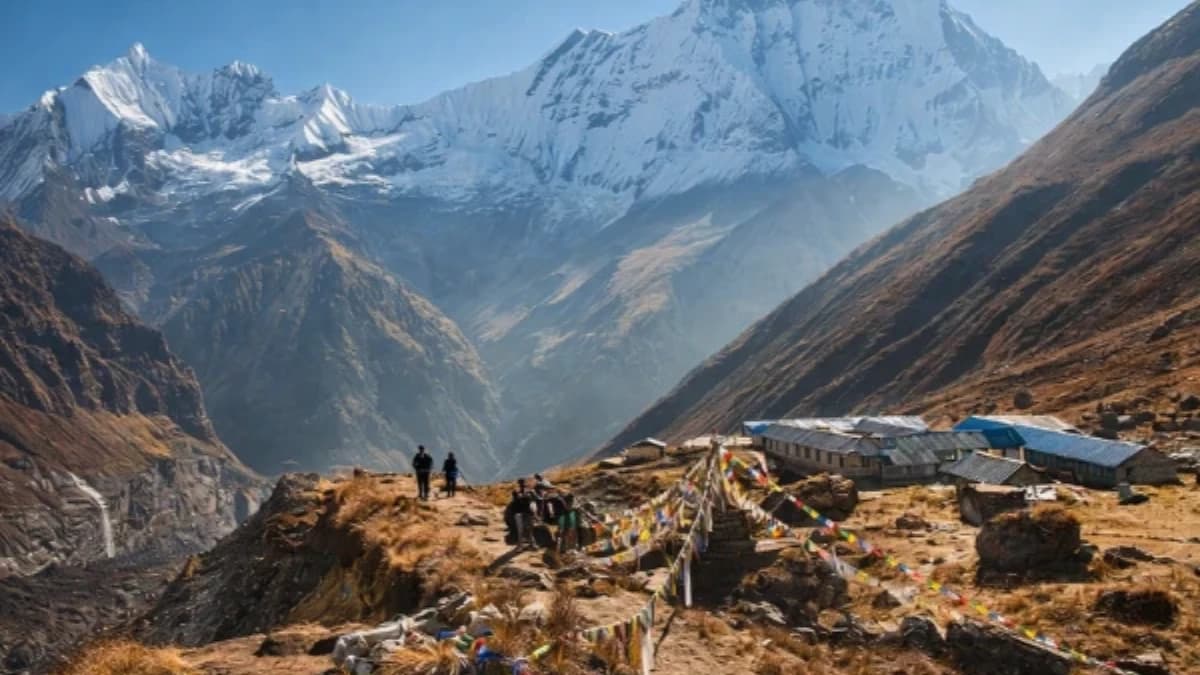
The mountains appear all at once. You round a bend on the moraine trail above Chomrong, the bamboo thins, the cloud lifts, and suddenly you are standing inside a ring of ice. Annapurna I (8,091m) fills the northern sky. Annapurna South closes the west. Machhapuchhre, the sacred Fishtail, rises to the east with its twin summit catching the first gold of morning. Between them, glaciers tumble into a bowl of silence so deep you can hear your own heartbeat. This is the Annapurna Sanctuary, a natural amphitheatre at 4,130 metres (13,550ft) that the Gurung people have considered sacred ground for centuries. No roads reach here. No helicopters land. The only way in is on foot, and you have just walked it.

This 9-day trek takes you from Pokhara, Nepal's lakeside adventure capital, through terraced hillsides and Gurung villages, up through rhododendron forests that blaze crimson in spring, past bamboo groves and waterfalls, and into the heart of the Annapurna Conservation Area. You'll sleep in teahouses run by families who have hosted trekkers for generations, eat dal bhat and Nepali momos cooked over wood fires, and soak tired muscles in the natural hot springs at Jhinu Danda on the way down. It is one of Nepal's most rewarding treks packed into just nine days, designed by Shreejan Simkhada, whose family has been guiding people through these mountains since the 1960s.

What Makes This Trek Unforgettable

  • Stand inside the Annapurna Sanctuary, a 360-degree amphitheatre of peaks above 7,000 metres, with Annapurna Base Camp at its centre (4,130m / 13,550ft)
  • See Machhapuchhre (Fishtail) from closer than almost any other trail in Nepal. No climbing permit has ever been issued for this sacred peak, and from ABC, its sheer south face fills half the sky
  • Walk through Ghandruk, one of Nepal's most beautiful Gurung villages, where stone houses with slate roofs sit among terraced fields and the Gurung cultural heritage is still very much alive. You'll pass prayer flags strung between stone houses and hear stories of mountain gods
  • Soak in the natural hot springs at Jhinu Danda on the descent, where a riverside pool heated by geothermal springs sits beneath the forest canopy
  • Trek through rhododendron forests that explode in red, pink and white blooms from March to May, creating one of the most spectacular spring displays in the Himalayas
  • Complete one of Nepal's classic high-altitude treks in just 9 days, making it achievable even with limited annual leave
  • All permits included (ACAP and TIMS), so you don't need to spend a day in Kathmandu queuing at government offices
  • Small groups of 2 to 20, always with a Nepal government well-trained guide who knows this trail intimately
  • Three tiers (Budget, Standard, Luxury) so you can choose the comfort level that suits you without compromising on safety or expertise
  • Every booking supports education for 70 children in rural Nepal through the Nagarjun Learning Center

9-Day Overview

Your journey begins and ends in Kathmandu, but the trek itself starts from Pokhara, reached by a scenic drive through Nepal's middle hills. From Pokhara, you travel to Nayapul, the traditional trailhead for the Annapurna Sanctuary route. The first days climb through Ghandruk and Chomrong, two of the most photographed villages in the Annapurna region, where terraced fields cascade down hillsides and the mountain panorama grows wider with each hour of walking. Beyond Chomrong, the trail enters the Modi Khola gorge, passing through bamboo forests, past waterfalls, and up through increasingly stark alpine terrain to Deurali and Machhapuchhre Base Camp (MBC). From MBC, a final morning walk across the glacial moraine delivers you to Annapurna Base Camp itself. The descent follows a different line through Jhinu Danda, where the hot springs provide a perfect end to the mountain days before returning to Pokhara and then Kathmandu.

Before You Arrive

Please arrive in Kathmandu the day before your trek starts. This gives you time to recover from your international flight, meet your guide, and do any last-minute gear shopping in Thamel if needed. We arrange your hotel and airport transfer, so you can step off the plane knowing everything is sorted. Make sure your Nepal visa and trekking insurance are in order before you fly, and bring enough Nepali rupees for personal spending on the trail.

Online Briefing

After you book, we schedule a video call to walk you through everything: what to wear, what to pack, what the teahouses are really like, how acclimatisation works on this route, and anything else on your mind. This is also when you share your hotel preferences in Kathmandu and Pokhara so we can match the right accommodation to you. No question is too small.

Transport

All three tiers travel the same route: Kathmandu to Pokhara by road (approximately 6-7 hours), then Pokhara to Nayapul (about 1.5 hours) to reach the trailhead. The return follows the same route in reverse. The difference between tiers is the vehicle. Budget trekkers travel by local tourist bus or shared vehicle, which is comfortable, safe and well-used by Nepalis and travellers alike. Standard trekkers ride in a private tourist vehicle with more legroom and air conditioning. Luxury trekkers get a premium private vehicle with extra comfort for the long drive. There are no flights on this itinerary; everything is by road, which keeps costs down and gives you more of Nepal's countryside. For a full breakdown of what trekking in Nepal actually costs, see our complete cost guide.

Your Trek, Your Way

Every trek we run is arranged privately for your group. You won't be paired with strangers unless you choose to join a public departure. Whether you book as a solo trekker, a couple, or a group of friends, this itinerary belongs to you. Want to add a rest day? Spend longer in Ghandruk? Extend to include Poon Hill? We can adjust. Our three tiers (Budget, Standard and Luxury) give you genuine choice over accommodation, meals, porter support and transport without affecting the route itself. Same expert guides. Same safety standards. Three comfort levels. Read more about what the price difference actually buys or explore our budget trekking guide.

Difficulty

We rate this trek Moderate to Challenging (3 out of 5). That rating reflects the combination of altitude, terrain and daily walking hours rather than any single extreme element. You'll reach 4,130 metres at ABC, which is high enough for altitude sickness to be a genuine concern. The ascent from Chomrong involves thousands of stone steps, both up and down, and the infamous Chomrong staircase is a test for even experienced trekkers. Daily walking ranges from 4 to 7 hours over uneven trails, river crossings on suspension bridges, and sections of exposed moraine near the base camp. The trail gains altitude rapidly once you leave the Modi Khola valley, so good cardiovascular fitness and proper acclimatisation habits matter. Our guides carry a pulse oximeter and monitor your oxygen levels daily, and we build the itinerary with a steady altitude gain profile. If you can comfortably walk 6-7 hours a day on hilly terrain, you can do this trek. If you have concerns, read our beginner's guide to Nepal trekking.

Compare Our Three Packages

Feature Budget Standard Luxury
Price from USD $425 USD $750 USD $1,200
Meals Not included (order and pay at teahouses) 3 meals daily + tea, fruits and 2L water All meals + all drinks (except alcohol)
Room Shared teahouse room Private twin with attached bathroom Private deluxe with bed heater
Porter Not included 1 porter per 2 trekkers 1 porter per trekker (carry nothing)
Guide 1 guide per group (assistant at 8+) 1 guide per 6 trekkers (assistant at 6+) 1 guide per 2 trekkers
Transport Local vehicle Private tourist vehicle Luxury private vehicle
SIM & Data SIM card only SIM with limited data SIM with unlimited data (see our SIM card guide)
Best for Backpackers and independent travellers Comfort trekkers, couples, families Premium experience seekers

Himalayas for Every Budget. Same expert guides, same safety, three comfort levels. Every tier includes all permits, a Nepal government well-trained guide, airport transfers and 24/7 emergency support. The only things that change are the comfort details. Read our full comparison of what the price difference actually buys or explore luxury trekking in Nepal. Note: in Pokhara, only breakfast is included at your hotel across all tiers; other meals in Pokhara are at your own expense and choice, giving you the freedom to explore the city's lakeside restaurants. Check our guide on WiFi and charging on the trail so you know what to expect above Chomrong.

Your Trek, Our Family

The Everest Holiday is not a faceless agency. It's a family.

Hari Lal Simkhada, Shreejan's grandfather, arranged logistics and supported Himalayan expeditions in the 1960s and 1970s, back when reaching Nepal's high mountains required weeks of approach marching and a willingness to solve problems nobody had solved before. Ganesh Prasad Simkhada, Shreejan's father, has held senior positions in Nepal's tourism and mountaineering institutions, helping shape the industry that now brings over 200,000 trekkers to Nepal each year.

Today, Shreejan Simkhada runs The Everest Holiday as CEO and third-generation guide. He personally designs every itinerary, selects every guide, and remains available to trekkers before, during and after their trip. This is not a company where you are handed off to a call centre. When you message us on WhatsApp (+977 9810351300), you are talking to the family.

Our Credentials

  • 196 TripAdvisor Reviews, rated 4.9 out of 5, TripAdvisor Travellers Choice 2024
  • 108+ Google Reviews, rated 4.9 out of 5
  • TAAN Certified, Member #1586, Government Registration: 147653/072/073
  • Secure 10% deposit processed through Himalayan Bank Limited, Nepal's most trusted commercial bank
  • Himalayas for Every Budget: three tiers, one standard of care
  • Three generations of Himalayan guiding since the 1960s

Solo Trekkers Welcome

Most of our trekkers book alone. It's the single most common booking type we receive, and if you're wondering whether it's strange to trek solo in Nepal, it isn't. Nepal's mandatory guide rule means nobody treks without professional support, and our small groups (2-20 people) mean you'll be walking with a handful of like-minded travellers, not a convoy. By day three, most groups feel like family. You can book a private departure if you prefer to walk with just your guide, or join a public group to share costs and meet people. Either way, you are not alone out there. You'll want to read our guide on Nepal travel etiquette before you go, and our notes on tipping your guide and porter. Read more in our solo female trekking guide (the advice applies to everyone, not just women).

Difficulty

Moderate to Challenging (3 out of 5). Here is what that means in practical terms for the Annapurna Base Camp trek.

The maximum altitude is 4,130 metres (13,550ft) at ABC. This is well above the threshold where altitude sickness can occur, and the rapid altitude gain from Chomrong (2,170m) to ABC over just three trekking days demands respect. Our guides monitor your oxygen saturation with a pulse oximeter and know when to slow down, when to push on, and when to turn back. We also recommend consulting your doctor about Diamox before departure.

The terrain is relentless in places. The Chomrong staircase involves roughly 2,500 stone steps descending into the Modi Khola valley and then climbing back up the other side. Your knees will know about it. Bring your camera but also trekking poles. Above Bamboo, the trail follows the river gorge through increasingly narrow and steep sections. Near Deurali and MBC, you're walking on exposed moraine and loose stone. River crossings are made on suspension bridges, some of them narrow and high.

Daily walking hours range from 4 to 7 hours, with the longest days on the approach to ABC and the descent day. You should be comfortable walking uphill for extended periods, and ideally have done some hill training before arrival. If you're unsure, our beginner's guide covers what fitness level is genuinely required.

Trek With a Purpose — Changing the World, One Step at a Time

In 2019, Shreejan Simkhada and Shamjhana Basukala founded the Nagarjun Learning Center in one of Nepal's most remote communities. Today, 70 children receive free education and hot meals every school day at the centre's flagship branch in Saldum Village, Dhading District. More than 600 people have received free medical care through annual health camps. 275 women have been reached through support and skills programmes. Seven learning centres now operate across Nepal.

The Nagarjun Learning Center is verified and listed on the UN Partner Portal.

When you trek with us, you are not just climbing mountains. You are building futures. A portion of every booking goes directly to the centre, funding teachers, meals, and internet access for children who had none before. Every trek also upholds our commitment to responsible trekking and porter welfare. You can learn more at nepallearningcenter.com.

What Trekkers Say About This Trek

"The Annapurna Sanctuary took our breath away. Standing inside that amphitheatre of peaks at sunrise, with Machhapuchhre glowing orange above us, was the most beautiful morning of my life. Shamjhana organised everything beautifully."

— Anna Bergström, Sweden (TripAdvisor, 5 stars)

"As a solo female traveller I felt completely safe the entire trek. Our guide Janak knew every teahouse owner by name and always got us the best rooms. The hot springs at Jhinu after days of trekking were absolute heaven."

— Rachel Adams, United States (Google, 5 stars)

"I took my 14-year-old daughter on the ABC trek and it was the best family holiday we have ever had. The trail was manageable, the teahouses were comfortable, and our guide was patient and encouraging with her every step."

— Michelle Laurent, France (TripAdvisor, 5 stars)

"Did ABC in November 2025. Crystal clear views every single day. The Chomrong stairs nearly killed me but the sanctuary made it all worthwhile. Shreejan answered every question I had before the trip within minutes."

— Thomas Keller, Germany (TripAdvisor, 5 stars)

"Third time trekking in Nepal, first time with The Everest Holiday. Wish I had found them sooner. The standard package was excellent value — all meals, great guide, and the 10% deposit made booking easy."

— James Whitfield, Australia (Google, 5 stars)

Read all 320+ reviews →

Short Itinerary
Day 01: Drive from Kathmandu to Pokhara (820m / 2,690ft)
Max Altitude: 820m / 2,690ft
Day 02: Drive to Nayapul, trek to Ghandruk (1,940m / 6,364ft)
Max Altitude: 1,940m / 6,364ft
Day 03: Trek from Ghandruk to Chomrong (2,170m / 7,120ft)
Max Altitude: 2,170m / 7,120ft
Day 04: Trek from Chomrong to Deurali (3,174m / 10,413ft)
Max Altitude: 3,174m / 10,413ft
Day 05: Trek from Deurali to Annapurna Base Camp (4,130m / 13,550ft) via MBC
Max Altitude: 4,130m / 13,550ft
Day 06: Trek from Annapurna Base Camp to Bamboo (2,310m / 7,579ft)
Max Altitude: 2,310m / 7,579ft
Day 07: Trek from Bamboo to Jhinu Danda (1,780m / 5,840ft)
Max Altitude: 1,780m / 5,840ft
Day 08: Trek to Nayapul, drive to Pokhara (820m / 2,690ft)
Max Altitude: 820m / 2,690ft
Day 09: Drive from Pokhara to Kathmandu (1,400m / 4,593ft)
Max Altitude: 1,400m / 4,593ft
Expand
Detailed Itinerary
Day 01:

The road out of Kathmandu climbs through the city's western edge before dropping into the green corridor of the Prithvi Highway, a 200-kilometre ribbon of tarmac that follows the Trisuli River gorge through some of Nepal's most dramatic middle-hill scenery. Your driver will make stops at local roadside restaurants where the dal bhat is fresh and the chai is sweet, and you'll watch the landscape shift from the red-brick sprawl of the Kathmandu Valley to the terraced rice paddies and banana groves of the subtropical lowlands. By the time the highway rounds its final bend and the turquoise water of Fewa Lake appears below, framed by the white wall of the Annapurna range, you'll understand why so many trekkers say this drive is a highlight in itself.

The journey takes approximately seven to eight hours depending on traffic and road conditions. Budget trekkers travel by local tourist bus, a comfortable and well-used service that runs daily. Standard trekkers ride in a private tourist vehicle with more legroom and air conditioning. Luxury trekkers get a premium private vehicle for the entire drive. Whichever tier you choose, the scenery is the same, and it is spectacular.

Pokhara sits at 820 metres on the shore of Fewa Lake, with the Annapurna massif rising directly to the north. It is Nepal's adventure capital, home to paragliding, kayaking, and some of the country's best lakeside restaurants. Your evening is free, and we recommend walking the Lakeside strip, watching the sunset paint Machhapuchhre gold from the water's edge, or simply sitting on a rooftop with a coffee and letting the mountain view sink in. Your hotel is in the heart of Lakeside, within walking distance of everything. Breakfast is included at your hotel across all tiers. Other meals in Pokhara are at your own expense, giving you the freedom to explore the city's food scene at your own pace. If you'd like recommendations, your guide knows every kitchen worth visiting.

Note on meals in Pokhara: Across all three tiers, only breakfast is included at your Pokhara hotel. Lunch and dinner are at your own choice and cost, both tonight and on any other evenings spent in Pokhara. This is intentional: Pokhara has dozens of excellent restaurants ranging from Nepali thali sets to wood-fired pizza, and we want you to enjoy whatever catches your eye rather than being locked into a group dinner. See our full guide to food on Nepal treks for what to expect once you're on the trail.

View the full Annapurna Base Camp Trek route on Google Maps

Max Altitude: 820m / 2,690ftAccommodation: Hotel in PokharaDuration: 7-8 hourDistance: 200 km/135 miles
Day 02:

The morning drive from Pokhara to Nayapul takes about ninety minutes, winding through green foothills past Tibetan refugee settlements and roadside chai stalls. At Nayapul, you step out of the vehicle and onto the trail. The transition is instant: one moment you're in a dusty market town, the next you're walking along a stone path through terraced fields with the sound of the Modi Khola river echoing from the valley below. From Nayapul, a short jeep ride takes you up to Kimche, saving roughly ninety minutes of road walking without missing any of the good scenery.

From Kimche, the trail climbs steadily through farmland and scattered Gurung homesteads. The path is well-maintained stone steps for much of the way, wide enough for two people to walk side by side. Mule trains pass occasionally, their bells jangling as they carry supplies to the villages above. Rhododendron trees line the upper sections, and in spring (March to May) they burst into crimson and pink blooms that turn entire hillsides into a natural garden.

Ghandruk is one of the most beautiful villages in the Annapurna region. Stone houses with slate roofs sit on a wide shelf overlooking the Modi Khola valley, with Machhapuchhre (Fishtail) and Annapurna South filling the northern skyline. The village is the cultural heart of the Gurung people, and you'll see their traditions everywhere: in the carved wooden doorways, the prayer flags strung between houses, the small museum documenting Gurung life, and the elderly women spinning wool on their porches. Your teahouse sits on the village's upper edge with uninterrupted mountain views from the dining room.

This is a gentle first day of trekking, roughly three to four hours of walking with moderate elevation gain. It is designed to ease your body into the rhythm of trail life before the bigger days ahead. Your guide will point out the route to Annapurna Base Camp visible on the far side of the valley, a thin line scratched into the mountainside that you will be walking in three days' time.

Max Altitude: 1,940m / 6,364ftAccommodation: Teahouse in GhandrukDuration: 3 hrs.Elevation: 156 m/511.811ft.
Day 03:

You leave Ghandruk on a stone path that descends steeply through terraced fields to the Kimrong Khola, a tributary of the Modi Khola that runs cold and fast from the glaciers above. The suspension bridge across it sways gently underfoot, and on the far side the trail begins its long climb toward Chomrong. This is the day you'll feel the trek in your legs for the first time. The ascent is relentless in places, gaining and losing hundreds of metres through forested ridges and small settlements where children wave from doorways and farmers tend their terraces with hand tools that haven't changed in centuries.

The trail passes through patches of dense rhododendron forest where sunlight filters through the canopy in shafts of green and gold. Birdlife is abundant: you may spot Himalayan monals with their iridescent plumage, laughingthrushes calling from the undergrowth, or eagles circling on thermals high above the valley. The Annapurna Conservation Area protects this entire corridor, and the effect is visible. The forests are thick, the water is clean, and the wildlife has not learned to fear humans.

Chomrong sits at 2,170 metres on a steep hillside overlooking the entrance to the Annapurna Sanctuary. It is the last major village before the trail enters the Modi Khola gorge, and the last place with reliable WiFi, hot showers, and phone charging. The teahouses here are some of the best on the trail, with proper beds, attached bathrooms at higher tiers, and dining rooms that serve everything from momos and dal bhat to apple pie. Stock up on snacks and charge your devices tonight. Above Chomrong, facilities become simpler and the mountains become bigger.

From Chomrong's terrace, you can see directly into the Annapurna Sanctuary. Annapurna South dominates the left, Hiunchuli guards the right, and the gap between them is the gateway you'll walk through tomorrow. It is one of the most dramatic views on the entire trek, made better by the knowledge that you are about to enter it on foot. Your guide will brief you on acclimatisation protocols for the days ahead.

Max Altitude: 2,170m / 7,120ftAccommodation: Teahouse in ChomrongDuration: 4 hoursDistance: 10–13  km /6–8  milesElevation: 230 m /754.593.
Day 04:

Today you enter the Annapurna Sanctuary. The day begins with the infamous Chomrong staircase: roughly 2,500 stone steps that descend steeply into the Modi Khola gorge before climbing back up the other side. It is the most physically demanding section of the entire trek, and it comes early in the morning when your legs are still cold. Take it slowly. Rest at the bottom where a small suspension bridge crosses the river, drink some water, and remind yourself that everyone who reaches Annapurna Base Camp has climbed these same steps.

Once past the staircase, the trail enters a world that feels entirely different from the Gurung villages below. Bamboo forests close in around the path, their stalks creaking in the wind. The air is cooler and damper, and the light takes on a green underwater quality. You pass through the tiny settlement of Sinuwa, then descend again to the river before climbing to Bamboo (2,310m), a cluster of teahouses in a clearing surrounded by towering bamboo and rhododendron. From Bamboo, the trail follows the river gorge upward through increasingly alpine terrain. The bamboo gives way to scrubby birch and juniper, the valley narrows, and waterfalls tumble from cliffs on both sides.

You'll stop for lunch at Himalaya Hotel (2,890m), a lonely settlement perched on a ledge above the river. The food is simple but filling: dal bhat, noodle soup, chapati with vegetables. From here, the trail climbs more steeply through open grassland dotted with boulders and crossed by small streams. The altitude is starting to make itself felt now, and your guide will remind you to drink water regularly and walk at a steady pace.

Deurali sits at 3,174 metres on a flat shelf above the river, with views up into the narrowing sanctuary ahead. The teahouse here is basic but warm, and the staff know exactly what tired trekkers need: hot water, a filling dinner, and a thick blanket. Your guide will check your oxygen levels with the pulse oximeter tonight and brief you on tomorrow's plan. You are now above the tree line, and the air is noticeably thinner. Altitude awareness matters from this point forward. Drink at least three litres of water today, avoid alcohol, and report any headache or nausea to your guide immediately.

Max Altitude: 3,174m / 10,413ftAccommodation: Teahouse in DeuraliDuration: 7  hoursDistance: 10-12 km/6-7 milesElevation: 1,000 m/3280.84ft.
Day 05:

This is the day you've been walking toward. You leave Deurali early, before the sun has reached the valley floor, and follow the Modi Khola upstream through a landscape of glacial moraine and scattered boulders. The trail is exposed and the air is cold, but the views ahead are already extraordinary. Machhapuchhre's south face grows larger with every step, its twin summit catching the first pink light of dawn while the valley below remains in shadow.

Machhapuchhre Base Camp (MBC) sits at 3,720 metres on a broad plateau with views in every direction. Despite the name, MBC is not actually at the base of Machhapuchhre. It is a resting point on the trail, named for the mountain that dominates the skyline to the east. You'll stop here for tea and perhaps a second breakfast, sitting on a bench outside the teahouse while your guide points out the peaks: Machhapuchhre (6,993m), Annapurna III (7,555m), Gangapurna (7,455m), and the ridge of Annapurna South that walls off the western sky.

From MBC, the trail crosses a broad glacial valley floor strewn with rocks deposited by ancient ice flows. The walking is relatively flat but the altitude makes every step feel heavier than it should. You're above 3,700 metres now, and the oxygen content of the air is roughly 60% of what it is at sea level. Walk slowly. Breathe deeply. Stop whenever you need to. There is no rush. Annapurna Base Camp is less than two hours ahead.

And then you arrive. The trail rounds a final moraine ridge and the Annapurna Sanctuary opens up in front of you like a natural amphitheatre. Annapurna I (8,091m), the tenth highest mountain on earth, fills the northern horizon. Annapurna South closes the west. Hiunchuli, Tent Peak, and Machhapuchhre complete the circle. You are standing inside a ring of ice at 4,130 metres, in a place the Gurung people have considered sacred for centuries. The silence is vast. Your guide will help you find the best spot for photographs, and you'll have the afternoon to explore the moraine ridges, visit the memorial plaques for climbers who didn't come home, and simply sit with the view. Sunset at ABC, when the peaks turn from white to gold to pink to purple, is one of the most moving experiences in all of Himalayan trekking.

Max Altitude: 4,130m / 13,550ftAccommodation: Teahouse at ABCDuration: 2–3  hoursDistance: 7 to 8 kilometers (4.3 to 5 miles)Elevation: 1,240 meters/4,068.2 ft.
Day 06:

Wake early for sunrise. If the sky is clear, and at this altitude it usually is, the first light hits the summit of Annapurna I while the base camp is still in cold blue shadow. The entire amphitheatre turns gold from the top down, peak by peak, as the sun climbs higher. It lasts perhaps twenty minutes, and it is the kind of morning that stays with you for years.

After breakfast, you begin the long descent. The return from Annapurna Base Camp retraces the same trail through MBC and Deurali, but the perspective is entirely different going downhill. You're facing south now, looking out of the Sanctuary toward the green hills and river valleys below, and the sense of emerging from the mountains is dramatic. The air thickens, the temperature rises, and the vegetation returns in layers: first scrubby grass, then juniper, then birch, then the tall bamboo forests that give your destination its name.

The descent is harder on the body than the ascent in some ways. Downhill walking puts pressure on the knees, ankles, and toes, and the stone steps that were difficult to climb are even more difficult to descend safely when wet. Trekking poles are strongly recommended. Your guide will set a pace that protects your joints while maintaining good progress. You'll stop for lunch at Himalaya Hotel or Deurali, where the dal bhat tastes even better than it did two days ago now that you're burning through altitude-earned appetite.

Bamboo sits at 2,310 metres in a narrow clearing surrounded by the dense bamboo groves that line the Modi Khola gorge. The teahouse is simple but welcoming, and the atmosphere among trekkers is celebratory. Everyone at Bamboo today has just come from Base Camp, and the dining room conversation is full of shared summit stories, photograph comparisons, and plans for what comes next. You've dropped almost 1,800 metres today, and your body will thank you for the thicker air and warmer temperature tonight.

Max Altitude: 2,310m / 7,579ftAccommodation: Teahouse in BambooDuration: 6  hoursDistance: 15 to 19 kilometers (9 to 12 miles)Elevation: 1,780 m/5,839.8 ft.
Day 07:

The trail from Bamboo descends through forests that feel almost tropical after the stark moraine of the upper Sanctuary. Rhododendron, oak, and bamboo canopy the path, and the sound of running water is constant. The Modi Khola is a proper river now, wide and fast, and you'll cross it on suspension bridges that bounce gently with each step. This is some of the most pleasant walking on the entire trek: downhill, shaded, with the relief of knowing the hard altitude days are behind you.

Rather than returning via Chomrong and the brutal staircase you descended on Day 4, the trail takes a different line through the forest, branching off before the Chomrong climb and following a quieter path that contours along the hillside to Jhinu Danda. This alternative route avoids the steepest sections and gives you a completely new perspective on the valley you've been trekking through.

Jhinu Danda is famous for one thing: its natural hot springs. A ten-minute walk below the village, beside the river, stone-lined pools fed by geothermal springs sit beneath a canopy of subtropical trees. The water is hot enough to loosen every muscle you've been using for the past week, and the setting, with the river rushing past and the forest rising on both sides, is one of those perfect Nepal moments that photographs can't quite capture. Standard and Luxury trekkers have entrance included. Budget trekkers pay a small fee at the gate (around 100 rupees). Bring a swimsuit and a towel.

Your teahouse in Jhinu Danda sits on a ridge above the springs with views down the valley. The evening feels like a celebration. The trek's hard days are done, the hot water has unknotted your calves and shoulders, and tomorrow is your final morning on the trail. If you've been waiting for the right moment to buy your guide and porter a round of Nepali tea and say thank you, tonight is it. See our guide on tipping your guide and porter for what's appropriate.

Max Altitude: 1,780m / 5,840ftAccommodation: Teahouse in Jhinu DandaDuration: 4 hoursDistance: 8.5 to 11.7 kilometers (5.3 to 7.3 miles)Elevation: 570 m 1870.08 ft.
Day 08:

Your final morning on the trail begins with a steady descent from Jhinu Danda through terraced hillsides where farmers are already at work in the early light. The path follows the river valley downward, passing through small settlements where slate-roofed houses sit among orange and lemon trees. Children in school uniforms walk the same trail in the opposite direction, heading uphill to classrooms that seem impossibly remote by Western standards. These are the communities that the Annapurna Conservation Area project supports, and their presence on the trail is a quiet reminder that these mountains are not wilderness. They are home.

The trail reaches Nayapul after approximately three to four hours of walking, where your vehicle is waiting for the ninety-minute drive back to Pokhara. The transition from trail to road feels abrupt: one moment you're walking on stone steps, the next you're in a car watching the hills recede through the window. Most trekkers feel a mix of relief and loss. Your feet are grateful. Your heart wants one more day.

Back in Pokhara, the rest of the day is yours. You might visit Sarangkot for a sunset view over the lake and mountains, browse the shops along Lakeside, or simply collapse into a comfortable bed and sleep the deepest sleep of your trip. Many trekkers book a paragliding flight over Fewa Lake on this free afternoon, combining the mountain panorama with a rush of adrenaline.

Breakfast is included at your Pokhara hotel. Lunch and dinner are at your own choice and expense, giving you freedom to explore Pokhara's excellent restaurant scene. Your guide can recommend lakeside cafes, authentic Nepali restaurants, or quiet spots to sit with a coffee and process what you've just experienced.

Max Altitude: 820m / 2,690ftAccommodation: Hotel in PokharaDuration: 4 hoursDistance: 4  kilometers/2.4  milesElevation: 960 meters/3149.61 ft.
Day 09:

After breakfast at your Pokhara hotel, you'll start the seven to eight hour drive back to Kathmandu along the Prithvi Highway. The route follows the same road you drove on Day 1, but the experience feels completely different now. You've spent a week walking through the mountains that you're now watching from a car window, and the scale of what you've accomplished is easier to see from down here: the white peaks stretching across the northern horizon, the deep valleys you trekked through, the impossible steepness of the terrain you climbed on foot.

The drive includes rest stops at riverside restaurants where you can stretch your legs and have lunch (at your own expense). Your driver knows the best spots for views and the best spots for food, and the journey passes faster than you expect when the scenery is this good.

Back in Kathmandu, you'll have time to freshen up before the farewell dinner with your guide and the team. This is where Shreejan or your guide will present you with your achievement certificate and company T-shirt, and where you'll swap contact details with the people who have been walking beside you for the past nine days. The conversation is always good at farewell dinners: everyone has stories, everyone has a favourite moment, and everyone is already thinking about which trek to do next.

If you're flying out tomorrow, we'll arrange your airport transfer. If you have time in Kathmandu, your guide can recommend temples, markets, and cultural sites worth visiting. Many trekkers extend their trip with a Dhulikhel Namobuddha day hike, a visit to Bhaktapur, or a flight to Chitwan National Park for a wildlife safari. Whatever comes next, the Annapurna Sanctuary will stay with you. The ring of ice, the silence, the sunrise. You walked into it. You can always walk back.

Interactive Route Map

Explore the full trek route on our interactive Google Map. Click markers for altitude details at each stop.

Open Full Route Map in Google Maps

Max Altitude: 1,400m / 4,593ftDuration: 7-8 hoursDistance: 210 km/135 milesElevation: 530 m/1738.85 ft.
Couldn't find what you're after?Reach out to our travel experts.
Customise Trip
Route Map
Annapurna Base Camp Trek Route Map Nepal
Altitude Chart
Annapurna Base Camp - 9 Days
Availability
Book your own private small group trip

Discounts are determined exclusively by the size of your group. We do not add additional members to your group.

hbl logo
Secure Payment by Himalayan Bank.

Equipment Lists

Only pack what’s needed for the trek to travel light and comfortably. You can store your excess luggage at The Everest Holiday for free. Porters will carry your main trekking bag, but the weight limit is 10 kg for each trekker. Since one porter carries the luggage for two people, we suggest that you and a trekking partner share one large duffel bag (over 60 Liters).

  • Sun hat (wide-brimmed)
  • Beanie (for warmth)
  • A neck gaiter or buff (for warmth and sun protection)
  • Sunglasses with UV protection
  • Insulated gloves or mittens (for cold weather)
  • Waterproof gloves (for wet conditions)
  • A thick-wool or synthetic pair of moisture-wicking socks.
  • waterproof hiking boots with ankle support and excellent traction.
  • Sandals (for camp use or river crossings).
  • Gaiters protect.
  • Moisture-wicking t-shirts (short and long sleeves).
  • Thermal base layer (for colder conditions).
  • Fleece jacket and down jacket (Mandatory).
  • Lightweight puffy jacket (for extra warmth).
  • Waterproof and windproof jacket (Gore-Tex or similar).
  • Raincoat.
  • Lightweight, breathable long-sleeve shirt.
  • Polypropylene underwear (four).
  • Quick-drying pants/trousers (convertible or full-length).
  • Insulated pants (for colder conditions).
  • Lightweight cotton pants.
  • Wear long underwear or thermal leggings when it is cold.
  • Two pairs of thermal/trekking trousers (pants).
  • Biodegradable bar soap.
  • Toothbrush and toothpaste.
  • Medium-sized drying towel.
  • Wet wipes or hand sanitizers.
  • The toilet paper is stored in a Ziplock bag.
  • Feminine hygiene products.
  • Travel-sized shampoo.
  • Nail clippers.
  • Small mirror.
  • A duffel bag with a capacity of over 60 litres is intended for porters, with one duffel bag for every trekker.
  • An individual's daypack or backpack with a 20- or 30-litre capacity should be plenty.
  • Adjustable and lightweight poles (preferably collapsible)
  • A two-litre water bladder or bottle (with a protective cover for cold climates)
  • Use water purification methods such as purification tablets, filter bottles, or UV filters.
  • Camera/smartphone (extra memory cards and batteries)
  • A portable charger, spare batteries, or a battery pack
  • Two-pin charging plug
  • Basic first aid supplies include band-aids, antiseptic wipes, pain relievers, and Diamox (which is used to prevent or lessen symptoms related to mountain sickness).
  • Personal medications (inhalers, allergy meds, etc.)
  • Few passport-size photos
  • Passport photocopies
  • Notebook and pen
  • Binoculars
  • Basic first aid kit (band-aids, antiseptic wipes, pain relievers, etc.)
  • Diamox (for altitude sickness prevention/relief)
  • Personal medications (inhalers, allergy meds, etc.)
  • Water purification (tablets, filter bottle, UV filter)
  • Energy bar
  • Lightweight headlamp (with adjustable brightness)
  • Face wipes
  • An extra pair of batteries
Essential Information

Annapurna Base Camp Trek Information

Welcome, Arrival, and Start of the 9-day Trek

When you get to Tribhuvan International Airport (KTM), our agent will be waiting for you in the arrivals area. They will be carrying a sign with your name on it and will greet you in a loving, traditional way with a marigold garland or a Khada, which is a white ceremonial scarf that stands 
for respect and good luck. After a short introduction, we will be taken to a private car that will take you to the hotel of your choice in Kathmandu.
Please make sure you get to Kathmandu at least one day before your hike so you can get ready and go over the details. On the first day, we'll go on a tourist bus and have a beautiful 6–8 hour journey to Pokhara. You can arrange private transportation or flights for an extra fee.

Lodging

The Annapurna Base Camp Trek is a 9-day hike with eight nights of lodge-to-lodge accommodation. You'll stay at a lodge or teahouse. Along the walk, there will be different facilities, such as hot showers, electricity for charging devices, and wifi, but these will cost extra. You will need at least two additional nights in Kathmandu, but our package does not cover them.

Food

This trek reaches high altitudes near the world’s tallest peaks, so your body needs plenty of carbohydrates, proteins, and other nutrients. While food options may be limited, we will ensure you have enough healthy and tasty meals throughout the trek. This package includes three standard meals throughout the trek. 

The menu primarily includes traditional Nepali, Asian, and Western dishes on the trek. We highly recommend sticking to healthy and hydrating options like fresh vegetables, green tea, hot lemon, ginger tea, and garlic soup. For a hearty and energizing meal, try the local favourite, Dal Bhat Tarkari (lentil soup, rice, and vegetable curry). The package does not include personal expenses such as alcoholic drinks, tea, coffee, cold drinks, or snacks at tea houses or cafes.

No meals are included in Pokhara except for breakfast at your hotel, and no meals will be provided during the drive between Kathmandu and Pokhara, as there are many dining options available on the highway and in Pokhara, allowing you to choose your preferred meals.

Baggage

We provide one porter for every two trekkers. Each trekker’s luggage limit is 10 kg, so a porter will carry no more than 20 kg in total. We never overload our porters. You will still need to carry a small backpack for your valuables. We recommend bringing only essentials. Extra baggage can be stored for free at your hotel or with us. All luggage and gear will be checked before the trek begins.

Important Things and Facilities

Water

You can buy bottled water from shops along the trekking route or drink boiled or filtered water provided at the lodges. We strongly recommend bringing a reusable water bottle and refilling it with boiled water to help reduce plastic waste. Avoid drinking untreated tap, river, or well water, as it may cause sickness. For added safety, carry water purification tablets or buy them at local shops on the trail. To avoid altitude sickness and keep your energy up on your walk, it's vitally crucial to drink plenty of water at high altitudes.

Travel Essentials

Visa

Foreigners require a visa to enter Nepal, but Indians don't. Most people can get a visa when they arrive at Kathmandu International Airport. The current fee is USD 50 for 30 days, payable in cash. Citizens of China and SAARC countries receive a free visa. Also, we recommend you to inform your country embassy or consulate of your visit to Nepal and your travel partner here. 

Travel insurance

This trek is easy in terms of hiking, but it takes place at high altitudes, so there is a small risk of altitude sickness and other hazards. Therefore, travel insurance is required. Your policy must cover medical expenses and emergency helicopter rescue up to an altitude of 4500 metres. We ask our clients to provide detailed insurance information within a week of booking. In case of an emergency, we will use your insurance details to arrange a quick evacuation and transfer to medical facilities. 

Currency Exchange

The Nepali Rupee (NPR) is the country's official currency; one US dollar is equivalent to around 130 NPR. In Kathmandu, you may find banks and approved money exchange centres where you can exchange major foreign currencies. ATMs are widely available to withdraw NPR, but extra service fees may apply. Make sure your notes are new and undamaged, as old or torn bills may be refused. Only the 100 INR note from India is legally accepted in Nepal. It’s best to exchange money in Kathmandu before heading to trekking regions, as exchange options in remote areas are limited.

Extra Expense

While our package covers most of your expenses during the trek, you will need to budget for some personal items like meals and accommodation in Kathmandu, visa fees, snacks, hot showers, personal equipment, tips for the crew, etc. We recommend you budget approximately $20 USD per day for these personal expenses during the trek.

Trek Season and the Weather

The Annapurna Base Camp Trek is open from March to May and September to November, and it is a safe season for trekking. Spring (March–May) is ideal, with clear skies, blooming rhododendrons and views of Mt. Annapurna. Daytime temperatures range from 18 °C to 24 °C, dropping to -4 °C at night. Autumn (September–November) also offers stable weather and beautiful mountain views, with temperatures from 15 to 25°C and nighttime lows around -6 °C. Snow increases from December, making high passes difficult to cross.

A Typical Day on the Hike

Around 7 AM, you get a big breakfast to start your day. The normal trekking day lasts 4 to 6 hours, with a lunch break along the way. You can rest or explore in the evenings and then have supper and a briefing on the next day's plans.

Reservations and Rules

Personal trek

We can only provide a personal trek, so you will only be trekking with your group. We will never add strangers to your treks. All the treks are customizable per your schedule.

Individual-Group bookings 

Our treks are organised with a minimum of 2 people, so if anyone is alone and does not have a friend or family joining them, we can organise a group trek open for all. If you prefer to join a group, we can also help you connect with other trekkers. Once you confirm, your group trek will 
be posted on our website, so others can join too. Our policy is designed to transform every trek into your own personal holiday in the Himalayas.

Trust trek booking

The Everest Holiday is a registered and bonded trekking operator, ensuring a secure booking process. We are proudly members of the Trekking Agency Association of Nepal (TAAN) and the Nepal Mountaineering Association (NMA). Our Founder, Mr. Ganesh Simkhada, has held senior positions in the Nepal Tourism Board (NTB) and former General Secretary of the Nepal Mountaineering Association (NMA). To confirm your booking, we require a 10% advance payment.

Payment options include the Himalayan Bank online portal (on our website), major credit cards, bank transfers, Wise, and Western Union. After you arrive in Kathmandu, you can pay the remaining balance. Please send us your important travel documents, such as a passport copy, within one week of booking. Please make sure your passport has a minimum of 6 months of validity remaining at your arrival date in Nepal.

Last-minute booking

We recommend booking your trek in advance. However, we also offer a last-minute booking option, which requires full payment 24 hours before departure. For the last-minute booking, please contact Shreejan at +977-9810351300 or email us at info@theeverestholiday.com. Please note that last-minute treks may face delays due to circumstances beyond our control. 

Flexible Schedule

Our trip schedule is determined by your travel date, and you can make any changes to it. If our scheduled trek dates don't work for you, please let us know, and we will be happy to arrange a trip according to your time and schedule.

Trip Extension

You can easily extend your stay with other adventures. We can arrange exciting activities for you, such as a jungle safari (Chitwan and Bardiya), Bungee jumping (Pokhara, Bhote koshi, Kushma), Rafting (Bhote koshi, Trishuli, and Seti river) and kayaking(Trishuli, and 
Pokhara), paragliding (Pokhara and Kathmandu), zip flying (Kathmandu, Pokhara and Kushma), canyoning (Pokhara and Sukhuta Beach), and Hot ballooning (Pokhara), according to your interests. We can also set up sightseeing tours around the Kathmandu Valley if you're interested in culture and history.

These tours will take you to UNESCO World Heritage sites like Bhaktapur Durbar Square, Patan Durbar Square, Kathmandu Durbar Square, Swayambhunath (Monkey Temple), Boudhanath Stupa, Changunarayan Temple, and Pashupatinath Temple. We suggest a trip to Nagarkot and Dhulikhel, hill stations just outside of Kathmandu, around sunrise for a serene getaway. We can also set up spiritual trips for Buddhists and Hindus that take you to temples, stupas, monasteries, and meditation centres. When you're booking a trip, please have a look at our ADD-ON package for an amazing adventure during the trek.

Ecotourism practices

We request that you join our eco-friendly trekking practice as part of our strong commitment to protecting the fragile beauty of the Everest region. Every guest will get their own eco-waste bag at the beginning of our trip. Please use this bag to collect all of your personal trash that can't be composted, like snack wrappers, plastic bottles, and batteries.

Please don't leave anything on the trail. Instead, carry this bag with you as we go down, and our guides will show you where to find the public trash cans and recycling bins where you can properly dispose of it. We need your help to keep the Himalayas clean and beautiful for future generations.

TEH Family 

We are a family firm that has been in the tourism business in Nepal for three generations. We believe that all of our employees and teams are family. we started as porters and now run an agency. Our professional and experienced guides and Sherpas will be with you the whole time to make sure your trek is safe and memorable. They know how to do first aid in the bush and rock climbing and how to stay safe in the mountains. They also speak good English. They are from the upper Himalayas, so they know the area well. We take care of their insurance, food, housing, and medical. Please treat our workers like family, and don't hesitate to ask for help or have questions at any time.

Trip conclusion 

Farewell Dinner 

We will celebrate our successful trek with a goodbye supper in Kathmandu after the trek. This is a great opportunity to share stories from your adventure and provide us with your feedback. We will also present you with a certificate of achievement to recognise your incredible 
accomplishment. 

Departure 

To arrange your airport transfer, please let us know your hotel name, room number, and flight departure details. We will take you from your hotel to Tribhuvan International Airport so you may catch your trip home. We sincerely hope you had an amazing journey and hope to see you again soon for another trip in Nepal. 

Tipping culture 

Tipping is a common practice in Nepal. We recommend giving a group tip to your guide and porters at the end of the trek. The amount is up to you and can depend on the quality of service, trip length, your budget, and the overall cost of the trek.

FAQs

How difficult is the 9-day Annapurna Base Camp trek, and is it suitable for beginners?
This trek is rated Moderate to Challenging (3 out of 5). There are many steep climbs and descents on stone stairs and rough roads along the track, but no technical climbing is required. This is a wonderful choice for  novices  who  are  in  decent  shape  and  have  done  some  training  before,  such  as  hiking, aerobics, and climbing stairs. The most important thing is to go at a modest, steady speed and become used to the new environment.

What is the highest point reached on this hike, and is there a chance of becoming sick from the altitude?
Annapurna Base Camp (4,130 m/13,549 ft) is the highest point. There is a chance of getting sick from being at a high altitude, but it's usually smaller than on treks like Everest Base Camp since the climb is more gradual and you don't sleep at really high elevations for more than one night. The trek has built-in acclimatisation; however, it's very important to drink enough water and tell your guide if you have any symptoms.

What is the usual number of people in a group for this trek? Will I be with other travelers?
Most groups are tiny, with only 2 to 10 people. This makes sure that the guide pays attention to you and that you have a better time overall. If you buy a trip by yourself, you will probably be put in a small group with other people who are also trekking. You have the option to organize private hikes.

How fit do I need to be to do this journey comfortably?
You need to be in good shape for your heart and lungs. You need to be able to walk for 5 to 7 hours a day for several days in a row with a daypack on rough  ground.  Before  the expedition, it's a good idea to go hiking, running, biking, and climbing stairs on a regular basis.

2. What should I do to be ready for the walk in the weeks before it?
 Work on your leg strength and stamina.
 Cardio: 3 to 4 times a week, do 45 to 60 minutes of cardiovascular activity like jogging, biking, or swimming.
 Squats, lunges, and calf raises are all good exercises for building leg strength.
 Practice treks: If you can, go on full-day treks on steep ground with your trekking boots and a full bag.

3. Are there any health requirements or immunizations that need to be met?
There are no required immunizations for Nepal, although it is a good idea to be up-to-date on common vaccines like MMR and Tetanus-Diphtheria. Many people who go trekking also think about  getting  shots  for  Hepatitis  A, Typhoid,  and  even  Japanese  Encephalitis.  At  least  two months before you leave, please see a travel doctor.

What permissions do you need for the Annapurna Base Camp Trek, and are they included in the price?
You need two permits:
 Annapurna Conservation Area Permit (ACAP)
 TIMS Card for Trekkers' Information Management System
Yes, most organized trekking tours include these things in the price. Your Company will take care of the paperwork.

2. What do the permits cost, and how do we get them?
 For foreigners, the ACAP costs NPR 3,000 (about $25).
 For solitary hikers, the TIMS card costs NPR 2,000; for trekkers in a group, it costs NPR 1,000.
 You may get  them  from  the  Nepal  Tourism  Board  headquarters  in  Kathmandu  or Pokhara. Before the hike, your trekking company will get these for you.

3. Do I have to give passport photographs for the permits?
Yes, you will need to send in two pictures of yourself that are the same size as a passport. You should carry a few extra pictures with you to Nepal.

Is travel insurance required, and what should the coverage include?
Yes, you must have full travel insurance.  Your policy has to cover:
 Evacuation by helicopter in an emergency (up to 4,500 meters)
 Sending someone back home
 Costs of medical care
 Cancellation or interruption of a trip
 Luggage that was lost

What do I need to do to get a visa for Nepal, and how much does it cost?
Most people may get a Visa on Arrival at Tribhuvan International Airport in Kathmandu without any trouble.
 Visa for 15 days: $30
 Visa for 30 days: $50
 Visa for 90 days: $125
 You will need to fill out an application form and provide passport photographs.

Is it possible to receive a visa when I arrive at Kathmandu airport?
Yes, getting a visa on arrival is easy for most nations.   The lines may be long, so having the right 
amount of cash and a picture ready can help things go more quickly.

Do you have to have a guide for the Annapurna Base Camp trek?
It is not legally required to hire a guide; however, it is strongly recommended. A guide keeps you safe, takes care of the details, teaches you about the culture, and makes your trip better overall. It is very important for those who are hiking alone or for the first time.

What does the guide do, and how many guides are there for each trekker?
The guide is in charge of finding your way, keeping an eye on your health, making sure you have a place to stay and food to eat, teaching you about the culture and environment, and fixing problems. 

In Budget
     The budget includes 8 trekkers and 1 assistant guide but does not include any porters.
In  Standar 
        There will be 6 trekkers and 1 assistant guide, along with 1 porter who can carry a maximum of 20 kg, which is equivalent to 10 kg per trekker.
In Luxury 
         2 trekkers, 1 assistant guide for the trekkers, and 1 porter who can carry no more than 20 kg (10 kg per trekker).

Are there porters available, and how much should you tip the guides and porters?
Usually, porters are hired to carry the major duffel packs (one porter for every two hikers). It's common to tip, and it's a big portion of their revenue.
 Guide: $15 to $25 each day, per group.
 Porter: $10 to $15 a day for each group.
The group members split the money and distributed it to each participant at the end of the walk as a thank you. 
 

What kind of place to stay can I expect on the hike (teahouses/lodges)?
You will sleep in teahouses, which are mountain lodges. These teahouses are basic yet decent places to stay. Most  of  them  provide  twin-share  rooms  with  hardwood  beds,  mattresses,  and  pillows. There are blankets, but a sleeping bag is better for warmth and cleanliness.

Do you have your own room or share one with someone else? Are hot showers available?
Most of the time, two people share rooms. For an additional fee, single rooms may be provided at lower altitudes, but they can't be guaranteed at higher teahouses. Most teahouses provide hot showers for an extra cost (USD $3–$5); however, at higher elevations, the water may not be very hot.

Is there a way to get electricity to charge electrical devices?
Yes, teahouses include power in the eating areas so that people may charge their electronics. But this service usually costs between $2 and $5 per hour for each device. It is very important to bring a power bank.

What sorts of food do the teahouses serve?
Teahouses  provide  many  different  kinds  of  food.  There  are  a  lot  of  items  on  the  menu, including
 Staples include soups, noodles, spaghetti, potatoes, and dal bhat (lentil soup with rice).
 Pizza, pancakes, fries, and eggs are some of the options in the West.
 Snickers bars, cookies, and popcorn are among the snacks.
 For hikers, Dal Bhat is the healthiest and most invigorating choice.

 Is the water I drink safe? How can I get clean water while I'm on the trek?
 You shouldn't drink tap water. You may get safe water by:
 Buying bottled water costs a lot and isn't good for the environment.
 Using pills or drops to purify water is a cheap and effective way to do so.
 The best and most eco-friendly choice is to use a reusable water bottle with a built-in filter.

Can  the  journey  handle  unique  nutritional  needs,  including  being  vegetarian,  vegan,  or gluten-free?
Yes, it's easy to accommodate vegetarian and vegan diets because many of the dishes, like Dal Bhat, are made with plants. There are fewer gluten-free choices, although they do exist (rice, potatoes, lentils). It's really important to let your trekking company know ahead of time.

When is the ideal time of year to go on the Annapurna Base Camp trek?
The finest times of year are
 Fall (September to November): This season offers clear skies, dependable weather, and great views of the mountains. This is the period when most people come. 
 From March to May, the weather is nice, and the rhododendron woods are in full flower.

What are the weather conditions like at the base camp (4130m) during the hiking season? 
During the day, temperatures can be nice and sunny, ranging from 5°C to 10°C (41°F to 50°F), but at night and in the early morning, it can be quite chilly. 
in the early morning, it can be quite chilly, sometimes plunging below freezing.   Outside of the normal seasons, it can be windy, and snow can fall.

What happens if the weather becomes bad or your flight is canceled?
This is a big reason to book with a well-known agency. They will handle any delays, arrange alternative transportation (like a private vehicle) in the event of a flight delay, and adjust the schedule as necessary. It's usually a good idea to include a flexible buffer day in your travel arrangements.

How do you handle altitude sickness?
 The steps are to stop, recognize, and go down.
 "Climb high, sleep low," drink a lot of water (3–4 liters a day), and go up slowly.
 Recognition:  Your  guide  will  keep  an  eye  on  you  for  signs,  including  headaches, dizziness, and nausea.
 Action: The only way to get better is to get down right away if you have symptoms. Don't go any higher.

What do you do if someone has a medical issue on the trail?
If there is a significant medical emergency, your guide will arrange for a helicopter to take you away. This is why you need insurance that covers emergency evacuation. All guides know how to give first aid in the bush.

 Are the paths easy to follow and safe to walk on?
The primary path to ABC is usually clear and well-used. But other parts have steep slopes, rough roads,  and  the  risk  of  landslides  if  it  rains.  A  guide  makes  sure  you  stay  on  the  safest  path, 
especially when you can't see well.

What are the most important clothes and gear for this hike?
 Broken-in waterproof hiking boots for your feet.
 Clothes include base layers that drain away moisture, mid-layers for warmth (such as a fleece or down jacket), and an outer shell to keep you dry and warm. fleece or down jacket), and an outer shell that keeps you dry and warm.
  A warm hat, gloves, sunglasses, a headlight, and a 30- to 40-liter daypack are all things you need.

Is it possible to rent trekking gear, such as sleeping bags or down jackets, in Kathmandu or Pokhara? 
You can simply and cheaply rent or buy good gear (sleeping bags, down jackets, trekking poles) in the Thamel neighborhood of Kathmandu or the Lakeside region of Pokhara.

If I have a porter, what is the weight restriction for my duffel bag?
A porter usually carries your duffel bag, which may hold 10 to 15 kg (22 to 33 lbs).   You will just need to carry a light daypack with water, food, a camera, and a jacket.

What is and isn't included in the cost of the trekking package?
 Most of the time, this fee includes all of your hotels, meals on the journey, a qualified guide, a porter, permits, and ground transportation.
 Usually not included are international flights, a visa for Nepal, travel insurance, personal costs  (snacks,  beverages,  Wi-Fi,  hot  showers,  battery  charging),  and  gratuities  for personnel.

How do I pay, and what happens if I need to cancel?
Most agencies ask for a deposit of 10% to 20% to hold the booking, and the rest is required when you arrive in Kathmandu. Read the conditions carefully because the cancellation policy is different for each case. It usually depends on how close to the trek date you cancel.

Are there any extra fees I should plan for while I'm on the trek?
 There are beverages like bottled water, tea, coffee, and soft drinks.
 Amenities: Wi-Fi, hot showers, and charging stations.
 Snacks: cookies and chocolate.
 For guides and porters, here are some tips.
 Meals: In Pokhara and Kathmandu.

Does the package cover the flight from Kathmandu to Pokhara?
It all depends on the bundle.   Most packages include a sightseeing bus, but a domestic flight is frequently an optional upgrade that costs extra.  Please look at your itinerary.

What kind of vehicle is utilized for transportation on the road?
You will ride on a nice, air-conditioned vehicle on the sightseeing bus. A private automobile or jeep will be set up for private transport.

What do I do if the weather makes my flight to or from Pokhara late or canceled?
It's usual for flights to be delayed because of the weather. Your trekking company will help you schedule  the  next  available  flight.  If  the  delay  is  long,  they  could  arrange  for  a  private  jeep transfer (a 6-7 hour journey) to make sure your trek starts or ends on schedule. This could cost extra, though.