Everest Base Camp Trek - 12 Days

From US$139912 Days
5· 49 reviews
Updated Jun 19, 2026

At a glance: cost

A fully guided Everest Base Camp Trek - 12 Days with The Everest Holiday costs $1,399 (Budget), $2,499 (Standard), or $4,999 (Premium) per person for the 12-Days trip. Budget about $20/day for personal expenses; travel insurance is arranged separately.

Everest Base Camp Trek - 12 Days price by tier
TierPrice (per person)
Budget$1,399
Standard$2,499
Premium$4,999

Book with a 10% deposit; balance payable in Kathmandu. Full inclusions and group-discount tiers are below.

Everest Base Camp Trek
Quick Overview
Duration12 Days
Trip GradeModerate
CountryNepal
Maximum Altitude5,545m / 18,192ft
Group Size2-20
StartsKathmandu Airport
EndsKathmandu Airport
ActivitiesTrekking
Best TimeSep to Nov and Mar to May

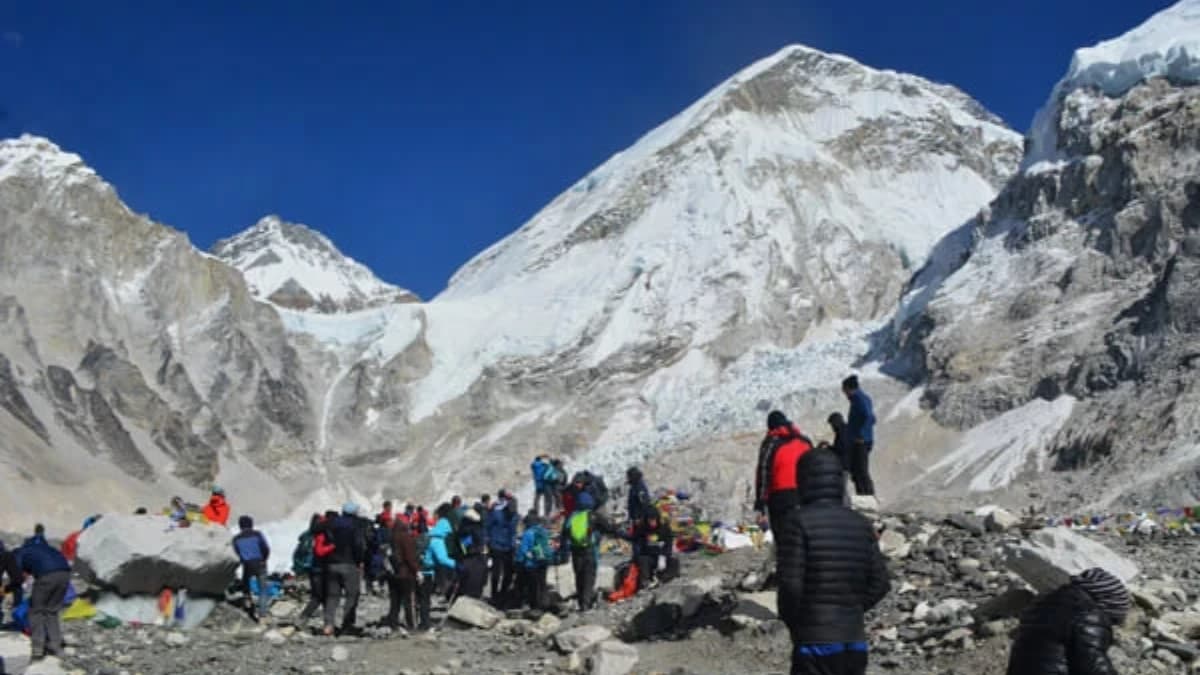
The morning air at 5,364 metres (17,598ft) is thin and cold, and the silence is so deep you can hear your own heartbeat. Then the sun breaks over the ridge, and Everest fills the sky. This is not a photograph. You are standing here.

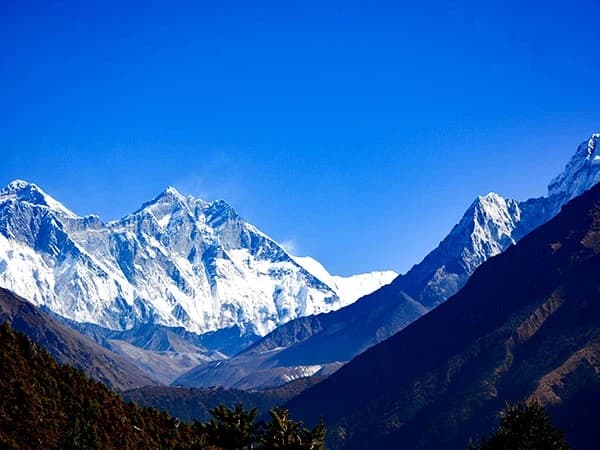
The 12-day Everest Base Camp Trek takes you through the heart of the Khumbu, across suspension bridges strung above glacial rivers, past ancient Sherpa monasteries where monks chant at dawn, and through villages where prayer flags snap in the mountain wind. You will walk beneath four of the world’s fourteen highest peaks: Everest (8,849m / 29,032ft), Lhotse (8,516m / 27,940ft), Makalu (8,485m / 27,838ft), and Cho Oyu (8,188m / 26,906ft). You will sleep in teahouses warmed by yak-dung stoves, eat dal bhat with families who have lived in these mountains for generations, and wake each morning to views that most people only see in documentaries.

Everest Base Camp Trek Highlights

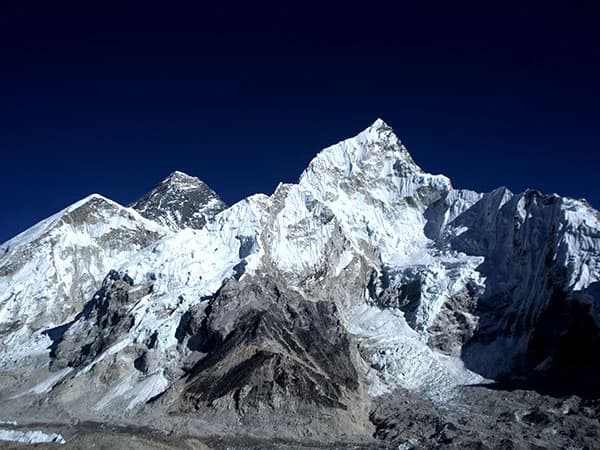
  • Stand at Kala Patthar (5,545m / 18,192ft) at sunrise, the most famous viewpoint of Everest, where four of the world’s highest peaks surround you
  • Walk through Sagarmatha National Park, a UNESCO World Heritage Site, home to snow leopards, Himalayan tahr, musk deer, and over 100 species of birds
  • Visit Tengboche Monastery, the spiritual heart of the Khumbu, with Everest and Ama Dablam framed behind it
  • Cross suspension bridges draped in prayer flags over the Dudh Koshi River, some of the highest in the world
  • Experience Sherpa hospitality in centuries-old villages where Buddhist prayer wheels spin at every corner
  • See the Khumbu Glacier up close, the largest glacier in the Everest region, stretching 12 kilometres
  • Land at Lukla, one of the world’s most dramatic airports at 2,860m (9,383ft), where the runway ends at a mountain wall
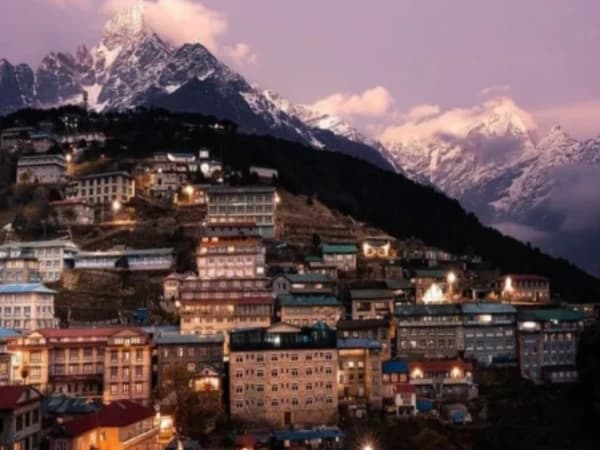
  • Acclimatise in Namche Bazaar (3,440m / 11,286ft), the lively Sherpa capital with markets, bakeries, and the best apple pie in the Himalayas
  • Hike to Everest View Hotel (3,880m / 12,730ft) on your rest day, your first clear view of Everest, with a hot cup of tea in your hand
  • Pass the Thukla memorial cairns, a quiet, powerful tribute to the climbers who gave everything to these mountains
  • Stand at Everest Base Camp (5,364m / 17,598ft), where the world’s greatest mountaineering expeditions begin, on the edge of the Khumbu Icefall

Why I built this trek the way I did

I am Shreejan, the founder of The Everest Holiday. I am a third-generation guide. My father and grandfather both walked these trails before me, and I designed the 12-day Everest Base Camp route around one principle that most operators get wrong on EBC: the slow trekker is not the problem trekker. We tell every first-time client the Nepali phrase "Bistarai, bistarai" (slowly, slowly). That is how we walk this route by default. Not because we tolerate slow pace, but because that is the pace that gets people safely to 5,545m and back.

The 12-day schedule is built around two acclimatisation rest days: Namche Bazaar at 3,440m on day 3, and Dingboche at 4,410m on day 6. We do not skip either to save a day for a cheaper price. The Dingboche rest is where most AMS appears on operators who try to push through. Our rest day there includes an acclimatisation hike to Nagarjun Hill at 5,083m, which sleeps you higher for one afternoon so the night at 4,410m feels easier. That single move changes the success rate on the Lobuche to Gorakshep push.

On Lukla flights: I will not pretend the weather risk is gone. October and April are the cleanest months for the flight, and the Ramechhap/Manthali shift has made delays much rarer than they used to be, but they still happen. We build 2 buffer days into every itinerary at the end of the trek for this reason, and we recommend you keep at least 3 days between landing back in Kathmandu and your international flight home. If you cannot, ask us about the helicopter Kathmandu-to-Lukla return option in our Luxury tier. It removes the flight weather risk entirely.

We run this as a private trek only. No shared-group commitment. Your pace, your rest days, your conversations at dinner. We do not change the guide-to-porter ratio when the group is smaller. Your guide and porter are with you whether you are two people or six.

Every booking on this trip helps us pay the teacher’s salary at our Nagarjun Learning Center in Saldum, where 70 children get free education. The salary is currently funded out of my own pocket. Your trek is what makes that sustainable.

“I have returned to Nepal five times since 2018, booking with The Everest Holiday each time. As a local business run by a local family, they ensure amazing Nepal experiences. You will not be disappointed.”

— Jon Daskam · Verified TrustPilot Review, August 2025 · ★★★★★

12-Day Everest Base Camp Trek Overview

Twelve days. That's all it takes to walk from Lukla airstrip to the foot of the highest mountain on earth and back. Most trekkers say those twelve days changed how they see the world.

The route follows the Dudh Koshi River valley through Sagarmatha National Park, climbing steadily from Phakding (2,610m / 8,563ft) through Namche Bazaar (3,440m / 11,286ft), Tengboche (3,860m / 12,664ft), Dingboche (4,410m / 14,468ft), and Lobuche (4,940m / 16,207ft) before reaching Everest Base Camp at 5,364 metres (17,598ft). Along the way, the scenery transforms from rhododendron forests alive with birdsong to the stark, windswept moraines of the Khumbu Glacier, where nothing grows and the only sound is ice shifting beneath your feet.

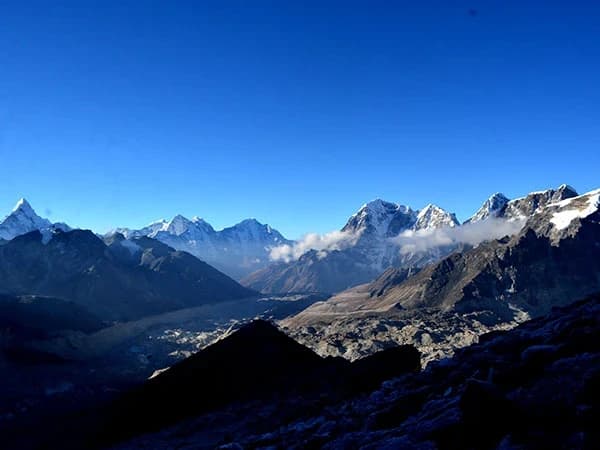
Two acclimatization days are built into the itinerary, one at Namche Bazaar and one at Dingboche, because rushing altitude is dangerous, and we will never compromise your safety for schedule. These rest days are not wasted days. At Namche, you hike to the Everest View Hotel (3,880m / 12,730ft) for your first clear view of the summit. At Dingboche, you climb to a ridge where Island Peak, Makalu, and Lhotse fill the horizon.

The summit day is not the peak itself; it is Kala Patthar (5,545m / 18,192ft), a rocky viewpoint where you stand before dawn in freezing darkness, waiting. Then the sun hits Everest. That moment is why people come here.

The walk back to Lukla takes three days of descending through familiar villages where teahouse owners now greet you by name. The final evening in Kathmandu is a farewell dinner with your guide and team, a chance to look back at what you did and realise you are not the same person who landed at Tribhuvan Airport twelve days ago.

Before You Arrive

Please arrive in Kathmandu by 4 PM the day before your trek. This gives you time for a final gear check, a briefing with your guide, and a good night’s rest before the early morning start.

Your Online Briefing

Think of this as our first coffee together, but online. After you book, we will schedule a video call where we walk you through every detail: what to pack, what each day on the trail looks like, how the altitude will feel, and anything else on your mind. No question is too small.

This phase is also when we learn about you. Our trek itinerary does not include your hotel in Kathmandu. During the briefing, please share your preferences and budget, and we will arrange accommodation that fits your needs. Whether you want a simple guesthouse in Thamel or a five-star hotel, we will set it up for you.

Lukla Flight — What You Need to Know

The flight to Lukla is one of the most dramatic in the world, a short ride between mountain peaks that ends on a runway carved into a hillside at 2,860m (9,383ft). From Kathmandu, it takes about 40 minutes. From Manthali, it takes about 20 minutes. It is also weather-dependent. Fog, cloud, or wind can delay flights, sometimes for a full day. This is normal in the Himalayas and nothing to worry about, but it is something to plan for.

We strongly recommend keeping two buffer days at the end of your trip before your international flight home. This protects your connection if weather delays your return from Lukla.

During peak trekking season (March–May and October–November), flights to Lukla operate from Manthali Airport (Ramechhap) instead of Kathmandu to reduce congestion on Kathmandu’s single runway. If your flight leaves Manthali, we will pick you up from your hotel around midnight and drive you there (4–6 hours).

For your return, you fly from Lukla back to Kathmandu or Manthali. If your return flight lands at Manthali, we drive you back to Kathmandu (4–6 hours). All ground transportation is included in every package.

Your Trek, Your Way

Every trek we run is private, your group only, with no strangers added. Whether you choose Budget, Standard, or Luxury, the mountains are yours and your companions’ alone. This is not a conveyor belt. This is your personal Himalayan experience.

Your hotel in Kathmandu is not included in the trek package, and that is intentional. Kathmandu has everything from USD 10 guesthouses in Thamel to five-star hotels with rooftop views of the city. During the online briefing, tell us what you prefer, and we will arrange it for you. Your trek package begins the moment you leave Kathmandu for the mountains.

Difficulty: Moderate to Challenging (4 out of 5)

You will walk 5-8 hours a day over mountain trails, gaining altitude each day until you reach 5,545m (18,192ft). The paths are well-established but uneven; stone steps, river crossings, and steep ascents are part of every day. No previous trekking experience is required, but you should be comfortable walking for extended periods and be in reasonable physical health. The two acclimatization days help your body adjust, and our guides monitor your condition throughout.

Compare Our Three Packages

  Budget Standard Luxury
Price from USD 1,399 USD 2,499 USD 4,999
Meals Choose your own (approx. USD 15-25/day) 3 meals + tea + fruits + 2L water daily All meals + all drinks anytime (except alcohol)
Room Shared teahouse Private twin w/ bathroom Private deluxe w/ bed heater
Porter Not included 1 per 2 trekkers 1 per trekker (carry nothing)
Guide 1 guide, assistant at 8+ 1 guide per 6; assistant at 6+ 1 guide per 2 trekkers
Transport Local vehicle + flight to Lukla Private vehicle + flight to Lukla Luxury vehicle + helicopter to Lukla
SIM data SIM only Limited data Unlimited data
Best for Backpackers and independent travellers Comfort trekkers, couples, families Premium experience seekers

Himalayas for Every Budget: the same expert guides, the same safety, and three comfort levels.

Difficulty: Moderate to Challenging (4 out of 5)

You need to be comfortable walking 5-8 hours per day over uneven terrain with significant altitude gain. No previous trekking experience is required, but a reasonable level of fitness is important. We build two acclimatization days into the itinerary (Namche Bazaar and Dingboche) to help your body adjust safely.

The bookings that built a school

The Everest Base Camp trek is the most-booked trip on our website, and it pays for the most schooling. Every booking funnels a fixed share into the Nagarjun Learning Center, the village school we set up in Saldum in 2019 to give seventy children free classes and two warm meals each day. The center is verified on the UN Partner Portal and run by my mother and her sister. When you book a trek with us, you are not making a donation—you are funding part of a school year, automatically.

Plan your Everest Base Camp Trek

Why Book This Trek With The Everest Holiday

Three Generations of Family Guides

Family-run since 2016 with three generations of guiding heritage. Not an agency — the family that runs the company leads your trek personally.

Private Group — No Strangers

Every trek we run is private. Your group only. We never combine bookings or add strangers to your party. If you book solo, you walk with a guide; if you book as four friends, your group stays four.

Nagarjun Learning Center Giveback

A fixed share of every booking funds the Nagarjun Learning Center — 70 children, 7 community centres, 3 full-time teachers, 600+ medical interventions, 275+ women supported. You see the impact at the centre on day 1.

Government Registered, TAAN Member

Govt Regd. No. 147653/072/073. Tourism License 2838/072. TAAN Member #1586. 300+ five-star reviews across TripAdvisor, Google, and Trustpilot. We are a real, audited Nepal company — not a booking-platform middleman.

Itinerary

Day 01: Fly to Lukla and trek to Phakding
Max Altitude: 2,850m / 9,350ft
Day 02: Trek from Phakding to Namche Bazaar
Max Altitude: 3,440m / 11,286ft
Day 03: Acclimatisation at Namche Bazaar
Max Altitude: 3,440m / 11,286ft
Day 04: Trek from Namche Bazaar to Tengboche
Max Altitude: 3,860m / 12,664ft
Day 05: Trek from Tengboche to Dingboche
Max Altitude: 4,410m / 14,468ft
Day 06: Acclimatisation at Dingboche
Max Altitude: 4,410m / 14,468ft
Day 07: Trek from Dingboche to Lobuche
Max Altitude: 4,940m / 16,207ft
Day 08: Trek from Lobuche to Everest Base Camp via Gorakshep
Max Altitude: 5,364m / 17,598ft
Day 09: Hike to Kala Patthar at sunrise, descend to Pangboche
Max Altitude: 5,545m / 18,192ft
Day 10: Trek from Pangboche to Namche Bazaar
Max Altitude: 3,440m / 11,286ft
Day 11: Trek from Namche Bazaar to Lukla
Max Altitude: 2,860m / 9,383ft
Day 12: Fly from Lukla to Kathmandu
Max Altitude: 1,350m / 4,429ft
Expand All
Couldn't find what you're after?Reach out to our travel experts.
Customise Trip

Interactive Route Map

Altitude Chart

Everest Base Camp Trek Elevation Profile 12 Days

Pricing & What's Included

Book your own private small group trip
No. of travellers
Price per person
1 - 4 pax
US$1399
5 - 8 pax
US$1299
9 - 12 pax
US$1199
13 - 20 pax
US$999

Discounts are determined exclusively by the size of your group. We do not add additional members to your group.

Book Now
hbl logo
Secure Payment by Himalayan Bank.
Cost Includes

Transportation

  • Airport pickup and drop-off from Tribhuvan International Airport to the hotel of your choice by taxi or local Jeep transfer.
  • Round-trip flight from Kathmandu/Manthali to Lukla. (Local bus or Jeep ground transportation to Manthali and back to Kathmandu is also included if the flight is rescheduled.)

Accommodation and Food

  • During the trek, food and drinks are not included.
  • You will stay in a local teahouse or lodge in a shared room for the duration of the trek.

Guide and Porter

  • An English-speaking, Nepal government well-trained guide is provided (one guide for your group). For groups of 8 or more trekkers, an additional assistant guide is included.
  • Porter service is not included in the Budget package, only the guide.

Permits and Expenses

  • Sagarmatha National Park permit.
  • Khumbu Pasang Lhamu Rural Municipality fees.
  • Trekkers Information Management System (TIMS) card fee.
  • All government taxes and official expenses.
  • Rescue operation arrangement in case of an emergency health condition (funded by the trekker's travel insurance).

Medical Assistance

  • First aid kit provided, including an oximeter to check blood oxygen levels at high altitudes.

Complimentary

  • Company T-shirt and cap before the trek.
  • At the end of your trip, you'll have a farewell meal at a local restaurant.

Benefits

  • Sleeping bags and down jackets: if you do not have your own, please inform us either at your online briefing or after the arrival briefing in Kathmandu before your trek so we can provide you with one for your use during the trek.
  • Free excess luggage storage at The Everest Holiday store for the duration of the trek.
  • We will arrange a SIM card for every individual trekker upon arrival in Kathmandu and provide guidance on how to purchase data packages and top-up services.
Cost Excludes

Food and Drinks

  • No food or drinks are included in the Budget package. All meals and beverages during the trek are at your own expense. You will order and pay directly at teahouses along the trail.

International Flights

  • Cost of international flights to and from Nepal.

Nepal Visa

  • Upon arrival at Tribhuvan International Airport, you can pay the following visa fees: $30 for a 15-day visa, $50 for a 30-day visa, or $120 for a 90-day visa. Alternatively, you can apply for a Nepal visa from the Nepalese embassy or consulate in your home country.

(Note: Travellers with a visa obtained before arrival can use the express line at immigration. To obtain a visa upon arrival at TIA Kathmandu, you must have the necessary funds in US dollars.)

Accommodation

  • Accommodation in Kathmandu before and after the trek is not included in this package. Please let us know your preferences, budget, and desired hotel standard during the online meeting so we can arrange it for you accordingly.

Gratuities

  • Tips for guides and porters (recommended).

Other Expenses

  • Excess luggage charges for an extra porter, as well as any airline charges for extra luggage. Note: Porter service is not included in the Budget package; any requested porter service will incur an additional fee.
  • All drinks, including bottled water, hot water, soft drinks, juice, tea, coffee, and alcoholic beverages.
  • Additional costs due to delays caused by circumstances beyond our control, such as landslides, unfavourable weather, itinerary modifications for safety, illness, changes in government policies, strikes, etc.

Dates & Booking

Your trek, your choice, your price

Choose the style that suits you. Book a private departure on any date with just your party, or join a fixed group departure and trek with fellow adventurers from around the world. Same routes, same guides, same quality — 3 comfort tiers on both options. Per-person price follows our group-discount tiers based on YOUR party size (a couple pays less per pax than a solo trekker, 5+ pays less again) — the same tiers apply on both booking types.

Private Departure

  • Any date you choose
  • Just your party + dedicated guide
  • 3 comfort tiers (Budget, Standard, Luxury)
  • Per-pax price tier set by YOUR party size

Fixed Group Departure

  • Scheduled dates (see below)
  • Join other trekkers from around the world
  • 3 comfort tiers (Budget, Standard, Luxury)
  • Per-pax price tier set by YOUR party size (same tier as Private)

Prefer email? Send a question and we will reply within a few hours.

Oct 2026
Starts
Oct 11, 2026
Ends
Oct 22, 2026
Status
ConfirmedConfirmed group - 2 trekkers booked, join this departure
Price
US$1399

The Everest Holiday offers fixed departure dates throughout the year. If none of our listed dates work for you, contact us and we will arrange a trek on your preferred dates.

Fixed Group Departures

Join one of our scheduled fixed departures and share the trail with other trekkers on the same dates. Choose your preferred tier (Budget, Standard, or Luxury) when booking. Per-person price follows our group-discount tiers based on YOUR party size — a couple pays less per person than a solo trekker, and a party of 5+ pays less again. The same tiers apply on private departures too.

Need a different date? Extra departure dates are available on request. Contact us or message Shreejan on WhatsApp.

Start DateEnd DateSeasonStatusBook a Tier
1 Sept 202612 Sept 2026Autumn 2026Open
11 Sept 202622 Sept 2026Autumn 2026Open
21 Sept 20262 Oct 2026Autumn 2026Open
1 Oct 202612 Oct 2026Autumn 2026Open
11 Oct 202622 Oct 2026Autumn 2026ConfirmedConfirmed group - 2 trekkers booked, join this departure
21 Oct 20261 Nov 2026Autumn 2026Open
31 Oct 202611 Nov 2026Autumn 2026Open
10 Nov 202621 Nov 2026Autumn 2026Open
20 Nov 20261 Dec 2026Autumn 2026Open
30 Nov 202611 Dec 2026Autumn 2026Open
1 Mar 202712 Mar 2027Spring 2027Open
11 Mar 202722 Mar 2027Spring 2027Open
21 Mar 20271 Apr 2027Spring 2027Open
31 Mar 202711 Apr 2027Spring 2027Open
10 Apr 202721 Apr 2027Spring 2027Open
20 Apr 20271 May 2027Spring 2027Open
30 Apr 202711 May 2027Spring 2027Open
10 May 202721 May 2027Spring 2027Open
20 May 202731 May 2027Spring 2027Open
30 May 202710 Jun 2027Spring 2027Open
1 Sept 202712 Sept 2027Autumn 2027Open
11 Sept 202722 Sept 2027Autumn 2027Open
21 Sept 20272 Oct 2027Autumn 2027Open
1 Oct 202712 Oct 2027Autumn 2027Open
11 Oct 202722 Oct 2027Autumn 2027Open
21 Oct 20271 Nov 2027Autumn 2027Open
31 Oct 202711 Nov 2027Autumn 2027Open
10 Nov 202721 Nov 2027Autumn 2027Open
20 Nov 20271 Dec 2027Autumn 2027Open
30 Nov 202711 Dec 2027Autumn 2027Open

All fixed departures are guaranteed with a minimum of 2 participants. Solo trekkers are welcome and will be matched with other travellers on the same date. Private departures on any date you choose are also available — the per-pax group-discount tier (based on YOUR party size, not the total trip headcount) applies on both. Pick a fixed date if you want company on the trail; pick a private departure if you want full date flexibility.

Questions about this trek?

Chat directly with Shreejan — our founder replies personally within minutes

WhatsApp Shreejan

Equipment Lists

Pack only what you need for the trek — travel light and comfortable. You can store excess luggage at The Everest Holiday office in Kathmandu for free. Porters carry your main trekking bag while you walk with a daypack.

Budget: Porter service is not included but can be arranged at extra cost.

Standard: One porter carries for two trekkers, with a 10 kg weight limit per person. We recommend sharing one large duffel bag (60+ litres) with your trekking partner.

Luxury: One dedicated porter per trekker, with a 20 kg weight limit.

  • Sun hat (wide-brimmed)
  • Beanie (for warmth)
  • Neck gaiter or buff (for warmth and sun protection)
  • Sunglasses with UV protection
  • Insulated gloves or mittens (for cold weather)
  • Waterproof gloves (for wet conditions)
  • Waterproof hiking boots with ankle support and good traction
  • Thick wool or synthetic moisture-wicking socks (3-4 pairs)
  • Sandals or flip-flops (for teahouse use)
  • Gaiters (optional, useful in snow or mud)
  • Moisture-wicking t-shirts (short and long sleeves)
  • Thermal base layer (for colder conditions)
  • Fleece jacket (mandatory)
  • Down jacket (mandatory)
  • Waterproof and windproof jacket (Gore-Tex or similar)
  • Lightweight, breathable long-sleeve shirt
  • Polypropylene underwear (3-4 sets)
  • Quick-drying trekking trousers (2 pairs)
  • Thermal leggings or long underwear (for cold mornings and evenings)
  • Lightweight cotton pants (for teahouse evenings)
  • Biodegradable bar soap
  • Toothbrush and toothpaste
  • Medium-sized quick-dry towel
  • Wet wipes or hand sanitiser
  • Toilet paper (stored in a ziplock bag)
  • Feminine hygiene products
  • Travel-sized shampoo
  • Nail clippers
  • Small mirror
  • Duffel bag (60+ litres) for porter to carry
  • Daypack (20-30 litres) for daily essentials
  • Notebook and pen
  • Few passport-size photos
  • Passport photocopies
  • Binoculars (optional)
  • Camera or smartphone (extra memory cards and batteries)
  • Portable charger or battery pack
  • Two-pin charging plug (Nepal uses Type C/D/M sockets)
  • Lightweight headlamp (with extra batteries)
  • Water bottle or hydration bladder (2 litres, with insulated cover for cold)
  • Water purification tablets, filter bottle, or UV filter
  • Energy bars or trail snacks
  • Basic first aid kit (plasters, antiseptic wipes, blister pads)
  • Pain relievers (ibuprofen, paracetamol)
  • Diamox (for altitude sickness prevention — consult your doctor)
  • Personal medications (inhalers, allergy meds, etc.)
  • Rehydration salts
  • Adjustable trekking poles (collapsible)
  • Face wipes
  • Ziplock bags (for keeping items dry)
  • Small padlock (for duffel bag)

Essential Information

Essential information for the Everest Base Camp trek (12 Days)

Arriving in Kathmandu

When your plane touches down at Tribhuvan International Airport, one of our team will be waiting for you at arrivals, holding a sign with your name and a marigold garland. It's a small thing, but after a long flight it makes Nepal feel like home from the first minute.

A private vehicle takes you to your accommodation from there. We ask that you arrive in Kathmandu at least one day before the trek begins, ideally by 4:00 PM, so there's time to settle in, sort your gear, and meet your guide over a briefing.

On trek day, we pick you up from your hotel and head to the airport for your flight to Lukla. During peak season (March to May and September to November), flights sometimes depart from Manthali Airport instead of Kathmandu to ease air traffic. If that happens, our guide collects you around 12:30 AM for the drive to Manthali, followed by a 20-minute flight to Lukla. In the quieter months (December to February and June to August), flights leave directly from Kathmandu, a 40-minute hop into the mountains.

Accommodation

You'll spend 11 nights in traditional teahouses and lodges along the trail. Some have Wi-Fi, charging points, and hot showers, though at higher altitudes these come at a small extra cost. Your Kathmandu accommodation is not included in the trek package, but we'll help you find the right hotel for your budget during the online briefing before you arrive.

At very high altitudes, accommodation options narrow. In those spots, we always secure the best available rooms regardless of tier.

Meals

The teahouse menus along the Everest trail are surprisingly varied, from dal bhat (the Nepali staple of lentil soup, rice, and vegetable curry that will keep you going all day) to pasta, soup, and pancakes. Our guides will steer you towards what works best at altitude: garlic soup for acclimatisation, ginger tea for digestion, plenty of fresh vegetables and fluids. We'd suggest avoiding alcohol and heavy meat dishes above 4,000 metres.

Luggage

Pack light. You'll carry only a daypack (20-30 litres) with your water, snacks, camera, and warm layers for the day. Your main trekking bag goes with the porter. Any luggage you don't need on the trek can be stored at our Kathmandu office for free.

Water

Clean drinking water matters more than almost anything else on this trek. You can buy bottled water at shops along the trail or get boiled water from lodges. We recommend bringing a reusable bottle and refilling with boiled or purified water. Never drink untreated tap, well, or river water. Water purification tablets are available in Kathmandu and at shops along the trail.

Communication

We'll provide you with a Nepali SIM card in Kathmandu and show you how to set up data and top up credit. Mobile signal is reliable up to Namche Bazaar but weakens at higher altitudes. For safety, our lead guide maintains daily radio contact with all teams via mobile phone and maintains regular check-ins with our Kathmandu office.

Travel essentials

Visa

All foreign nationals except Indian citizens need a visa to enter Nepal. Most nationalities can get one on arrival at Kathmandu airport. You'll need a passport valid for at least six months, one passport-sized photo, and cash for the visa fee (US $50 for a 30-day visa).

Travel insurance

Travel insurance is mandatory for this trek, which reaches 5,545 metres at Kala Patthar. Your policy must cover medical expenses and emergency helicopter rescue up to 6,000 metres. We'll need a copy of your insurance policy before the trek begins. This is not optional, and we will check.

Currency

Nepal's currency is the Nepali Rupee (NPR), roughly 140 NPR to 1 USD. Banks and authorised exchange centres in Kathmandu offer good rates. ATMs are widely available but may charge a service fee. Bring clean, undamaged notes as torn or old bills are often refused. Indian travellers can now use UPI and other Indian payment apps at many Kathmandu shops and trekking lodges. For physical cash, only the 100 INR note from India is officially exchanged. Exchange everything you need in Kathmandu before heading to the mountains, as there are very few options on the trail.

Personal budget

Beyond the package cost, you'll want to budget for Kathmandu meals and accommodation, your Nepal visa, hot showers along the trail, personal snacks and drinks, and tips for the crew. We recommend setting aside roughly $20 USD per day for personal expenses during the trek.

Best time to trek

Spring (March to May) and autumn (September to November) are the prime seasons: stable weather, clear mountain views, and comfortable temperatures. Spring days sit around 20°C, dropping to -5°C at night at altitude. Autumn days are warmer, up to 25°C, with nights around -10°C.

Summer trekking (June to August) is possible but wet. The trails are quieter and the hills are green, but rain and cloud can limit views. Daytime temperatures reach 27°C at altitude, with mild evenings around 5°C.

Winter (December to February) brings cold, clear skies and empty trails. Days reach 15°C, but nights can plunge to -20°C. You'll need serious cold-weather gear, but the solitude and the clarity of the mountain views make it worth it for the right trekker.

Lukla flight delays

Flights to Lukla depend entirely on weather and can be delayed or cancelled, sometimes for days. If your flight is cancelled, a helicopter is the alternative, typically costing $500 to $1,000 USD per person (based on five people sharing). We strongly recommend building one or two buffer days into your travel plans after the trek, so a delayed flight doesn't mean a missed international connection.

A typical day on the trail

Mornings start early. Breakfast, pack up, and you're walking by 7:00 or 8:00 AM. The day splits naturally into a 3-4 hour morning trek, a long lunch break at a teahouse where you warm up and refuel, and a shorter 2-3 hour afternoon stretch to the next stop. You arrive at the day's lodge by mid-afternoon, in time for tea, a hot shower if one's available, and some time to explore the village or just sit and watch the mountains change colour. Dinner is served around 7:00 PM, and afterward your guide briefs you on the next day's route, altitude, and what to expect. The rest of the evening is yours.

Booking your trek

Your trek, your group

Every trek we run is private. You'll only walk with your own group. We never add strangers to your trek, and every itinerary is customisable to your schedule.

Solo trekkers and group bookings

Our treks run with a minimum of one person. If you're travelling alone, we can connect you with other solo trekkers and organise an open group trek. Once you confirm, your group trek is posted on our website so others from around the world can join. This way, every trek becomes your own personal holiday in the Himalayas.

Why book with us

The Everest Holiday is a government-registered trekking operator (Reg: 147653/072/073), proudly a member of the Trekking Agencies' Association of Nepal (TAAN, 1586) and the Nepal Mountaineering Association. Our family has been in Nepal's tourism and mountaineering industry for three generations. Ganesh Prasad Simkhada has held senior positions in Nepal's tourism institutions, including the Nepal Tourism Board and the Nepal Mountaineering Association. His son Shreejan co-founded The Everest Holiday in 2016 and personally oversees the design of every trek.

To confirm your booking, we require a 10% advance payment through the Himalayan Bank online portal on our website, or by bank transfer, Wise, or Western Union. The remaining balance is due upon your arrival in Kathmandu. Please send us a copy of your passport within one week of booking, and make sure it has at least six months' validity from your arrival date in Nepal.

Last-minute bookings

We recommend booking in advance, but we understand plans change. Last-minute bookings require full payment 24 hours before departure. Contact Shreejan directly on WhatsApp at +977-9810351300 or email [email protected]. Last-minute treks may face delays due to permit processing and logistics, but we'll do everything we can.

Flexible dates

Your travel date determines the schedule, and we can adjust it. If none of our listed departure dates work for you, let us know and we'll arrange a trek that fits your timeline.

Extend your adventure

Nepal has more to offer than the Everest trail. After your trek, we can arrange a jungle safari in Chitwan or Bardiya, white-water rafting on the Bhote Koshi, Trishuli, or Seti rivers, paragliding over Pokhara, zip-flying in Kushma, or canyoning near Pokhara.

If culture interests you more, we can set up guided tours of the Kathmandu Valley's seven UNESCO World Heritage Sites: Bhaktapur Durbar Square, Patan Durbar Square, Kathmandu Durbar Square, Swayambhunath, Boudhanath Stupa, Changu Narayan, and Pashupatinath Temple. For a quieter day, we suggest sunrise from Nagarkot or a walk through Dhulikhel. Check our add-on packages when you book.

Our commitment

Leave no trace

We take the Everest region's fragile environment seriously. At the start of your trek, each person receives an eco-waste bag. Everything that can't be composted, from snack wrappers to batteries, goes in the bag and comes back down with us. Our guides know where every recycling point and waste station is along the trail. We need your help carrying every wrapper out of the Khumbu so the next trekker walks a clean trail.

The family behind your trek

We are a family business, three generations deep in Nepal's mountains. We started as porters and now run the agency. Every guide, every porter, every cook on our team is family to us. Our guides hold wilderness first-aid certifications and speak fluent English. Many are from the upper Himalayan villages along the very trails you'll be walking, which means they know every teahouse owner, every shortcut, every weather sign. We cover their insurance, meals, accommodation, and medical care. Please treat them as family too, and never hesitate to ask them anything.

Farewell dinner

When you return to Kathmandu, we celebrate with a farewell dinner. It's a chance to share stories from the trail, swap photos, and raise a glass to what you've just achieved. You'll also receive a trek completion certificate to take home.

Departure

Let us know your hotel, room number, and flight details, and we'll arrange your transfer to Tribhuvan International Airport. We hope this won't be goodbye, just see you next time.

Tipping

Tipping is a common and appreciated practice in Nepal. At the end of your trek, most groups give a combined tip to the guide and porters. The amount is entirely up to you and depends on the length of the trip, quality of service, and your own budget.

Everest Trek Data

Monthly Weather at 5,364m (17,598ft)

MonthDay Temp (C)Night Temp (C)RainfallTrekking
Jan-15 to 5Below -20<20mmPossible
Feb-10 to 10-1530-40mmCold
Mar0 to 15-530-40mmGood
Apr0 to 15-550-60mmExcellent
May5 to 10-560-70mmGood
Jun-AugUp to 105200-300mmMonsoon
Sep5 to 12-550-70mmGood
Oct-6 to 12-10<30mmBest
Nov-5 to 10-15<20mmExcellent
Dec-3 to 6Below -15<20mmCold

Permit Costs 2026

PermitCostNote
Sagarmatha National Park~USD 28NPR 3,000 + 13% VAT
Khumbu Rural Municipality~USD 30Varies by season
TIMS Card (group)~USD 8NPR 1,000
TIMS Card (independent)~USD 16NPR 2,000

All permits are included in our package price. You do not need to arrange these yourself.

Trek Completion Rate: 90-95%

With proper acclimatisation (2+ rest days). Drops to ~65% on rushed itineraries.

FAQs

The 12-day Everest Base Camp trek is US$1,399 per person (Budget), US$2,499 (Standard), or US$4,999 (Luxury) — and the per-person rate drops as your group grows (down to US$999 / US$2,349 / US$4,849 for larger parties). Every tier includes your licensed guide, all trekking permits, teahouse lodging and the listed meals on the trail. You budget separately for international flights, the Lukla flight, travel insurance, your Nepal visa and tips.

What you payBudgetStandardLuxury
Per person (from)US$1,399US$2,499US$4,999
Guide ratio1 : 81 : 61 : 2
PorterAdd-on1 per 2 (10kg)1 per trekker (20kg)
Lukla transferBus/shared jeepPrivate jeepHelicopter

Typical extra costs (not in the package price):

  • Kathmandu–Lukla flight (round trip): ~US$510 (lower via Ramechhap in peak season) — or skip it on our Everest Base Camp by Road trip
  • Trekking permits (Sagarmatha NP + Khumbu municipality + TIMS): ~US$50, already included in every tier
  • Your own travel insurance with helicopter evacuation: ~US$150–250 (the package insures only your guide and porters)
  • Nepal visa (30-day, on arrival): US$50
  • Guide & porter tips (customary): ~US$150–250
  • Drinks, charging, Wi-Fi, hot showers, snacks: ~US$10–20/day (covered on Luxury)

A 10% deposit (as little as US$95) confirms your booking; the balance is due in Kathmandu.

About 99% of our trekkers reach Everest Base Camp. We get there by going slow, building in two acclimatisation days, and checking your oxygen daily — not by pushing. On the rare occasion someone can't continue (almost always altitude, which can affect anyone), our guides bring them down safely and immediately. We're open about that record: we even ask trekkers whose trip didn't go to plan to leave an honest review, because trust matters more to us than a perfect-looking page.

Fit enough to walk 5–7 hours a day for twelve consecutive days on uneven terrain, with some steep uphill sections. You don't need to be an athlete — you need to be consistent. The people who do well are the ones who trained for six weeks beforehand, not the ones who ran a marathon five years ago.

Yes, with preparation. You don't need previous trekking experience — the trail is well-maintained, with no ropes, scrambling or technical sections. The challenge is altitude, not terrain. Most of our first-timers finish it; the ones who struggle are the ones who rush. Our guides set a deliberately slow pace and check your oxygen daily with a pulse oximeter.

Start 6–8 weeks before your trek, and walk uphill — that's the single best thing you can do. Add stair climbing, jogging or cycling for cardiovascular endurance, and do weekend practice hikes with a 5–8 kg daypack. Squats and lunges help with the descents, which are harder on the knees than the climbs. If you can walk uphill four hours without stopping and want to do it again the next day, you're ready.

Twelve days on the trail, with two acclimatisation days built into every itinerary — one at Namche Bazaar, one at Dingboche — because rushing altitude is how people get sick. Arrive in Kathmandu one day before departure, and keep one or two buffer days after the trek in case Lukla flights are delayed by weather. A missed international connection is worse than an extra day in Kathmandu.

The trail follows the Khumbu Valley in north-eastern Nepal, through Sagarmatha National Park. You start in Lukla at 2,860m and walk north through Sherpa villages, across suspension bridges over the Dudh Koshi, through rhododendron forests, past Tengboche Monastery, and up through glacier valleys to Everest Base Camp at 5,364m — with the Khumbu Icefall right in front of you.

The flight into Lukla is an experience before the walk even begins. From there: Namche Bazaar, the Sherpa capital; Tengboche Monastery with Ama Dablam rising behind it; the memorial cairns at Thukla Pass; and sunrise from Kala Patthar (5,545m), where Everest, Lhotse, Nuptse and Changtse light up gold before the sun reaches you.

Every trek is private — you walk with your own group, never strangers added to fill numbers — and you choose from three tiers (Budget, Standard, Luxury). Our guides grew up in the Khumbu; they know the teahouse owners by name and read the weather before it turns. And a fixed share of every booking funds the Nagarjun Learning Center — 70 children in rural Dhading getting a free education.

Spring (March–May) and autumn (September–November) — stable weather, clear views, comfortable temperatures. Spring days are around 20°C dropping to −5°C at night, with rhododendrons in bloom; autumn is slightly warmer by day, colder at night, with the sharpest skies of the year.

Yes to both, with trade-offs. Summer (June–August) is monsoon — rain below Namche and afternoon cloud, but quiet, green trails and a rain-shadow effect above Namche. Winter (December–February) is seriously cold (nights at Gorak Shep can hit −20°C) but gives the clearest skies, fresh snow, and near-empty trails. With the right gear, both are unforgettable in a way peak season isn't.

Three: a Sagarmatha National Park entry permit, a Khumbu Pasang Lhamu Rural Municipality permit, and a TIMS card (Trekkers' Information Management System) — which we issue for you as a registered TAAN member (#1586). They're checked at Monjo, the national park entrance and along the trail. All three are included in every tier; you just bring passport-sized photos and a copy of your passport.

Yes — all of them, in every tier. We handle the paperwork; you just bring passport-sized photos and a copy of your passport. Permits are arranged before you leave Kathmandu.

You fly Kathmandu to Lukla — a 40-minute flight onto one of the world's most famous runways, cut into a mountainside. In peak season (Mar–May, Sep–Nov) flights often shift to Manthali (Ramechhap) Airport due to air traffic: our guide picks you up around 12:30 AM for a five-hour drive, then a 20-minute flight. Budget travels to Manthali by bus or shared jeep, Standard by private jeep, and Luxury skips the drive entirely by helicopter.

Yes. We run an Everest Base Camp by Road trip (15 days) that drives to the trailhead instead of flying. You save on the flight and see Nepal's hill country on the way — a lot of trekkers tell us the drive was one of their favourite parts.

Lukla's runway needs clear visibility, so cloud, wind or rain can cancel flights — sometimes for a day or more. This is exactly why we tell every trekker to build buffer days into their plans after the trek. If flights cancel, helicopter transfers are available at extra cost (roughly US$500–1,000 per person, shared between 4–5 passengers).

You fly from Lukla back to Kathmandu or Manthali (if Manthali, we drive you back); Luxury trekkers return by helicopter. Build a buffer day into your plans — Lukla flights cancel more often than they run on time.

Yes. Since 2023, Nepal law requires all trekkers to have a registered guide. Ours are TAAN-certified with wilderness first-aid training, and most are from the villages along the trail you'll be walking — they didn't learn the Khumbu from a textbook.

Your guide leads the trek, handles all teahouse and checkpoint logistics, monitors your health daily (oxygen, heart rate, sleep, headaches), and shares the local knowledge that turns a walk into an experience. Porters carry your main bag so you walk with just a daypack — they're quiet, strong and fast, and your bag is in your room before you arrive.

Budget: one guide for up to 8 trekkers; no porter (you carry your own bag; porter available at extra cost); assistant guide for groups over 8.

Standard: one guide for up to 6; one porter per two trekkers (up to 10 kg each); assistant guide for groups over 6.

Luxury: one guide per two trekkers; a dedicated porter per trekker (up to 20 kg) — you carry only a daypack.

In traditional mountain teahouses run by Sherpa families: twin beds, blankets, and a communal dining room warmed by a yak-dung or wood stove. The higher you go the more basic they get, but even at Gorak Shep (5,164m) you'll have a bed, a blanket and a hot meal. At very high altitude there may be only one room type — we always secure the best that exists at each stop, whatever your tier.

Yes at most stops, but it gets expensive and unreliable above Namche. Charging your phone may cost NPR 200–500 at higher lodges, and Wi-Fi works below Tengboche but don't rely on it above. Standard and Luxury tiers include charging; Luxury covers Wi-Fi too.

At lower altitudes, yes — most lodges have solar or gas-heated showers. Above Dingboche, availability drops and the water may be barely warm. Honestly, by day eight you won't care — everyone smells the same. The Luxury tier covers all hot-shower costs.

More than you'd expect. Every teahouse has a menu — dal bhat ("dal bhat power, 24 hour"), fried rice, noodle soup, pasta, momos, chapati, pancakes, eggs, porridge — and some lodges bake bread and apple pie that has no business being that good at 3,800m. Order the garlic soup: it helps with acclimatisation and tastes better than it sounds after six hours of walking.

Plenty. Dal bhat is naturally vegetarian and the most nutritious meal on the menu, and most teahouses also serve vegetarian pasta, soup, fried rice and noodles. Tell us your dietary requirements when you book and our guides will pass them on at each stop.

Budget gives you flexibility to order what you like from teahouse menus; Standard includes three meals a day with tea or coffee; Luxury covers everything, including unlimited drinks, snacks and extras. The full breakdown is in the What's Included section above.

Altitude sickness — full stop. It causes headache, nausea, dizziness, loss of appetite and disturbed sleep, and it can hit anyone regardless of age or fitness (we've seen marathon runners get it and grandmothers walk through fine). The difference is pace and hydration, not fitness. The underrated risk is sunburn: UV at 5,000m is brutal, so wear sunscreen, SPF lip balm and sunglasses daily.

Our guides carry a pulse oximeter and check your oxygen and heart rate every morning and evening, and we build in two acclimatisation days (Namche 3,440m, Dingboche 4,410m) where you hike high and sleep low. Stay hydrated (3+ litres a day), walk slowly, avoid alcohol above 3,500m, and tell your guide the moment you feel off. If symptoms get serious, we descend immediately — no "let's wait and see."

Our guides are trained in wilderness first aid, and if you need evacuation we coordinate a helicopter through your insurance provider — it can reach most points on the trail within 30–60 minutes in clear weather. This is exactly why travel insurance with helicopter cover is mandatory, not a suggestion.

Mandatory — no exceptions. Your policy must cover emergency helicopter evacuation and medical treatment up to 5,555m, and we ask for a copy before the trek begins. At 5,000m the only way down in an emergency is a helicopter, and an uninsured rescue costs US$3,000–5,000 out of your pocket. Our package covers accident and rescue insurance for your guide and porters (as Nepal law requires of us) — your own personal travel insurance is separate, and mandatory to join the trek.

High-altitude helicopter rescue (to 5,555m), medical treatment, trip cancellation and personal belongings. Many standard policies exclude trekking above 4,000m — check the fine print, and if yours doesn't cover it, buy a specialist trekking policy. World Nomads and Global Rescue are two that our trekkers use often.

All foreign nationals except Indian citizens need one, and most nationalities get it on arrival at Kathmandu airport — no advance application. Bring a passport valid for at least six months, one passport photo, and US$50 cash for a 30-day visa. The queue moves faster than it looks.

The essentials: waterproof hiking boots you've already broken in (never new), a fleece and a down jacket (both mandatory above Namche), thermal base layers, a waterproof shell, UV sunglasses, SPF 50+ and a daypack — full checklist in the Equipment section. Don't overpack: one set of walking clothes, one set of evening clothes, warm layers and rain protection. Everything else is weight your porter carries and you'll never use.

All teahouses provide bedding and blankets, but a sleeping bag adds warmth on cold nights above 4,000m and you'll be glad of it at Gorak Shep. If you don't own one, we can provide one for the trek — just tell us when you book.

Strongly recommended. On day one you'll wonder why you brought them; by the steep descent from Tengboche your knees will tell you exactly why. They reduce joint strain on descents and improve balance on rocky terrain, and over twelve days the difference is significant. Collapsible poles pack easily for flights.

NTC (Nepal Telecom) — it has the most reliable coverage on the Everest route: intermittent signal to Namche Bazaar, occasional beyond, and very little above Dingboche (4,410m). Ncell works well in Kathmandu but drops out earlier. We set you up with an NTC SIM in Kathmandu, and Luxury includes unlimited data. Bring a 20,000 mAh power bank — charging above Namche costs money and isn't always available.

At least a month, so we can arrange Lukla flights and logistics smoothly; peak season (October–November, March–April) fills faster, so two months is better. But we also take last-minute bookings — Shreejan has put treks together in 48 hours. WhatsApp him at +977-9810351300.

A 10% deposit confirms your booking — as low as US$95 depending on the package — with the balance due when you arrive in Kathmandu. We accept the Himalayan Bank portal, bank transfer, Wise or Western Union; card payments add a 3.5% processing fee. Once you book, we email you everything: payment details, preparation guide and packing list.

We have one, set out on our Terms & Conditions page, and we try to be fair. If your circumstances change and you'd rather reschedule than cancel, we'll work with you on that.