Mustang Mountain Bike Tour - 19 Days Itinerary and Cost

2 reviews
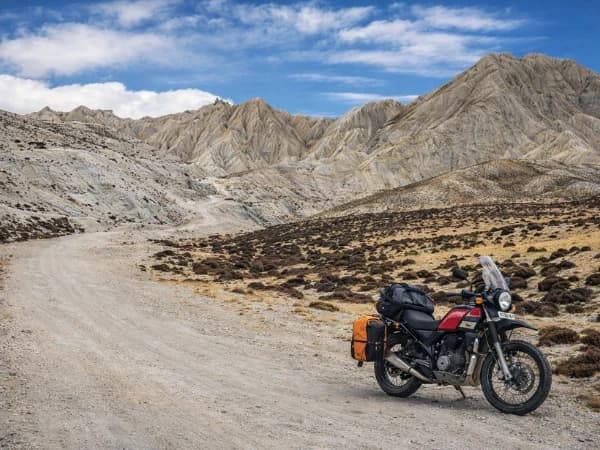
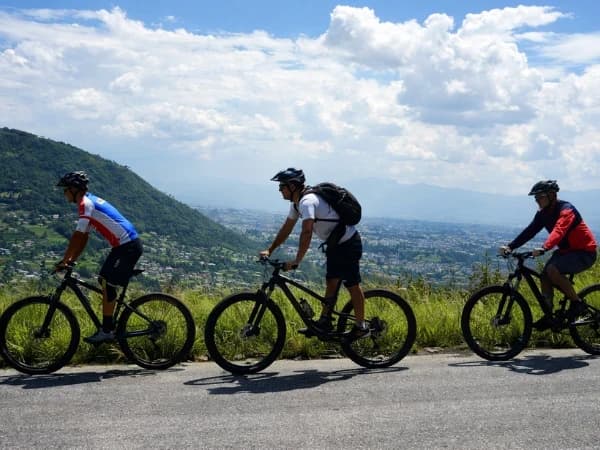
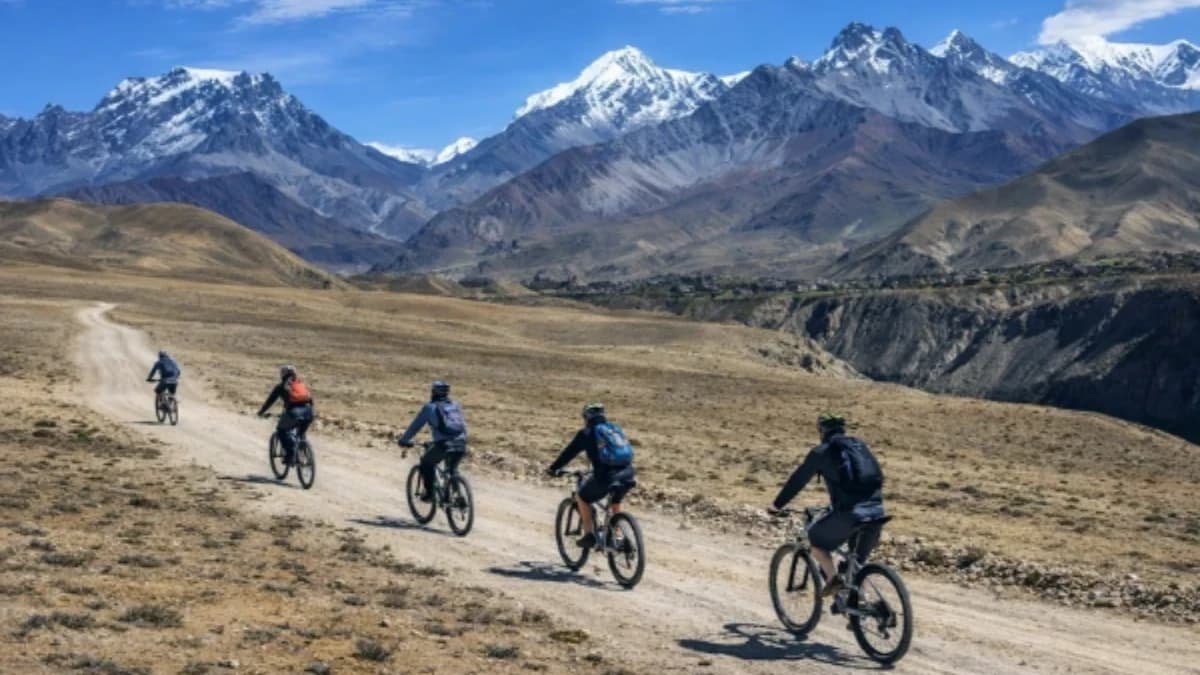
Group of Mountain Bike on a road in Nepal
Quick Overview
Duration19 Days
Trip GradeStrenuous
CountryNepal
Maximum Altitude3,840m / 12,598ft
Group Size2 - 20
StartsKathmandu
EndsKathmandu
ActivitiesCycling Tour
Best TimeSpring (March–May) and Autumn (September–November)

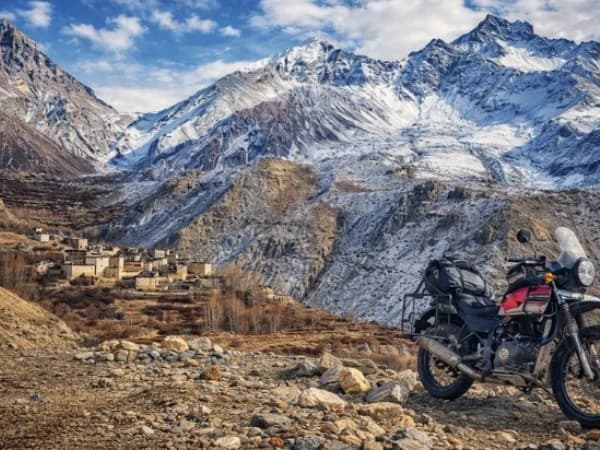
The trail drops off the ridge and suddenly there is nothing below you but the Kali Gandaki gorge, the deepest valley on earth, cutting a trench between two eight-thousand-metre peaks. Your front tyre finds the line between loose stone and packed earth. The wind that funnels through this gap carries the smell of juniper and dust, and somewhere ahead, prayer flags mark a chorten you haven't reached yet. You shift your weight back, let the brakes do their work, and remind yourself that the Tibetan plateau is only a few days north. This is mountain biking in Mustang, and every pedal stroke earns the view that comes next.

Over nineteen days, you'll cycle from the subtropical foothills near Pokhara deep into the rain shadow of the Himalayas, where the scenery transforms into something closer to Tibet than Nepal. The green valleys give way to red and ochre canyons, wind-carved caves, and ancient walled cities that were closed to outsiders until 1992. You'll ride through Jomsom, cross the threshold at Kagbeni where the restricted zone begins, and push north to Lo Manthang, the medieval capital of the Kingdom of Lo. This is not a leisure ride. It's a genuine expedition on two wheels, through one of the most remote and culturally preserved regions left on earth.

What Makes This Tour Unforgettable

  • Cycle through the deepest gorge on earth, the Kali Gandaki Valley, flanked by Dhaulagiri (8,167 m) and Annapurna I (8,091 m), two of the world's fourteen eight-thousanders.
  • Enter the restricted zone of Upper Mustang, closed to the outside world until 1992 and still one of the most culturally intact Tibetan Buddhist regions anywhere.
  • Reach Lo Manthang, the walled capital of the ancient Kingdom of Lo, where monks still chant in 600-year-old monasteries and the king's palace stands as it has for centuries.
  • Ride through landscapes that shift from green river valleys to stark desert canyons, wind-carved rock formations, and high-altitude plateaus that look like another planet.
  • Pass through Kagbeni, the gateway village to Upper Mustang, perched at the confluence of two rivers beneath medieval watchtowers and apple orchards.
  • All bikes are quality mountain bikes inspected before departure. A support vehicle carrying a mechanic, spare parts, tools, and your main luggage follows the route daily. If you get a mechanical, help is never far.
  • Ride with a local cycling guide who knows the trails, the river crossings, and the overnight stops. They handle all restricted area permits, checkpoints, and navigation so you focus on riding.
  • Experience living Tibetan Buddhist culture: monastery visits, prayer wheel circuits, festival encounters, and home-cooked meals in villages where tourism is still measured in dozens, not thousands.
  • Rest days built into the itinerary at key points for recovery, exploration, and acclimatisation at altitude. This is a strenuous tour, but we've designed it so your body can keep up with the terrain.

19-Day Mustang Mountain Bike Tour Overview

Mustang is unlike anywhere else in Nepal. Sheltered from the monsoon by the Annapurna and Dhaulagiri ranges, it receives almost no rainfall. The result is a stark, arid terrain of eroded cliffs, cave dwellings, and wind-scoured plateaus that feels closer to Ladakh or western Tibet than to the lush valleys most people associate with Nepal. For cyclists, this terrain is extraordinary. The trails are rough, the climbs are relentless, and the descents are technical enough to demand your full attention. But the reward is riding through a landscape and culture that very few people ever see.

The tour begins in Kathmandu with a drive to Pokhara, then follows the Kali Gandaki northward through Jomsom and Kagbeni into the restricted zone. The riding intensifies as you gain altitude and the trails become more remote. You'll pass through Chele, Syangboche, Ghami, and Tsarang before reaching Lo Manthang at 3,840 m. The return follows a different route where possible, giving you new terrain on the way back. Rest days are placed at strategic points for acclimatisation and cultural exploration.

Before You Arrive

We recommend arriving in Kathmandu by 4:00 pm the day before departure. This gives you time for a bike fitting, safety briefing, and gear check. We'll also verify your restricted area permit paperwork is in order.

Your Online Briefing

After you book, we'll send you an email with available times for a video call. This is your chance to discuss cycling fitness, bike preferences, and any concerns about altitude or trail conditions. We'll go through the route day by day, ask about dietary needs, and answer every question. If you have your own pedals, saddle, or cycling shoes you'd like to bring, let us know and we'll fit them to your bike.

Your Tour, Your Way

This is a private tour. Your group rides with your own guide, at your own pace. We'll never add strangers to your group. Want to spend an extra day exploring Lo Manthang? Prefer to ride a particular section and vehicle the rest? We adjust everything. The support vehicle means you can ride as much or as little as you choose on any given day without holding up the group.

Compare Our Three Packages

  Budget Standard Luxury
Price from USD 1,400 USD 1,799 USD 2,999
Meals Bed and breakfast All meals included (B/L/D) All meals at better restaurants + trail snacks
Bike Standard mountain bike Quality hardtail mountain bike Premium full-suspension mountain bike
Accommodation Teahouse / guesthouse (shared room) Best available guesthouse (private room) Best available room, bed heater where available
Transport Local vehicle (KTM-Pokhara) Private tourist vehicle Luxury private vehicle + internal flights where available
Support vehicle Shared support vehicle Private support vehicle + mechanic Private support vehicle + mechanic + spare bike
Guide English-speaking cycling guide Experienced cycling guide Expert cycling guide (1 per 2 riders)
Best for Fit cyclists on a budget Comfortable adventure cycling Premium expedition experience

Himalayas for Every Budget — same forbidden kingdom, same trails, three comfort levels.

Your Ride, Our Family

The Everest Holiday started with trekking, but the mountains called us to bikes too. Shreejan has cycled the Mustang trails himself — he knows where the gravel shifts, where the wind hits, and where the views make every pedal stroke worth it. This isn't a tour designed in an office. It was built on the road.

We're a third-generation Himalayan family. Government registered, TAAN certified, and small enough to care about every single guest. 320+ reviews say we get it right.

Why Cyclists Trust Us

Quality bikes, proper support. Hardtail mountain bikes with front suspension, inspected before every tour. A support vehicle carries your main luggage and follows the group — if you need a break, the van is always nearby.

Routes tested on two wheels. We've ridden every segment ourselves. We know where the gravel gets loose, where the descents are steep, and where the tea stops have the best views. The itinerary is built around cycling reality, not marketing fiction.

Small groups, personal attention. Maximum 12 riders with a dedicated cycling guide. 320+ reviews across all our trips. TripAdvisor Travellers' Choice 2024.

Solo Travellers Welcome

Many serious cyclists travel solo, and this tour is designed for exactly that. You can book the tour as a private expedition for yourself, or let us know and we'll list your date as a fixed departure so other solo riders can join you. Group size ranges from 1 to 20 cyclists, and the support vehicle ensures everyone rides at their own pace without pressure.

Solo cyclists on our Mustang tours often tell us the shared challenge of riding through this remote terrain creates friendships that last well beyond the trip. When you've pushed through a headwind together for three hours and then shared a pot of butter tea in a stone-walled lodge, you don't stay strangers for long.

Difficulty: Strenuous (3 out of 5)

This is a demanding cycling expedition. You'll ride on a mix of rough jeep tracks, single trails, river crossings, and loose gravel at altitudes between 800 m and 3,840 m. Daily riding distances range from 30 to 70 km depending on terrain, with significant climbing on most days. The wind in the Kali Gandaki gorge is a factor, often blowing strongly from midday onward. You should be a confident cyclist comfortable riding off-road for 4-6 hours per day and able to handle technical descents on loose surfaces.

That said, the support vehicle is there every day. If you're having a tough stretch, you can load the bike and ride in the vehicle for as long as you need. This is not a race. We've built rest days into the schedule at key points, and your guide will monitor the group's energy levels and adjust the pace accordingly. The altitude is moderate for Nepal (max 3,840 m), but acclimatisation days are included to let your body adjust.

Trek With a Purpose — Changing Lives, One Pedal Stroke at a Time

In 2019, Shreejan Simkhada and Shamjhana Basukala founded the Nagarjun Learning Center to give back to the communities that shaped their family. Today, 70 children receive free education and hot meals daily at the flagship centre in Saldum Village, Dhading District. The centre has expanded to 7 locations across Nepal, provided free medical care to over 600 people, and brought internet access to 65 children for the first time in their village's history.

A portion of every booking with The Everest Holiday supports the Nagarjun Learning Center, which is verified and listed on the UN Partner Portal. When you cycle through Mustang, every pedal stroke helps change a life.
Itinerary

Day 01: Arrival in Kathmandu
Max Altitude: 1,400 m / 4,593 ft
Day 02: Kathmandu Sightseeing & Preparation
Max Altitude: 1,400 m / 4,593 ft
Day 03: Day 02: Ride starts with 200 km from Kathmandu (1,400 m / 4,593 ft) to Pokhara (800 m / 2,625 ft), usually around 8 hours, with a total elevation change of 600 m / 1,968 ft.
Max Altitude: 800m/2,625ft
Day 04: Cycle starts with 60 km from Pokhara (800 m / 2,625 ft) to Beni (900 m / 2,953 ft), usually around 5 hours, with a total elevation change of 100 m / 328 ft.
Max Altitude: 900 m / 2,953 ft
Day 05: Cycle starts with 50 km from Beni (900 m / 2,953 ft) to Tatopani (1,190 m / 3,904 ft), usually around 4 to 5 hours, with a total elevation change of 290 m / 951 ft.
Max Altitude: 1,190m / 3,904ft
Day 06: Cycle starts with 45km from Tatopani (1,190 m / 3,904 ft) to Marpha (2,670 m / 8,760 ft), usually around 5 to 6 hours, with a total elevation change of approximately 1,480 m / 4,856 ft.
Max Altitude: 2,670 m / 8,760 ft
Day 07: Mountain bike starts with 35 km from Marpha (2,670 m / 8,760 ft) to Kagbeni (2,810 m / 9,219 ft), usually around 5 hours, with a total elevation change of approximately 140 m / 459 ft.
Max Altitude: 2,810 m / 9,219 ft
Day 08: Mountain bike starts with 40 km from Kagbeni (2,810 m / 9,219 ft) to Chele (3,050 m / 10,007 ft), usually around 6 hours, with a total elevation change of approximately 240 m / 787 ft.
Max Altitude: 3,050 m / 10,007 ft
Day 09: Mountain bike starts with 35 km from Chele (3,050 m / 10,007 ft) to Chharang / Tsarang (3,560 m / 11,680 ft), usually around 6 hours, with a total elevation change of 510 m / 1,673 ft.
Max Altitude: 3,560 m / 11,680 ft
Day 10: Mountain bike starts with 20 km from Chharang / Tsarang (3,560 m / 11,680 ft) to Lo Manthang (3,840 m / 12,598 ft), usually around 4 hours, with a total elevation change of approximately 280 m / 919 ft.
Max Altitude: 3,840 m / 12,598 ft
Day 11: Mountain bike starts with 50 km / 31 miles from Lo Manthang (3,840 m / 12,598 ft) to Kora La (4,660 m / 15,289 ft) and back to Lo Manthang, usually around 7 hours, with a total elevation change of 820 m / 2,690 ft.
Max Altitude: 4,660 m / 15,289 ft
Day 12: Rest day in Lo-Manthang
Max Altitude: 3,840 m / 12,598 ft
Day 13: Mountain bike starts with 45 km from Lo Manthang (3,840 m / 12,598 ft) to Dhi Gaon (3,400 m / 11,155 ft), usually around 6 hours, with a total elevation change of approximately 440 m / 1,443 ft
Max Altitude: 3,400 m / 11,155 ft
Day 14: Mountain bike starts with 40 km from Dhi Gaon (3,400 m / 11,155 ft) to Tangge (3,240 m / 10,630 ft), usually around 6 hours, with a total elevation change of approximately 160 m / 525 ft.
Max Altitude: 3,240 m / 10,630 ft
Day 15: Mountain bike starts with 35 km from Tangge (3,240 m / 10,630 ft) to Chhusang (2,980 m / 9,777 ft), usually around 4 to 5 hours, with a total elevation change of 260 m / 853 ft.
Max Altitude: 2,980 m / 9,777 ft
Day 16: Mountain bike starts with 55 km from Chhusang (2,980 m / 9,777 ft) to Jomsom (2,720 m / 8,924 ft), via Muktinath (3,710 m / 12,172 ft), usually around 7 hours, with a total elevation change of 730 m / 2,395 ft.
Max Altitude: 2,720 m / 8,924 ft
Day 17: Drive starts with 160 km from Jomsom (2,720 m / 8,924 ft) to Pokhara (800 m / 2,625 ft), usually around 8 hours, with a total elevation change of 1,920 m / 6,299 ft.
Max Altitude: 800 m / 2,625 ft
Day 18: Early Morning Drive starts with 200 km from Pokhara (800 m / 2,625 ft) to Kathmandu (1,400 m / 4,593 ft), usually around 7 to 8 hours, with a total elevation change of 600 m / 1,968 ft.
Max Altitude: 1,400 m / 4,593 ft
Day 19: Final Departure
Expand All
Couldn't find what you're after?Reach out to our travel experts.
Customise Trip

Interactive Route Map

Availability

Book your own private small group trip
No. of travellers
Price per person
2 - 4 pax
US$1399
5 - 8 pax
US$1299
9 - 12 pax
US$1199
13 - 20 pax
US$999

Discounts are determined exclusively by the size of your group. We do not add additional members to your group.

Book Now
hbl logo
Secure Payment by Himalayan Bank.
Cost Includes

Transportation

  • Airport pickup and drop-off from Tribhuvan International Airport to the hotel. 

Accommodation and food

  • During the tour, food or drinks are not included. 

  • You will stay at a hotel in a shared room during the tour.

Permits and Expenses

  • Annapurna Conservation Area Project (ACAP)

  • Trekker Information Management System (TIMS)

  • Upper Mustang Restricted Area Permit

Experienced Guide

  • A professional, friendly, and experienced mountain bike guide will be with you throughout the trip, so your safety and providing valuable insights into the regions you visit.

Mountain Bike and Tools

  • You can choose the mountain bike for a ride, making your journey exciting and adventurous.

  • All necessary basic tools and spare parts will be provided to ensure you are fully prepared for the trip.

  • A backup jeep is not included in the budget package and will include an additional cost if required. For groups of more than 8 participants, a support van is provided to ensure extra comfort and assistance throughout the journey.

Medical assistance

  • All riders are provided with first aid kits, including an oximeter to monitor blood oxygen levels at higher altitudes.

  • In case of any medical emergency, rescue operations can be arranged promptly, supported by the traveller’s own insurance coverage.

Complimentary

  • Company's T-shirt and cap before the tour.

  • At the end of your trip, you'll have a farewell meal at a restaurant in the area. At the farewell dinner after the Mustang Mountain Bike Tour—19 Days Itinerary and Cost—we will give you a certificate of achievement.

Benefits

  • The Everest Holiday store offers free excess luggage storage for the duration of the tour.

  • We will arrange a SIM card for you upon arrival in Kathmandu.

Cost Excludes

International Flight

  • International flight cost.

Nepali Visa

  • At Tribhuvan International Airport, you can pay the following fees upon arrival: $30 for a 15-day visa, $50 for a 30-day visa, and $120 for a 90-day visa. Alternatively, you can apply for and receive a Nepal visa from the Nepalese embassy or consulate in your country.

Mountain bike and Tools

  • Mountain bike and Tools are not provided

Insurances

  • Medical and bike insurance are not included in the tour and must be arranged by the rider.

Other expenses

  • All non-alcoholic drinks like bottled water, hot water, soft drinks, juice, tea, coffee and alcoholic drinks are not included, etc.

  • Additional costs due to delays caused by circumstances out of our control, like landslides, unfavourable weather, itinerary modification due to safety concerns, illness, changes in government policies, strikes, etc.

Equipment Lists

The Upper Mustang Cycling Tour is an exciting and unique adventure, where you feel the wind on your face, hear the roar of your bicycle, and share the experience with your group of riders. The following list offers you a good sense of the personal things you can carry on this bicycle journey. The personal objects are things that each person is interested in and chooses. The most essential thing to remember is that you should carry enough garments to keep you warm in the Himalayas.
The guide and a backup truck will provide the tools and spare parts you need for repairs on your bike journey. We do suggest that you carry some important tools and extra parts, such as a puncture kit and Allen keys.  You should carry your own items that you might need for the day, such as money, a water bottle, rain gear, a camera, sun cream, toilet paper, and so on. So you know to pack things in two distinct bags.

Riding Kit
If you’re bringing your own bike,

  • Bike

  • Brake pads specific to your bike x 2 sets

  • Rear mech hanger specific to your bike x 2

  • Bottle of dry lube

  • Four inner tubes, or spare bottles of fluid for

  • Tubeless tyres (two for each tyre)

  • Quick link to suit your chain

  • For 29” wheels, bring extra spare tubes; these are more difficult to find in Nepal

  • If you are hiring a bike, the above equipment can be bought around Kathmandu, the cost of which will be extra.

Other than that, you will need the following riding kits:

  • Bike gloves x 3 pairs

  • Biking glasses

  • Padded cycling shorts (to last at least 5 rides)

  • Long-sleeved base layers

  • Short-sleeved and long-sleeved cycling tops

  • Biking socks (at least 5 pairs)

  • Hat and non-biking gloves

(Please note: If you’re bringing your own bike, you must make sure that you have it professionally serviced before the trip, and ask your bike shop to use dry lube on your chain.)

General

  • Four-season (zero-degree) sleeping bag (We have rental sleeping bags available for an additional USD 35)

  • Puffy down jacket (We have rental jackets available for an additional USD 35)

  • Daypack (35-45 litres recommended) with rain cover

  • Sleeping bag liner

  • Head torch

  • Helmet

  • Sun hat or cap

  • Knitted hat/Beanie

  • Scarf/Neck Gaiter/Buff (highly recommended)

  • Headlamp

  • Sunglasses

  • Wool or technical fabric liner gloves

  • Hard-shell outer gloves (insulated for colder months)

  • Wool or technical fabric warm socks

  • Hiking socks

  • Liner socks (optional such as silk)

  • Trekking/hiking boots (waterproof recommended)

  • Casual shoes

  • Gaiters (lightweight for dust or heavy for snow in colder months)

  • Technical fabric base layer (light for warmer months, heavy for colder months)

  • Technical fabric short (2) and long sleeve (2) shirts

  • Waterproof, windproof shell

  • Fleece jacket or pullover

  • Technical fabric base layer (light for warmer months, heavy for colder months)

  • Hiking pants (2)

  • Comfortable pants for inside the teahouses

  • Waterproof, windproof shell

  • Hiking shorts

  •  Passport

  • Extra copies of passport-sized photos

  • Reusable water bottle

  • Toiletry kits

  • Water purification tablets or UV water purifier (if you plan to treat water)

  • Hydration bladder

  • Towel

  • Pillowcase

  • Toilet paper (2 rolls)

  • High protein snacks (such as protein bars or nuts)

  • Waterproof/dry bags for carrying important documents and money

  • Airline tickets (Please leave a copy at our office in Kathmandu. This can be useful if there is a change in the date of the flight.)

  • Sunscreen

  • Lip balm

  • Ointment

(Note: Guides carry medications and first aid kits during the trip. However, personal kits and medications are highly recommended.)

  • Power bank or extra batteries

  • Cameras and mobile phone

  • Cards/book

  • Binoculars

  • Trekking poles

  • Whistle

Essential Information

Essential Information

19 Days of Epic Himalayan Adventure on the Upper Mustang Cycling Tour

Our carefully crafted 19-day Upper Mustang Cycling Tour will take you on the trip of a lifetime. This trip is for serious cyclists. It goes through the famous "Forbidden Kingdom," which has tough high-altitude mountains, stunning dry landscapes, and a chance to really get to know a preserved Tibetan Buddhist culture. With our experienced help and logistics, you may ride from the verdant slopes of Pokhara to the stark, wind-swept beauty of the Mustang landscape.

Day-by-Day Adventure Overview

This 19-day itinerary is designed to blend challenging biking with cultural discovery and acclimating to the new environment.

  • Days 1 and 2: Arriving in Kathmandu and getting ready. When you get to Tribhuvan International Airport (TIA), you will have a traditional greeting. A private transfer will take you to your accommodation. The day before your trip, get ready by getting your bike fitted, checking your kit one more time, and going over the tour details.

  • Days 3 and 4: Take a scenic drive and warm up in Pokhara. Drive to Pokhara and see the beautiful scenery on the amazing drive. Spend a leisurely evening near Phewa Lake, then take a ride around the edges of the city to warm up your bike and legs.

  • Days 5–10: Climbing up to the Mustang Region. Start the real climb! Cycle from Pokhara to Tatopani, then go up to Marpha village to see the apple farm. Keep on to Tatopani and then Jomsom, the gateway to Mustang. The terrain and altitude will change as you go.

  • Days 11–16: The Upper Mustang's Heart. Go into the off-limits region. Ride your bicycle through old villages like Kagbeni, Chele, Syanbochen, and Ghami on your way to the capital, Lo Manthang. Visit to see its monasteries, medieval palaces, and cave architecture. Take a day off to explore the area before starting the trip back on alternate paths.

  • Days 17–19: Go back and leave. Go back to Jomsom, then drive to Pokhara, and then to Kathmandu. Have a farewell meal to celebrate your amazing accomplishment before you leave for another planet on Day 19 of the Upper Mustang Cycling Tour.

Why Choose Our 19-Day Upper Mustang Cycling Tour?

This isn't just a bike ride; it's a fully supported trip to one of the most unique places in the world.

  • Expert Logistics & Support: Travel without any problems since all of your permits (including the unique Upper Mustang permit), accommodations, most meals, and internal transport are taken care of.

  • Dedicated Cycling Support: Ride with confidence with an experienced English-speaking cycling guide, a skilled mechanic, and a support van that carries your baggage, spare parts, and food.

  • Quality Equipment: We have hardtail or full-suspension mountain bikes that are well-maintained and can handle rough terrain. You can bring your own bike if you like.

  • For an authentic experience, stay in traditional local lodges (teahouses), get to know the people, and visit old monasteries.

  • Safety First: Our guides know how to ride bikes at high altitudes, give first aid, and find their way around. The schedule includes days for optimal acclimatisation.

Level of Difficulty and Required Fitness

The Upper Mustang Cycling Tour is graded as challenging to difficult. It is best for experienced riders who are in great shape and have ridden mountain bikes before.

  • Expect a combination of rugged jeep tracks, rocky trails, river crossings, and steep, slippery climbs and descents. There aren't many paved roads.

  • Altitude: Most rides go above 3,500m, and the highest point is over 4,000m. The itinerary includes days for acclimatisation.

  • Daily Distances: Between 25 and 60 kilometers, depending on how much elevation gain there is and what the trails are like.

  • Before the trip, we suggest doing a lot of cardio, climbing hills, and riding your bike off-road.

Lodging and Food

  • Accommodation: During the riding part, you'll stay in the nicest local lodges (teahouses). These are modest, clean, and managed by families. They include twin-share rooms with minimal bedding. A few places provide hot showers for an additional price.
  • Meals:  Lodges provide healthy meals with a lot of calories, such as dal bhat (lentils and rice), noodles, spaghetti, and soups. We make sure that the food is clean and that there is enough of it to keep you going. You have breakfast and supper at the lodge and lunch at stations along the way.

The Best Times of Year for the Cycling Tour

The greatest times to go outdoors are when the weather is calm and the skies are clear:

  • Spring (March to May): The weather is nice, the wildflowers are in bloom, and you can see well.

  • Autumn (late September to November): The weather is stable, the mountains are clear, and the landscapes are bright.

  • Winter (December to February): Possible for tough bikers looking for peace. During the day, the weather might be nice, but at night, it gets quite chilly.

  • Stay away from the Monsoon (June to early September) because of landslides in the areas that lead up to it and paths full of ants and leeches.

Important travel information

  • Visa: Most nations may get one when they arrive at Kathmandu Airport. You need a passport that is valid for at least six months, one photo, and a fee (USD 30/50/125 for 15/30/90 days).

  • Travel insurance is required. Your coverage must cover medical costs, emergency evacuation from high altitudes up to 5,000 metres, and adventure cycling and hiking. You need proof to get permission.

  • The currency is the Nepali Rupee (NPR). Change money in Kathmandu. There aren't many ATMs outside of Pokhara. Bring enough cash to cover your own expenditures.

  • Personal Expenses: Plan on spending between $25 and $30 a day on extras like bottled water, snacks, hot showers, Wi-Fi, souvenirs, and gratuities for guides and staff.

Are you ready to ride your bike across the Forbidden Kingdom?

The 19-Day Upper Mustang Cycling Tour is the best journey for cyclists who want to see amazing scenery, experience new cultures, and face tough challenges. You may focus on the ride of your life as our skilled crew takes care of everything.

Travel Essentials

Currency Exchange

The Nepali Rupee (NPR) is the local currency. ATMs are available in Kathmandu, Pokhara, and major towns. Credit cards are accepted at larger hotels and restaurants but not at smaller shops or on remote trails.

We recommend carrying cash in NPR for daily expenses. USD, GBP, EUR, and AUD can be exchanged at banks and money changers in Kathmandu.

Individual to Group bookings

Our tours are organised with a minimum of 2 people, so If anyone is alone and does not have a friend or family joining them, we can organize a group trek open for all. If you prefer to join a group, we can also help you connect with other riders. Once you confirm, your group trek will be posted on our website, so others can join too.  This is our policy to make every trek into your own personal holiday in the Himalayas. 

Last-minute booking

We recommend booking your trek in advance. However, we also offer a last-minute booking option, which requires full payment 24 hours before departure. For the last-minute booking, please contact Shreejan (Joe) at +977-9810351300 or email us at info@theeverestholiday.com. Please note that last-minute treks may face delays due to circumstances beyond our control.

Flexible Schedule

Our trip schedule is determined by your travel date, and you can make any changes to it. If our scheduled trek dates don't work for you, please let us know, and we will be happy to arrange a trip according to your time and schedule.

Trip Extension

You can easily extend your stay with other adventures. We can arrange exciting activities for you, such as a jungle safari (Chitwan and Bardiya), bungee jumping (Pokhara, Bhote Koshi, and Kushma), rafting (Bhote Koshi, Trishuli, and Seti rivers), kayaking (Trishuli and Pokhara), paragliding (Pokhara and Kathmandu), zip-flying (Kathmandu, Pokhara, and Kushma), and canyoning (Pokhara and Sukhuta Beach), according to your interests. We can also set up sightseeing tours around the Kathmandu Valley if you're more interested in culture and history.

These tours will take you to UNESCO world heritage sites like Bhaktapur Durbar Square, Patan Durbar Square, Kathmandu Durbar Square, Swayambhunath (Monkey Temple), Boudhanath Stupa, Changunarayan Temple, and Pashupatinath Temple. We suggest a trip to Nagarkot and Dhulikhel, a hill station just outside of Kathmandu, around sunrise for a serene getaway. We can also set up spiritual trips for Buddhists and Hindus that take you to temples, stupas, monasteries, and meditation centres. When you're booking a trip, please have a look at our ADD-ON package for an amazing adventure during the tour.

Ecotourism practices

We ask that you join our eco-friendly hiking practice because we are very dedicated to keeping the Mustang region's fragile beauty safe. At the start of our excursion, each person will obtain their own eco-waste bag. Please put all of your rubbish that can't be composted, like snack wrappers, plastic bottles, and batteries, in this bag. Don't leave anything on the trail, please. Instead, take this bag with you as we walk down, and our guides will show you where to find the public trash cans and recycling bins where you can throw it away correctly. We need your help to keep the Himalayas clean and lovely for the next generation.

Typical Day and Contingencies

Flight Delays

Domestic flights in Nepal depend on the weather and can sometimes be delayed or cancelled. If your flight is cancelled, a helicopter is a possible alternative. A helicopter flight usually costs between USD 500 and USD 1,000 per person, depending on weather and group size. We highly recommend adding one or two extra days to your travel plans just in case there are any flight delays.

Trek Booking

Trek Booking

To confirm your trek booking, we require a 10% advance payment. Payment is processed securely through Himalayan Bank Limited’s online portal on our website. We also accept bank transfer via Wise. The remaining balance is due at least 60 days before your departure date.

Personal Trek

Every trek with The Everest Holiday is designed as a private experience. You will not be merged with strangers unless you choose to join a group departure. Your guide, porter, and itinerary are dedicated to you and your group.

Trust Trek Booking

The Everest Holiday is a registered and bonded trekking operator, ensuring a secure booking process. We are proudly members of the Trekking Agency Association of Nepal (TAAN) and the Nepal Mountaineering Association (NMA). Ganesh Prasad Simkhada, Shreejan’s father, has held senior positions in Nepal’s tourism and mountaineering institutions. To confirm your booking, we require a 10% advance payment.

Payment options include the Himalayan Bank online portal (on our website), major credit cards, or bank transfer via Wise. The remaining balance is due at least 60 days before your departure.

TEH Family

The Everest Holiday is more than a trekking company — it is a family. Founded in 2016 by Shreejan Simkhada and Shamjhana Basukala, the company carries forward three generations of Himalayan expertise.

Shreejan’s grandfather, Hari Lal Simkhada, arranged logistics and supported Himalayan expeditions in the 1960s and 1970s. His father, Ganesh Prasad Simkhada, has held senior positions in Nepal’s tourism and mountaineering institutions.

When you trek with us, you are joining this family tradition.

Trip Conclusion

Farewell Dinner

To celebrate your wonderful achievement, we will have a dinner in Kathmandu to say goodbye. This is a terrific chance for you to share your thoughts and experiences with us. We will also give you a tour achievement award to remember your experience.

Departure

To arrange your airport transfer, please let us know your hotel name, room number, and flight departure details. We will take you from your hotel to Tribhuvan International Airport so you may catch your trip home. We sincerely hope you had an amazing journey and hope to see you again soon for another trip in Nepal.

Tipping

Tipping is a common practice in Nepal. We recommend giving a group tip to your guide and porters at the end of the trek. The amount is up to you and can depend on the quality of service, trip length, your budget, and the overall cost of the trek.

FAQs

Q.1. Why tour with The Everest Holiday?

The Everest Holiday is an expert in planning real, well-supported cycling trips in Nepal's most famous areas, such as Mustang. Our main assets are that we have experienced local guides who know every path and community, strong logistics with dedicated support vehicles and technicians, and a dedication to safety and responsible travel. We take care of all the complicated permissions and plans so you can just enjoy the journey and the beautiful scenery. When you choose us, you have insider access and peace of mind because we know the area well.

Q.2. What additional documents do I need?

You will need a valid passport (valid for at least 6 months), a Nepal Tourist Visa (which you may get when you arrive or online), and the trekking permits we provide for you. The Annapurna Conservation Area Permit (ACAP) and the limited Upper Mustang Special Permit are two examples of this for Mustang. To process these permits, we need a copy of your passport and passport-sized pictures ahead of time. You must have full travel insurance that includes emergency evacuation from high altitudes and adventure riding, and you must provide us with the policy information.

Q.3. Can the guide speak English?

Yes. All of our lead bicycle guides speak English well. They learn not only how to find their way around and fix bikes, but also about the culture, history, and first aid in the environment. They are your safety manager and cultural bridge for the whole journey.

Q.4. What immunization will I need?

We recommend that you get your teeth checked before you go and find out what blood type you are. If you tell us about any important medical conditions, we can pass this information on in case of an emergency. The Everest Holiday maintains your medical information private until you need care.

  • Getting the COVID-19 vaccine (travelers who aren't immunized must provide a negative PCR report).
  • It is suggested that you get a typhoid vaccine, although it is not required.

Q.5. What type of bike is required for this trip, and what brands are available for hiking?

You need a strong, high-quality full-suspension or hardtail mountain bike with disc brakes that can handle rugged, rocky jeep paths and high-altitude terrain for this journey. We usually rent out well-maintained bikes from well-known brands like Giant, Trek, or Specialized. When you make a reservation, you can be confident that the right models and sizes are available.

Q.6. Can we hire a bike for the Cycling Tour?

Yes. As an extra to our trip packages, we rent out high-quality mountain bikes. This contains the bike, a regular helmet, and a basic set of tools for fixing things. Please let us know your height ahead of time so we can set aside the right frame size.

Q.7. What equipment and tools are included with the bike tour?

When you rent a bike from us, you get the bike, a helmet, and a basic multi-tool. Our support van has a full toolkit, extra components (tubes, tires, brake pads, chains), and a pump for the tour itself. Most repairs that need to be done on the route may be done by our guide/mechanic.

Q.8. Can I bring my own bike and accessories?

Of course. We ask that experienced riders bring their own bike and any extras they want, such as pedals and a saddle. Make sure it is a good mountain bike and that it works well mechanically. You are liable for any airline surcharges, and you must tell us ahead of time. Our technician will help you put everything together and fix anything that breaks while you're on the road. Please note that bringing your own bike does not lower the cost of the tour because the support logistics are the same.

Q.9. Best time of year for a Kathmandu to Mustang cycling tour?

The finest times of year are before and after the monsoon, which is from March to early June and from September to early November. During these times, the weather will be consistent, the skies will be clear, and the temperatures will be mild. You'll also be able to see the mountains in all their glory. The best time to visit is in the fall (September to November), when the weather is great, and the local culture is lively. The monsoon (July to August) brings torrential rain, landslides, and leeches to lower areas. The winter (December to February) brings intense cold and possible flight or snow delays in high passes.

Q.10. Average cost of a Kathmandu to Mustang cycling trip package?

A conventional 15- to 20-day guided cycling program usually costs between $3,000 and $6,000 per person. The total cost depends on how many people are in your party, how long the trip is, what level of service you want (cheap vs. luxury), and whether you use your own bike or rent one.

Q 11. What tour operators offer guided cycling trips to the Upper Mustang region?

  • Budget Package ($2,500–$3,500 USD): For small parties, this package includes modest teahouse or lodge accommodations, rental hardtail mountain bikes, lunches, permits, and a support vehicle.s
  • The most typical package is the Mid-Range Package, which costs between $3,500 and $5,000. Includes high-quality full-suspension rental bikes, superior lodges or standard accommodations, professional guides, complete mechanical and baggage support, and all meals and permits.
  • Luxury/Private Package ($5,000 - $7,500+ USD): Private tours, the nicest hotels and lodges, high-end demo or special rental bikes, longer days off, and premium services.

Why tour with The Everest Holiday?

The Everest Holiday is an expert in planning real, well-supported cycling trips in Nepal's most famous areas, such as Mustang. Our main assets are that we have experienced local guides who know every path and community, strong logistics with dedicated support vehicles and technicians, and a dedication to safety and responsible travel. We take care of all the complicated permissions and plans so you can just enjoy the journey.

Best time of year for a Kathmandu to Mustang cycling tour?

The finest times of year are before and after the monsoon, which is from March to early June and from September to early November. During these times, the weather will be consistent, the skies will be clear, and temperatures will be mild. The fall (September to November) is especially great for lively local culture. The monsoon (July to August) brings rain and landslides, while winter (December to February) brings intense cold and snow.

How many days does the Kathmandu to Mustang cycling tour take?

A typical guided cycling program for this route usually takes between 15 to 20 days. This allows for a safe, gradual acclimatisation to the high altitude, plenty of time to explore the ancient villages of Upper Mustang, and rest days built into the itinerary.

How fit do I need to be for the Mustang cycling tour?

You need to have a high level of cardiovascular fitness and endurance. You will be riding for several hours a day at high altitudes (often above 3,000 meters), ascending steep inclines, and navigating challenging off-road terrain. Regular aerobic training and long practice rides are highly recommended before arriving.

Do I need prior mountain biking experience?

Yes. This is not a tour for beginners. You must be comfortable handling a mountain bike on rugged, rocky jeep tracks, loose gravel, sandy patches, and steep descents. Technical off-road mountain biking experience is essential for your safety and enjoyment.

How should I train for high-altitude cycling?

We suggest focusing on building core strength, leg power, and cardiovascular endurance. Spend time riding on dirt trails and off-road tracks to hone your bike-handling skills. If possible, practice riding at higher elevations in your home country to see how your body reacts to the altitude.
 

What additional documents do I need?

You will need a valid passport (valid for at least 6 months), a Nepal Tourist Visa (which you may get when you arrive or online), and trekking permits. For Mustang, this includes the Annapurna Conservation Area Permit (ACAP) and the restricted Upper Mustang Special Permit. We process these for you, but need a passport copy and photos ahead of time.

What specific coverage must my travel insurance include?

You must have full travel insurance that explicitly covers adventure riding/mountain biking and emergency helicopter evacuation from high altitudes (up to at least 4,000 meters). You must provide us with your policy information before the tour begins.

Do I have to arrange the Upper Mustang restricted permit myself?

No, The Everest Holiday handles all the complicated paperwork for you. Because Upper Mustang is a restricted area, independent trekkers and cyclists cannot get this permit on their own; it must be processed through a registered local agency like ours.

Can the guide speak English?

Yes. All of our lead bicycle guides speak English well. They learn not only how to find their way around and fix bikes, but also about the culture, history, and first aid in the environment. They act as your safety manager and cultural bridge for the whole journey.

Is there a backup vehicle supporting the cyclists?

Absolutely. A dedicated 4x4 support jeep follows our cycling groups. This vehicle carries your heavy luggage, spare parts, tools, and a comprehensive medical kit. It also provides a comfortable resting place if you get too tired or if the weather turns bad.

What happens if my bike breaks down on the trail?

Our support van has a full toolkit, extra components (tubes, tires, brake pads, chains), and a pump. Most repairs can be done right on the route by our experienced guide/mechanic to get you back on the saddle quickly

What kind of accommodation is provided during the cycling tour?

In Kathmandu and Pokhara, you will stay in comfortable, tourist-standard hotels. Once we hit the trail in the Mustang region, you will stay in traditional local teahouses and lodges. These provide clean, twin-sharing rooms and cozy communal dining areas to relax in after a day of riding.

Are hot showers and electricity available in Mustang?

Yes, but they become more basic as you gain altitude. Most teahouses rely on solar power for electricity and hot water. While you can usually charge devices and take a hot shower, lodges in remote areas may charge a small extra fee for these amenities.

Is Wi-Fi available along the cycling route?

Wi-Fi is available in most teahouses in the lower Annapurna region. However, as you cycle deeper into the restricted Upper Mustang area, the connection can be slow or spotty due to the remote, high-altitude desert environment.

What kind of food will we eat during the cycling tour?

Teahouses offer an excellent menu to keep your energy up. You will find standard mountain staples like the traditional Nepali Dal Bhat (rice and lentils), momos, and thukpa (noodle soup), as well as familiar Western options like pasta, pizza, eggs, and porridge.

Is safe drinking water provided on the trail?

Yes. You can purchase boiled or filtered water at every lodge along the route. To help preserve the fragile environment of Upper Mustang, we strongly encourage bringing a reusable water bottle and your own water purification tablets or a portable filter.

Can you cater to dietary restrictions like vegetarian or gluten-free?

Vegetarian meals are standard and readily available everywhere. If you have strict vegan requirements, gluten allergies, or other specific dietary needs, please let us know during booking so we can coordinate with the remote lodges in advance.

What type of bike is required for this trip, and what brands are available?

You need a strong, high-quality full-suspension or hardtail mountain bike with disc brakes that can handle rugged, rocky jeep paths and high-altitude terrain. We usually rent out well-maintained bikes from well-known brands like Giant, Trek, or Specialized.

Can we hire a Mountain bike Tour?

Yes. As an extra to our trip packages, we rent out high-quality mountain bikes. This contains the bike, a regular helmet, and a basic set of tools for fixing things. Please let us know your height ahead of time so we can set aside the right frame size.

What equipment and tools are included with the bike tour?

When you rent a bike from us, you get the bike, a helmet, and a basic multi-tool. As mentioned, our support van also carries a full toolkit, a pump, and major spare components for the tour itself.

What immunization will I need?

We suggest getting a typhoid vaccine, though it is not required. Getting the COVID-19 vaccine is recommended (unimmunized travelers may need a negative PCR report depending on current regulations). We also recommend a dental check-up before you go and knowing your blood type for emergencies.

Is altitude sickness a risk on the Mustang cycling tour?

Yes, because the route takes you into the high Himalayas, reaching elevations nearing 4,000 meters in Upper Mustang. Our itinerary is carefully designed with rest days and a gradual ascent to allow your body to acclimatize safely.

Do the guides carry first aid and oxygen?

Yes, your safety is our top priority. Our lead guides and the 4x4 backup vehicle carry comprehensive medical and trauma kits, including basic medications for altitude sickness. We are fully prepared to assist with any health issues that arise on the trail.

Average cost of a Kathmandu to Mustang cycling trip package?

A conventional 15- to 20-day guided cycling program usually costs between $3,000 and $6,000 per person. The total cost depends on group size, trip length, level of service, and whether you use your own bike or rent one.

What package options do tour operators offer for Upper Mustang?

  • Budget Package ($2,500–$3,500): Modest teahouse accommodations, rental hardtail bikes, meals, permits, and a support vehicle.

  • Mid-Range Package ($3,500–$5,000): High-quality full-suspension rental bikes, superior lodges, professional guides, full mechanical support, meals, and permits.

  • Luxury/Private ($5,000–$7,500+): Private tours, the nicest hotels, high-end demo bikes, and premium services.

What are the payment and deposit terms to book?

To secure your tour, especially since the Upper Mustang restricted permits must be acquired in advance, we require a non-refundable deposit (typically 10%). The remaining balance can be settled securely upon your arrival in Kathmandu.